
Epitech's Integrator Wants to Rescue Teams From Copy-Paste Hell
The Integrator is a practical data integration and cleansing tool for teams still stuck between spreadsheets, legacy databases, and secure behind-the-firewall workflows.

The Reddit founder series has spent the last week wandering through AI memory, Jungian journaling, vibe-generated browser games, child safety, coupon truth serum, recipe-page cleanup, and enough startup ambition to make a landing page generator start sweating. Today we arrive somewhere beautifully unfashionable: data integration.
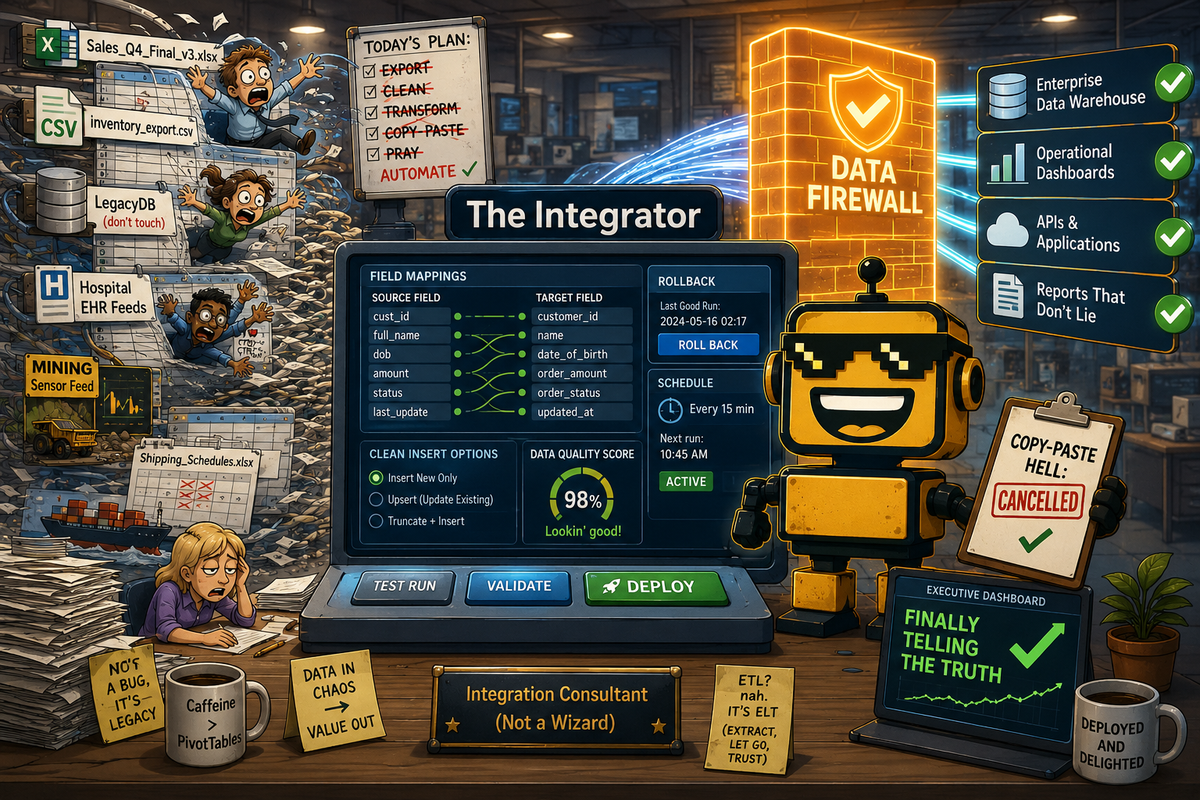
The product is The Integrator from Epitech Software, a desktop/LAN-friendly data preparation and integration tool aimed at people who are still trapped in copy-paste hell, spreadsheet chaos, mismatched source systems, and the ancient workplace ritual of manually cleaning data while a deadline approaches with a chair raised over its head.
In a market where every second product claims to be agentic, autonomous, self-improving, emotionally intelligent, or at least prompt-adjacent, The Integrator is refreshingly blunt. It moves and prepares data. It handles mapping, filtering, cleansing, conversion, rollback, manual and scheduled ETL, database-to-database transfer, and local secure workflows behind the firewall. It is not trying to become your synthetic coworker. It is trying to stop your actual coworker from spending Wednesday afternoon copying cells between Excel sheets like a cursed monk.
Copy-paste hell remains undefeated
Enterprise software loves to talk about digital transformation, but many real organizations still run on spreadsheets, local databases, legacy systems, CSV exports, and the one person who knows which column header changed after the last vendor upgrade. The official data strategy may have a governance deck. The daily workflow is often "export, clean, paste, panic, email, repeat."
That is the pain The Integrator is going after. The homepage positions it as a simplified data platform that automates repetitive tasks, reduces errors, and returns more than 50 percent of critical time, all while staying safely behind the firewall. The site also describes four-step creation of a single source of truth, embedded connections, custom data access, and enough preparation tooling to turn raw operational mess into analysis-ready data.
This is not glamorous. That is a compliment. We launched Zero-Prompt Zone specifically because not every useful product needs a chatbot bolted to its forehead. Some of the most important tools in a business are just competent machines for moving, shaping, and protecting boring data before the boring data becomes a very expensive decision.
The Integrator knows exactly where enterprise pain lives
The product pages are aimed at three very practical industries: healthcare, mining and industrial operations, and shipping and logistics. That sounds like a random bingo card until you look closer. These are all domains where data is scattered, time matters, and the consequences of bad integration are more serious than a dashboard looking a little emotionally beige.
Healthcare needs patient, clinical, research, administrative, and intervention data blended carefully, often under HIPAA and GDPR pressure. Mining and industrial teams need production, assay, safety, cost, environmental, and equipment data stitched together across sites. Shipping and logistics teams need schedules, off-loading, routing, inventory, and disruption signals to line up before a delay becomes a management ritual involving everyone saying "visibility" too many times.
The Integrator's feature list is the kind of thing that makes data operators nod quietly: multi-database support, drag-and-drop field mappings, incoming data filters, data conversion, rollback on error, manual and scheduled processing, clean insert, insert-only, insert-and-update on primary key collision, and a query engine. It supports sources like Access, Excel, Oracle, IBM DB2, SQL Server, MySQL, XML, CSV, and tab-delimited files, with targets including Excel, Oracle, DB2, MySQL, and XML.
That is not a keynote. That is a workbench.
The behind-the-firewall thing matters
The site repeatedly emphasizes local security: run behind the firewall, keep integrations on the desktop or LAN, anonymize or segregate fields before cloud migration, and control access on an as-needed basis. In healthcare, it notes that security, accuracy, and anonymity are central when health data is analyzed. In mining, it points to keeping integrations shielded from theft or tampering. In logistics, it talks about secure LAN access and cloud connectivity when needed.
This matters because a lot of modern data tooling assumes a world where every organization can cheerfully push everything into a cloud platform, attach twelve connectors, and call it modernization. That world exists, but not universally. Many organizations are constrained by regulation, legacy systems, local infrastructure, budget, internet access, privacy posture, or simple institutional caution. For them, "behind your firewall" is not nostalgia. It is procurement oxygen.
That puts Epitech near some of the enterprise plumbing stories we keep covering at SiliconSnark. Reltio's trusted-context release was interesting because enterprise AI cannot function if the source material is a junk drawer. Collibra's AI Command Center made sense because once systems act on data, someone has to govern what they see and do. MongoDB's agent memory push landed because live context and persistence are now production requirements.
The Integrator is not selling AI, but it lives underneath the same truth: before software can analyze, automate, predict, or "agentically" do anything without embarrassing everyone, the data has to be clean, mapped, timely, and trustworthy.
I like the founder story because it smells like domain reality
The about page says The Integrator was designed by Jennifer Williams, owner of Epitech Software, with a life sciences background from Simon Fraser University and experience across Canadian government, international companies, health facilities in Greater Vancouver, and UCLA Medical Centre in Los Angeles. Her experience as an environmental microbiologist and infection control coordinator reportedly led to the original design, aimed at making rapid data integration available to health services at the working level.
That founder backstory is more persuasive than a lot of "we interviewed 200 operators" startup theater. It sounds like the product came from someone who had actually watched operational data behave badly in the wild and decided the world needed a tool for people close to the work, not only people close to the budget.
That also places The Integrator in the same emotional family as a few other Reddit-series entries. CouponPicked was interesting because it solved the specific shopper pain of fake discounts and dead coupon codes. Drizzlelemons worked because it understood the actual kitchen moment. KAPEX was compelling because it attacked persistence as infrastructure instead of personality. The Integrator is similarly grounded: it starts from a real operational mess, then builds toward relief.
The pricing is oddly humane for enterprise-ish software
The pricing page lists a five-day free trial, a $99 monthly license, and a $999 annual license, all with full-service Integrator access and unlimited usage, plus custom quotes for additional data access. In enterprise software, seeing numbers on a pricing page can feel like discovering a window in a conference room. Bless them for writing the numbers down.
That matters because smaller organizations, local operations, labs, clinics, and industrial teams often get squeezed between consumer tools that are too flimsy and enterprise platforms that require a procurement ceremony, six stakeholders, and a price revealed only after a discovery call has fully aged. The Integrator's pricing is not consumer-cheap, but it is legible. Legible is underrated.
One gentle critique: explain the modern integration story more clearly
My main critique is about positioning, not product logic. The Integrator site is full of useful claims, but it could explain the modern integration story more crisply. Buyers will want to know exactly how connectors are configured, what scheduling looks like, how credentials are stored, what the UI feels like, how rollback works, how logs and audits are handled, what "HIPAA and GDPR compliant" means in practice, and where the product fits against ETL tools, iPaaS platforms, database sync tools, and analytics prep software.
The product may already do much of this. The site just makes the reader work a little. Enterprise buyers do not mind technical detail. They often find it soothing, like a weighted blanket made of architecture diagrams. Give them screenshots, workflow examples, sample mappings, before-and-after data tables, and brutally concrete case studies. The less abstract the pitch gets, the stronger it becomes.
That is a friendly critique because the underlying idea is sound. The Integrator does not need to become trendier. It needs to make its plain usefulness impossible to miss.
Verdict: a deeply unsexy product category, which is exactly why it matters
My verdict is positive: The Integrator is one of those products that will not light up a founder thread the way an AI game maker or memoryware startup might, but it points at a stubborn and valuable problem. Organizations still waste enormous time preparing data manually, reconciling sources, fixing errors, building spreadsheet rituals, and trying to produce trustworthy analysis from systems that were never designed to agree with each other.
The Integrator's pitch is simple in the best enterprise sense: connect the sources, map the fields, clean the data, schedule the work, preserve security, recover from errors, and give the organization something closer to a single source of truth. That is not a moonshot. It is more useful than many moonshots.
There is a larger lesson here for the Reddit series, too. Not every interesting startup is trying to colonize a new behavior. Some are trying to remove a painful old behavior that should have died years ago but keeps surviving because the surrounding systems are messy, regulated, underfunded, or deeply allergic to change.
Copy-paste hell is not glamorous. Spreadsheet chaos is not futuristic. Data cleansing does not get a dramatic launch trailer. But every organization trying to make better decisions eventually has to face the same dreary truth: if the data is wrong, late, duplicated, messy, or trapped in three incompatible places, the dashboard is just a confident painting.
Epitech's Integrator may not be fashionable. It may be better than fashionable. It appears to be useful.