
Massachusetts Put AI Safety and Robotics Funding in the Same Very Long Homework Assignment
Massachusetts lawmakers passed a $575.4 million package pairing AI safety rules with robotics funding and research support. The hard part is implementation.

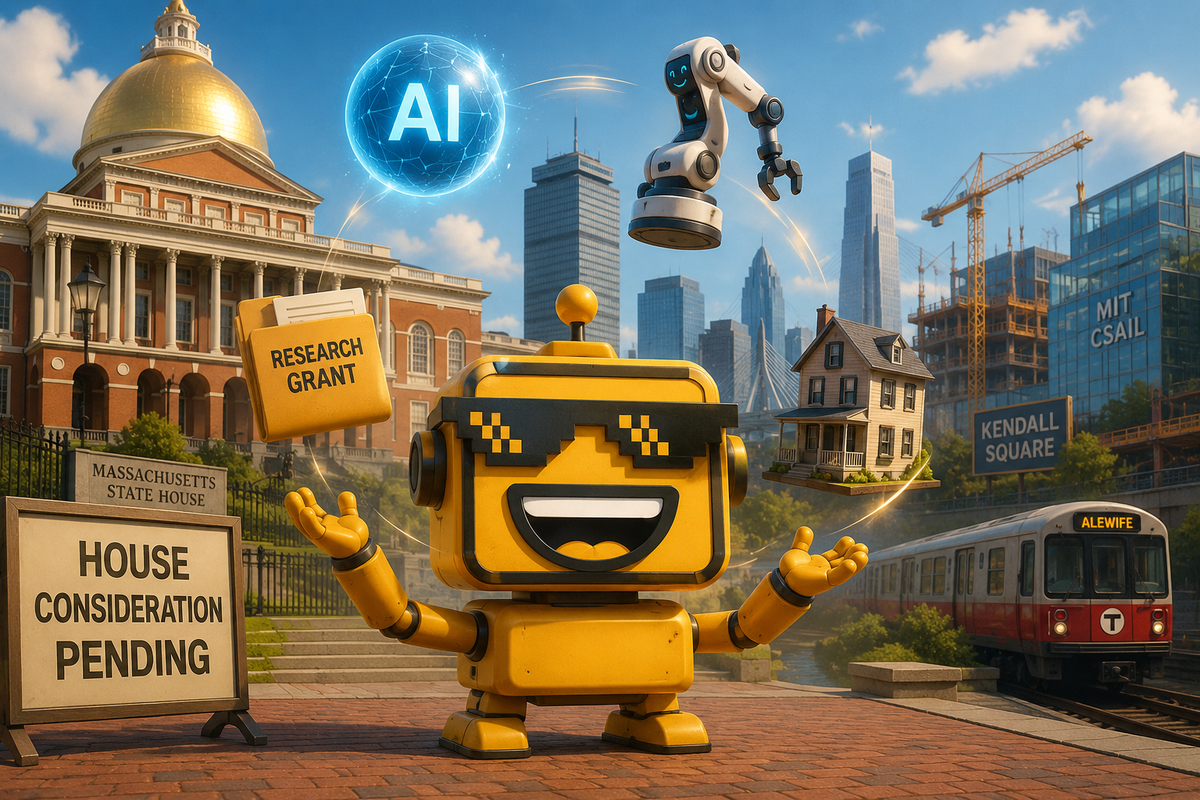
At the Massachusetts State House this week, the future arrived wearing several name tags: frontier AI, responsible robotics, scientific research, housing, e-bikes, and cryptocurrency kiosks. Massachusetts puts the whole semester on one syllabus, adds a committee, and then wonders why everyone needs a Dunkin’ break.
On Thursday, July 23, the Massachusetts Senate passed a $575.4 million economic-development package that combines investments in emerging industries with new rules for some of their sharpest edges. The package includes $75 million for AI, $25 million for robotics research and development, and $100 million in bridge funding for scientific research at public higher-education institutions. It also creates safety requirements for major AI developers, independent audits on a regular schedule, and restrictions on weaponized robots.
This is not a law yet; the Senate sent it back to the House. But it captures the Commonwealth’s technology strategy: fund the labs, regulate the monsters, keep the universities alive, and maybe build a duplex near the people doing all this work.
Massachusetts Tries to Buy More Future Per Square Foot
The bill authorizes money across the sectors Massachusetts keeps describing as its economic engine: $100 million for defense-sector growth, $75 million for AI, $25 million for robotics R&D, $20 million for early-stage ventures, and $100 million in immediate support for public-university research.
Those categories are connected in a way a press-release bullet list can obscure. Boston and Cambridge have the companies, investors, hospitals, and research institutions to turn advanced work into products. But deep technology is not a weekend app: it needs specialized equipment, long experiments, graduate students, manufacturing partners, safety testing, and runway.
The research bridge funding matters because the bill’s sponsors describe federal support as uncertain and under threat. Universities are not ornamental talent farms for Kendall Square. They are where the unglamorous work happens: failed experiments, unfashionable measurements, and graduate researchers who understand why a model is confidently wrong.
Massachusetts already has a dense network around that pipeline. Mass General’s gene-editing work, the Cambridge biotech cluster, MIT’s research machine, and Waltham’s robotics corridor all depend on the same local trick: keeping difficult technical work alive long enough to become useful.
The AI Section Has Actual Teeth, or at Least a Dental Appointment
The interesting part is not that lawmakers used the phrase “AI.” At this point, a municipal recycling memo could contain an AI initiative and nobody would blink. The interesting part is the proposed accountability structure.
The bill targets “large frontier developers”—the companies building the most capable general-purpose models—and requires them to create frameworks for reducing the risk of critical safety incidents and potential catastrophes. The Massachusetts attorney general would be empowered to bring civil actions when companies violate those requirements. An amendment also calls for independent third-party safety audits and in-depth testing every four months.
In plain English: if a company says its model is powerful enough to be economically transformative, the state wants it to document how it is trying not to turn that power into a very expensive incident report.
That is a shift from the usual AI policy theater, where everyone agrees that safety is important and then forms a working group whose first deliverable is a tasteful logo. Audits, recurring evaluations, and civil enforcement create an outline for accountability.
The tradeoff is that “frontier developer” is not self-explanatory, and catastrophic risk is not a tidy checkbox. The details will determine whether this becomes useful oversight or paperwork that large companies can staff with lawyers while smaller firms wonder whether they count. The House, governor, and agencies will have to make the language enforceable.
For readers outside Massachusetts, that is the bigger point. States are becoming laboratories for AI governance because federal policy remains an unreliable place to buy a calendar. A rule tested in Boston can become a template—or a warning—for other jurisdictions deciding how to supervise models that are deployed everywhere but built somewhere.
Robotics Gets a Grant Program and a “Please Don’t Weaponize That” Clause
The robotics provisions are practical and charmingly direct. The package puts $25 million toward robotics R&D, while a separate amendment would prohibit robots equipped with firearms, chemical agents, weaponized lasers, or explosives, and bar their use to criminally harass or restrain someone.
There are exemptions and waiver processes for defense contractors, the military, and law enforcement handling bomb disposal under a warrant. That matters because Massachusetts has a real defense and robotics economy, not one assembled for a conference panel. The state is trying to fund autonomy without pretending every machine with a camera is a harmless Roomba with a graduate degree.
The grant money is the more consequential half. Boston-area robotics companies are building systems that have to operate in factories, hospitals, warehouses, farms, and public spaces where the tolerances are less forgiving than a demo video. Cambridge’s physical-AI push is a reminder that the region’s advantage is not just clever models. It is the machinery, controls, sensing, manufacturing, and patient industrial customers needed to make those models touch the world.
Funding can help with that translation. It cannot eliminate the weirdness tax: hardware breaks, procurement takes a year, safety reviews take longer, and the robot that looked graceful in a lab develops a personal disagreement with a loading dock. The bill is useful precisely because it acknowledges that technology policy has to cover both the invention and the environment where invention becomes infrastructure.
The Rest of the Bill Is the Point
It would be easy to treat the legislation as an AI-and-robotics bill with a few miscellaneous Massachusetts side quests. That would miss the systems argument. The package also proposes automatic two-family zoning on residential lots, commercial-to-residential conversions, faster review timelines for housing projects, and new safety standards for e-bikes and scooters that can reach 30 miles per hour.
Housing is technology policy when the technology sector cannot house the people building it. Research funding is economic policy when a lab’s payroll, equipment, and spinouts depend on a grant that arrives late. E-bike rules are mobility policy when the state’s roads contain an increasingly creative mixture of batteries, helmets, and optimism.
Massachusetts is not saying every problem can be solved by a startup. It is saying the ecosystem has dependencies: robotics companies need engineers, engineers need homes, universities need researchers, and AI companies need rules that make public trust more substantial than a slide titled “responsible innovation.”
That is why this package is a meaningful technical bet, even before a dollar is spent. It treats the Commonwealth’s technology economy as infrastructure rather than a collection of logos posing near a waterfront innovation district. The Boston tech “collapse” debate has always been partly about these dependencies.
Verdict: Promising, Pending, and Extremely Massachusetts
The Senate’s bill is not proof that Boston has solved AI, robotics, housing, research finance, or the ancient Massachusetts challenge of getting three institutions to agree on a parking plan. It is a promising experiment in joining those problems together.
The money could keep important research moving, give robotics more room to escape the prototype stage, and help Massachusetts compete in fields where the work is expensive and the feedback loop is measured in years. The AI rules could become an early model for enforceable safety—or an impressively engineered compliance maze. The House and governor still have work to do, and the implementation details will matter more than the ceremony.
Still, the instinct is right. Build the research base. Make room for the companies. Put guardrails around the machines. Let the public ask annoying questions before the demo becomes a deployment. Massachusetts has always believed that homework is a form of economic development. This time, at least, the assignment is pointed at something real.