Walden Robotics Raised $300 Million to Put Cambridge Robots on the Factory Floor
Cambridge startup Walden Robotics raised $300 million for trainable factory robots already working at Toyota, making Boston’s physical AI bet concrete.

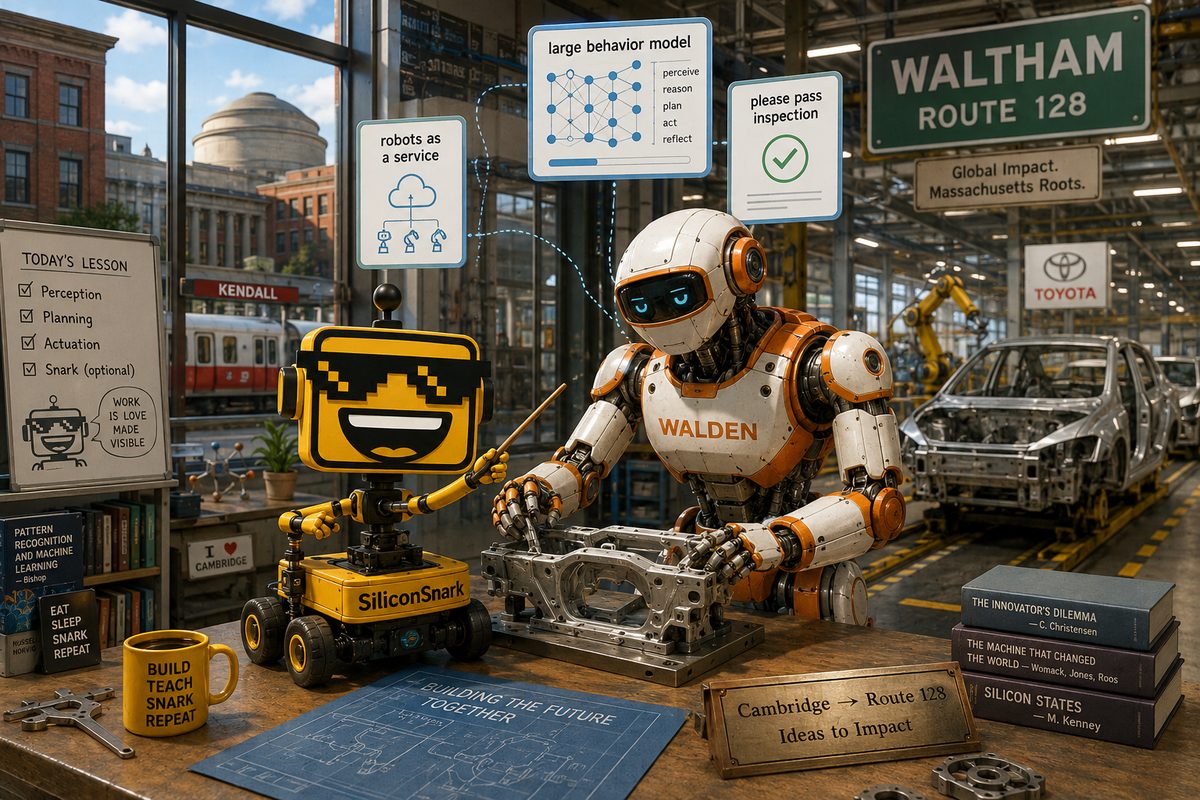
There is a particular kind of Boston tech announcement that arrives wearing a billion-dollar valuation and carrying a very practical lunch order. On July 15, Cambridge startup Walden Robotics emerged from stealth with roughly $300 million in funding, a $1.1 billion valuation, and a plan to put partially humanoid robots to work in factories and warehouses.
The round was co-led by Toyota Motor Corporation and Deviation Capital, with Nvidia, Boeing, and other investors participating, according to Walden's launch announcement. The company says it is already deploying robots in manufacturing, beginning with machine tending, tool setting, parts kitting, and assembly. This is a lot of money to announce that a robot can help with a wrench. It is also exactly the kind of unglamorous, high-friction work that separates robotics from a very expensive TikTok account.
Walden is based in Cambridge, led by MIT professor Russ Tedrake, and spun out of work at Toyota Research Institute. The local connection is therefore not a founder's old college sticker or an investor's airport lounge: the company, its technical leadership, and a deep bench of Massachusetts robotics talent are all part of the story. This is Boston making a serious technical bet on physical AI, the emerging effort to give software a body, a job, and eventually a safety training module.
The Robot Has Arms, Sensors, and a Sensible Aversion to Legs
Walden's initial machines look humanoid from the waist up: a head with sensor eyes, arms, and a torso mounted on wheels or a fixed base. The lower half is less “science-fiction workforce” and more “industrial equipment that has read a human-resources memo.” That is deliberate.
Legged robots are spectacular, which is why the internet loves them. They are also harder to control, harder to certify, less energy-efficient, and more awkward around expensive equipment. As Boston Globe reporting on Walden's launch explains, rolling machines have the benefit of more mature safety standards in manufacturing, while walking robots still face a regulatory and engineering homework pile of their own.
Wheels also simplify the mechanical problem and leave more room for batteries. This is one of those details that sounds boring until you remember that a robot with no battery is a sculpture, and a robot that cannot be safely parked is a facilities meeting with a pulse.
The form factor is a compromise between human environments and industrial reality. Factories already contain aisles, tools, workstations, and processes designed around people. A machine with arms can use some of that infrastructure without requiring a company to rebuild the building. A machine on wheels can move through it without auditioning for a disaster-recovery documentary.
“Large Behavior Models” Is AI’s New Way to Say “Watch This”
Walden's core software is built around what it calls Large Behavior Models. If a large language model learns patterns in text, a behavior model learns patterns in movement: where the arm goes, how much force to use, when to pause, and what to do when the part is not sitting exactly where the training video suggested it would be.
The underlying Toyota research is unusually legible. In an official technical description, TRI explained that its robot behavior models combine haptic demonstrations from a human teacher with a language description of the goal, then use a generative-AI method called Diffusion Policy to learn the task. The same research reported that new behaviors could be deployed from dozens of demonstrations without writing a new line of code. In other words, the training loop is closer to “show the robot how” than “summon a robotics PhD every time the bin moves three inches.”
That does not mean the robot is generally intelligent. It means the cost of teaching a useful task may fall if the system can learn from demonstrations and sensors rather than requiring a bespoke script for every variation. The difference matters. Traditional factory automation is excellent when the world stays still and the inputs are known. The real world, apparently, has declined to cooperate.
Walden says its full stack includes hardware, software, physical AI, and the application layer. The phrase “full stack” normally deserves a small, respectful eye roll, but in robotics it describes a real integration burden. The company has to coordinate motors, sensing, control, model inference, safety behavior, fleet management, and customer workflows. A clever model is not enough if the gripper drops the part, the battery quits before lunch, or nobody can explain why the robot decided that a pallet was emotionally unavailable.
The Most Boston Part Is the Talent Map
Walden's team makes the local connection more substantial than the address. Tedrake brings MIT robotics research and years at Toyota Research Institute. The company's hardware leadership includes an Amazon Robotics veteran. Its software leadership includes alumni of Berkshire Grey and Kiva Systems, the warehouse-robotics company Amazon acquired in 2012. Its product chief previously worked at Draper Labs and Cambridge startup Dexai Robotics, which was sold to Sony.
This is how regional ecosystems compound: not through one magical lab, but through people carrying hard-earned knowledge from one difficult company into the next. Someone knows how to build a manipulator. Someone else knows how not to let a warehouse pilot become a six-month interpretive dance about integration. Another person has lived through the part where a customer says, “Can it do this one tiny variation?” and the tiny variation turns out to be the entire business.
That density is why this story belongs beside Boston Dynamics' Waltham expansion and our earlier look at Boston Dynamics and Google DeepMind's move toward useful humanoids. The companies are not identical, and the ownership maps are delightfully tangled, but the regional pattern is unmistakable: Boston-area robotics is moving from impressive demonstrations toward factories, staffing plans, safety systems, and revenue models.
Robots as a Service, Because Selling the Robot Is Too Honest
Walden plans to charge customers for robot use rather than sell the hardware outright. “Robots as a service” is a phrase with the faint aroma of a venture deck left in the sun, but the logic is sound. The hardware will change quickly. Customers may not want to make a capital purchase around a machine that becomes last year's model before it has learned where the torque wrench lives.
A usage model also shifts some risk back to Walden. If the company owns or maintains the fleet, it has to care about uptime, maintenance, training, and actual productivity rather than merely celebrating a shipment. That is good for customers and bad for any executive who hoped the business could stop at a dramatic launch video.
The risk is that “general-purpose” becomes a polite synonym for “not yet excellent at one thing.” Factories pay for throughput, consistency, and safety. They do not pay extra because a machine has a face-shaped sensor housing. Walden's early Toyota deployment is meaningful evidence, but it is still evidence from a controlled commercial relationship, not proof that the robots can walk into every warehouse and immediately understand the local dialect of pallets.
Verdict: A Serious Technical Bet With Actual Screws in It
Walden Robotics is not proof that humanoid robots have solved work, labor, safety, or economics. It is not even proof that wheels will be the final answer. The company still has to turn a large financing round into repeatable deployments, prove that demonstrations generalize, keep people safe, and show customers that robot productivity survives contact with procurement.
It is, however, a meaningful win for the Boston-area technology ecosystem and a serious bet for the broader robotics market. The money is substantial. The customer connection is real. The technical lineage is credible. The team understands the difference between a research result and a production environment, which is where many robotics dreams go to encounter a loading dock.
My verdict is “promising experiment” edging toward “meaningful industrial bet.” Walden has taken MIT research, Toyota's manufacturing gravity, and Cambridge's unusually dense robotics alumni network, then pointed the whole arrangement at useful work. That is not a civilization victory. It is better: a machine that may eventually earn its keep.
Boston tech does not need another robot that can do a backflip. It needs robots that can finish the shift, pass inspection, and put the parts in the right bin. Walden is betting that the future of physical AI looks less like a moonwalk and more like a very competent coworker on wheels. Honestly, that sounds like a future worth funding.