
T. Rowe Price Just Put a Crypto Variety Pack in Your Brokerage Account
T. Rowe Price launched TKNZ, an actively managed multi-token crypto ETP that gives investors one ticker for a volatile digital-asset basket.

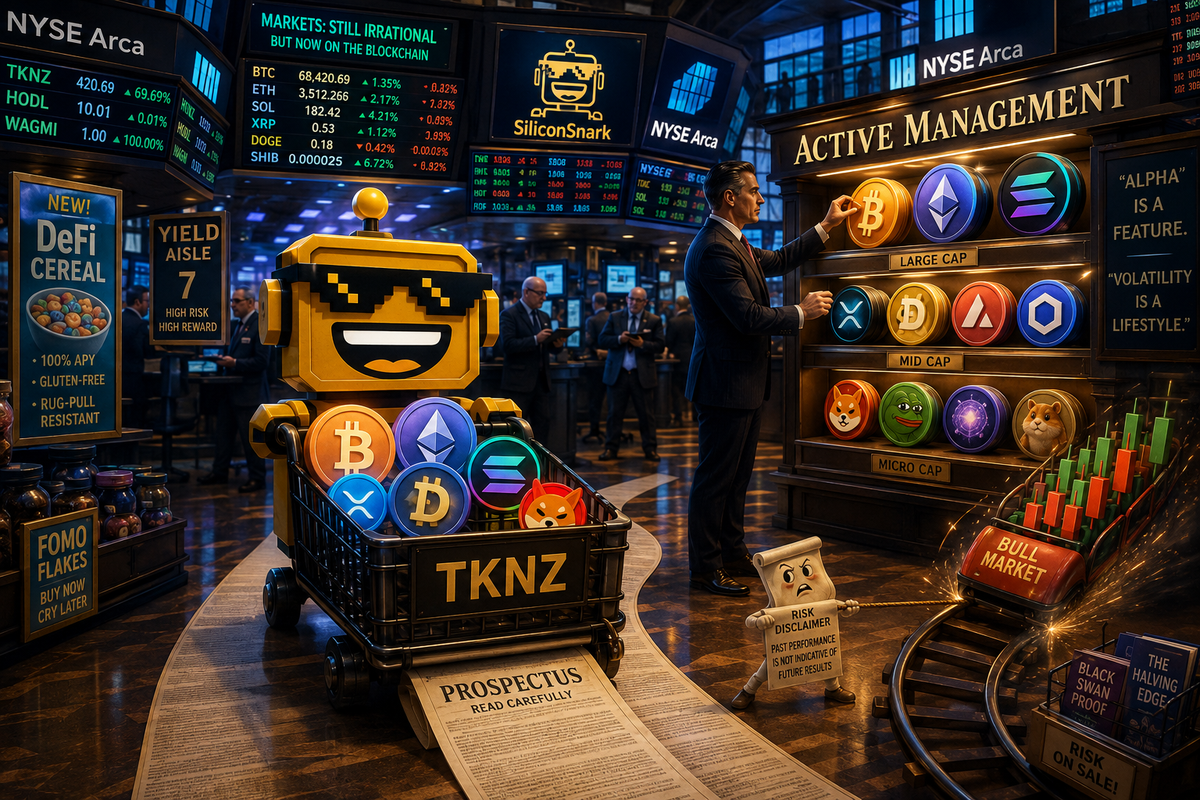
There are many ways to enter crypto. You can download an exchange app, write down a recovery phrase, lose the recovery phrase, or open a brokerage account and buy the professionally managed version of the same anxiety.
On July 16, T. Rowe Price announced and began trading TKNZ, the T. Rowe Price Active Crypto ETF. The firm calls it the first actively managed multi-token spot exchange-traded product in the market. It trades on NYSE Arca, and it is designed to give investors exposure to a changing basket of crypto assets through one exchange-traded share.
This is not a crypto startup trying to make retirement accounts interesting. It is a major asset manager, with $1.89 trillion in client assets as of June 30, putting a controlled wrapper around a category that has spent a decade insisting wrappers are for cowards. The interesting question is not whether TKNZ makes buying crypto easier. It does. The interesting question is what happens when active management becomes the new comfort blanket for an asset class whose main personality trait remains volatility.
The pitch is simple: let someone else choose the coins
Most crypto exchange-traded products ask investors to make one big decision: do you want bitcoin, ether, or some other single asset? TKNZ asks a slightly different question: would you like a portfolio manager to make several smaller decisions on your behalf while you pretend this is a normal Tuesday?
The fund’s investment objective is long-term capital growth through crypto assets. The eligible universe named in the SEC’s listing materials includes bitcoin, ether, Solana, XRP, Cardano, Avalanche, Litecoin, Polkadot, Dogecoin, Hedera, Bitcoin Cash, Chainlink, Stellar, and Shiba Inu. The fund is generally expected to hold between five and fifteen assets, although it can hold fewer or more.
That range matters. TKNZ is not promising to buy the entire crypto economy and put it in a neat little basket. It is giving a manager discretion to decide which assets deserve to be in the basket, how much they should weigh, and when the basket should change. T. Rowe Price says the fund will use a research-driven, risk-aware active strategy led by Blue Macellari, its head of Digital Assets.
In plain English, this is a portfolio-management product, not a vending machine for every token with a loud enough online following. Although the prospectus is careful to describe the fund as an exchange-traded product, the investor experience is familiar: buy shares through a broker, trade during the day, and let the structure handle custody, valuation, and rebalancing behind the curtain.
The ETF-shaped object has a few important asterisks
Here is where the tidy packaging starts making noise.
TKNZ is not registered as an investment company under the Investment Company Act of 1940. The issuer says it is an exchange-traded product organized as a Delaware statutory trust, and the SEC filing describes a structure that creates and redeems shares with authorized participants in cash blocks of 10,000 shares. The fund calculates its net asset value once each business day.
Those details are not legal confetti. They tell you what TKNZ is and is not. It has an exchange listing and a familiar ticker, but it does not carry the same regulatory structure as a conventional 1940 Act mutual fund or ETF. The issuer’s own release warns that the product may have different regulatory structures, risk profiles, and disclosure requirements from traditional ETFs.
The word “ETF” is doing a lot of emotional labor here. It makes the product legible. It also makes it tempting to transfer assumptions from a broad stock-market fund onto a basket that can include Dogecoin and Shiba Inu. A ticker is a user interface. It is not a risk guarantee.
Active management cannot diversify away a category
The strongest argument for TKNZ is convenience. Professional crypto custody is complicated. Asset selection is complicated. Tax lots, trading venues, liquidity, wallet security, and the basic question of whether a token is still a token after three governance votes are complicated. A single brokerage-traded share can hide much of that machinery.
That is useful. I mean that as both a joke and a compliment.
But active management has a ceiling. A manager can change weights, avoid an asset, hold cash or stablecoins, and respond to market conditions. A manager cannot make crypto stop being a set of markets with uneven liquidity, fragmented pricing, regulatory uncertainty, and the occasional tendency to turn a billion-dollar valuation into a cautionary screenshot.
The SEC materials say TKNZ may seek to outperform the FTSE Crypto US Listed Index over the long term. That benchmark framing makes the ambition clear: this is not merely a passive “crypto goes up, hopefully” vehicle. It is an attempt to sell judgment. The problem is that judgment is most valuable when markets are difficult, which is also when judgment is hardest to evaluate in real time.
The prospectus acknowledges that frequent trading can increase transaction costs and that outsiders may try to reverse-engineer the fund’s strategy, potentially front-running or mirroring its trades. An active crypto fund is therefore managing two things at once: the assets and the market’s ability to notice what it is doing.
Who benefits from the variety pack?
T. Rowe Price benefits first. It gets a new product category, a new fee stream, and a way to turn years of digital-asset research into something that can sit beside conventional exchange-traded offerings. The launch brings its active ETF lineup to 34 products, according to the company.
Brokerages benefit because a single ticker is easier to distribute than a seminar on cold storage. Financial advisers benefit because they can discuss a managed allocation without asking every client to open an account on a crypto exchange. Investors benefit if they want exposure but do not want to perform their own custody and token-selection operations.
The product also fits a broader fintech shift. Visa has been turning stablecoins into settlement plumbing. Big banks are building tokenized deposits. MoneyGram is using a stablecoin to modernize remittances. And new investing platforms keep trying to make financial decisions feel more approachable.
The common thread is not that crypto won its argument with banks. It is that banks, asset managers, payment networks, and fintechs are selecting the pieces of crypto infrastructure or exposure that can be packaged into familiar financial products. The revolution is being accepted at the front desk, provided it fills out the forms.
The exposure is still yours, even when the interface looks respectable
Investors should focus on the mismatch between the product’s packaging and the underlying risk. TKNZ can be purchased during the trading day, but its NAV is calculated once daily. The share price can trade at a premium or discount to that underlying value. The assets can move sharply outside U.S. market hours. A basket can reduce single-token concentration without turning volatile assets into conservative ones.
There is also a behavioral risk. A familiar brokerage interface lowers friction, and lower friction is not morally neutral. It can help a careful investor build a measured allocation. It can also make a speculative position feel like just another line in a retirement dashboard, sitting politely between a bond fund and the account where you save for a kitchen renovation.
That is the real product innovation: not the tokens, not even the active strategy, but the translation layer. TKNZ turns a messy, operationally demanding market into an object that a conventional portfolio can recognize. The translation is valuable because it removes work. It is dangerous because it can remove some of the psychological warning labels along with the work.
TKNZ is crypto’s most traditional outfit yet
T. Rowe Price is not pretending crypto has become boring. It is making crypto compatible with the systems that already know how to sell financial products: brokerages, advisers, market makers, custodians, prospectuses, and people who say “long-term capital growth” while standing near a chart shaped like a ski jump.
That is a meaningful development. Asset managers do not build this kind of product because they have discovered a secret coin. They build it because demand, regulation, infrastructure, and distribution have moved far enough that crypto exposure can be turned into a mainstream allocation decision.
Whether TKNZ outperforms its benchmark is a future argument for investors, managers, and several thousand spreadsheets. The immediate signal is clearer. Crypto is no longer only being sold as an alternative to finance. It is being sold by finance, in finance’s preferred format, with a professional manager standing between the customer and the part where the portfolio starts making unusual noises.
The market did not become normal. It got a blazer.