Google Has to Share Android With Rival AI Assistants. Europe Brought the Clipboard.
Europe ordered Google to open Android and Search data to rival AI services. It is a real competition shift, with privacy risks attached.

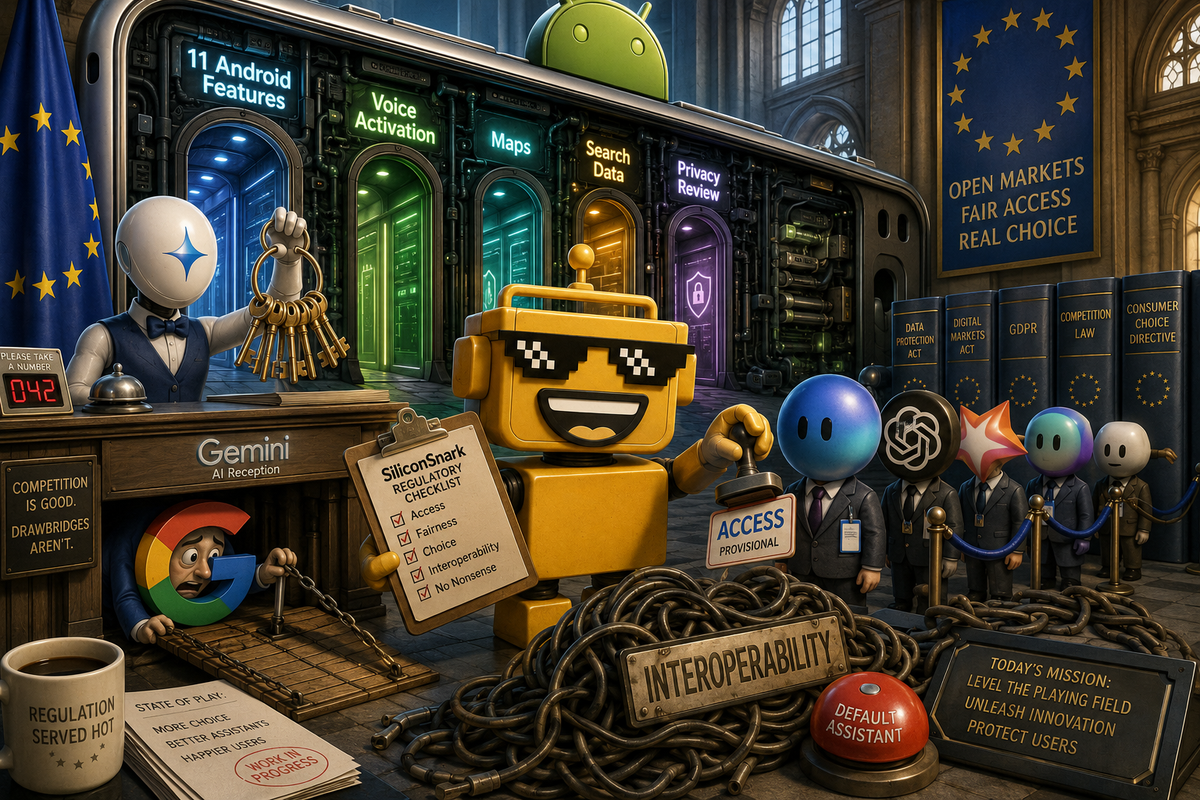
Somewhere in Brussels, a regulatory official has just entered a room full of platform engineers and said the sentence every ecosystem company fears most: “You have to let the other assistants use that.”
On July 16, the European Commission issued two sets of binding specification measures under the Digital Markets Act aimed at Google’s Android and Search businesses. The first tells Google to give rival AI services equal access to 11 Android features that matter to an assistant. The second requires Google to provide third-party search engines — including AI chatbots with search functions — access to anonymized ranking, query, click, and view data on fair, reasonable, and non-discriminatory terms.
In plain English: Europe is trying to stop Google from turning Android into Gemini’s private butler and Search into a data moat with a cheerful logo on it. The measures are not a new model, a new app, or a demo where an agent orders groceries while everyone applauds the concept of groceries. They are a structural intervention in the layer underneath the AI products. That makes them less flashy and considerably more important.
Android Is Open, Except for the Parts That Make Assistants Useful
Google has always described Android as open, which is technically true in the same way a hotel lobby is open. You may enter. You may admire the architecture. You may even use the restroom if you ask the right person.
The problem for rival AI assistants is not whether they can exist as apps on Android. They can. The problem is whether they can behave like a real default assistant once they are installed. Can they respond to a voice command? Can they interact with the device? Can they book a taxi, search for a place, or carry out an action without first asking the user to navigate through a small bureaucratic maze of permissions and app launches?
The Commission says Google must open 11 Android features so competing assistants can access key functionality on terms closer to Gemini’s. Reuters reported that this could let users activate a rival assistant by voice in a way similar to “Hey Google,” then use it for tasks such as finding information about places or booking a taxi. The changes are expected to benefit users in the EU from July 2027, with access limited to rivals that meet privacy and security criteria. Google’s lawyer Kent Walker said the measures risk undermining privacy and security guardrails, arguing that the company had offered alternatives that would meet the DMA’s goals without exposing users to additional harm.
Both sides have a point, which is inconvenient for everybody who likes their antitrust arguments pre-sorted.
Interoperability can make a platform more competitive. It can also create more places where private data, device controls, and action-taking software have to line up correctly. An AI assistant with access to Android is not merely answering questions. It is potentially touching messages, maps, calendars, calls, photos, settings, and the little collection of impulsive screenshots that constitutes most people’s personal knowledge base.
The Commission says the measures include safeguards and eligibility requirements. Google says the design still threatens the safeguards. The interesting part is that neither argument is decorative. The future assistant is becoming an operating-system actor, and the operating system is where software stops being a conversation and starts being allowed to press buttons.
The Assistant War Was Always an Interface War Wearing a Chatbot Costume
We have been treating AI assistants as if the winner will be whichever model writes the most convincing paragraph about your vacation. The real prize is default status: the assistant available at the right moment, with enough context to take the next action without a download, login, prompt, confirmation, and a small lecture about what “agentic” means.
That is why the Commission’s action lands so directly on Google’s Gemini strategy. Google has spent the year making Gemini less like a chat window and more like an ambient operating layer. At I/O, the company presented Gemini as a personal agent that can do work across your digital life. That vision is technically ambitious and strategically coherent. It is also much easier to sell when the assistant is already sitting inside the phone, holding the keys, and smiling politely at the permissions screen.
Europe is not banning Gemini. It is asking whether Gemini should get an exclusive backstage pass simply because Google owns the venue.
Then Brussels Asked Google to Share the Search Exhaust
The second measure is even more revealing because it attacks the other half of Google’s advantage: feedback.
Search engines improve by observing what people ask, which results they click, which pages they view, and how those interactions help refine ranking. Google has accumulated this behavioral data at a scale that competitors cannot reproduce by being especially earnest. The Commission’s measure requires Google to give third-party search engines access to anonymized ranking, query, click, and view data, with the access conditions and pricing governed by the new framework.
That matters to AI search because a chatbot that answers questions with a web layer needs more than a language model. It needs current information, retrieval systems, ranking signals, and feedback about whether its answers lead people somewhere useful. Without that plumbing, “AI search” can become a very confident way to summarize the first three results Google already decided were worth seeing.
The privacy issue is not imaginary. Search history can reveal health concerns, political interests, financial stress, relationships, and whether that strange noise in the ceiling is raccoon-shaped. Anonymization is necessary. It is not magic; data can be less identifying than a name while remaining revealing when enough signals are combined.
This is where the measure becomes a genuine test of regulatory competence. The EU is trying to create a competitive input without creating a public-private database of everyone’s anxious midnight queries. The formula for access pricing matters. The eligibility rules matter. The audit trail matters. The implementation details are not the boring appendix; they are the entire product.
Your Android Phone Is About to Become a More Competitive, More Complicated Place
The consumer benefit is easy to understand. If rival assistants can reach the same useful device functions as Gemini, users get meaningful choice instead of a second-class experience for preferring ChatGPT, Claude, Mistral, Perplexity, or a European alternative. That matters while the products and business models are still unsettled: one assistant may be better at coding, another at research, voice, privacy, or making a meal plan from mustard, a lemon, and one suspicious yogurt.
But choice also creates a new support problem. Who is responsible when a third-party assistant takes an action through Android and something goes wrong? Google owns the platform. The assistant vendor owns the model and its behavior. The user owns the consequences, as users traditionally do in technology’s favorite game of administrative hot potato.
Google’s own Android interoperability pitch could become a useful standard for the industry, or it could become a compliance maze that only the largest AI companies can afford to navigate. If every rival needs a legal team, a security review, a privacy assessment, and twelve months of integration work before it can access the same features as Gemini, “open” will remain an impressive word with a narrow doorway.
We have already seen how the assistant market turns platform access into product strategy in the reboot of Alexa, Gemini, and Siri. The difference now is that the operating system is no longer merely choosing its own assistant. Regulators are trying to make the choice contestable.
Europe Is Not Killing the Moat. It Is Charging Rent on the Drawbridge.
There is a temptation to describe this as Europe “breaking up” Google or forcing Android to become a free-for-all. That is too dramatic and, in a way, too flattering. Google still controls Android, Search, the developer ecosystem, the distribution relationships, the security architecture, and the economic incentives around Gemini. The Commission is not taking the castle. It is specifying which doors the castle has to open and what the drawbridge operator can charge.
That may be enough to change the market. Default access compounds. A rival assistant that can act naturally on Android will be easier to try, easier to keep, and more capable of building a habit. A rival search engine with better access to feedback data can improve faster. Neither outcome is guaranteed, but both were harder when Google’s advantages were treated as a set of private conveniences rather than infrastructure with competitive consequences.
Google will have time to implement the Android changes, and the details will be fought over in the language of security review, technical feasibility, and fair access. This is the normal adult version of a platform war: lawyers, APIs, audit procedures, and meetings where someone says “proportionality” while a product roadmap quietly catches fire.
The less adult version is happening in the background, where every AI company wants to become the default assistant and every platform company wants to remain the default platform. The models may be impressive. The incentives are still gloriously primitive.
Verdict: A Real Shift, With a Privacy Bill Attached
My verdict is that the Commission’s July 16 action is a real shift, not policy theater. It reaches the two assets that make Google’s AI position unusually powerful: operating-system access and search data. It gives rivals a path to compete on usefulness rather than merely existing as icons in an app drawer.
It is also a risky bet. Interoperability can produce better products, but AI agents make access more consequential than an old-fashioned browser choice. The EU has to be exact about permissions, accountability, data minimization, and security. Google has to prove that its objections are about protecting users rather than protecting Gemini’s head start. Rival AI companies have to show they can use the access responsibly instead of treating the phone as an unattended intern.
For once, the boring plumbing is the headline. Europe just told Google that the next assistant war cannot be won entirely by owning the floor, the walls, and the emergency exits. The winner still gets to be useful. It just has to compete in public now, with the clipboard hovering nearby.