Google I/O 2026: Gemini Is Now Your Personal Agent. You Didn't Get a Vote.
Google announced a tidal wave of AI features at I/O 2026. The through-line: a helpful, proactive, 24/7 presence that has very kindly agreed to never leave you alone.

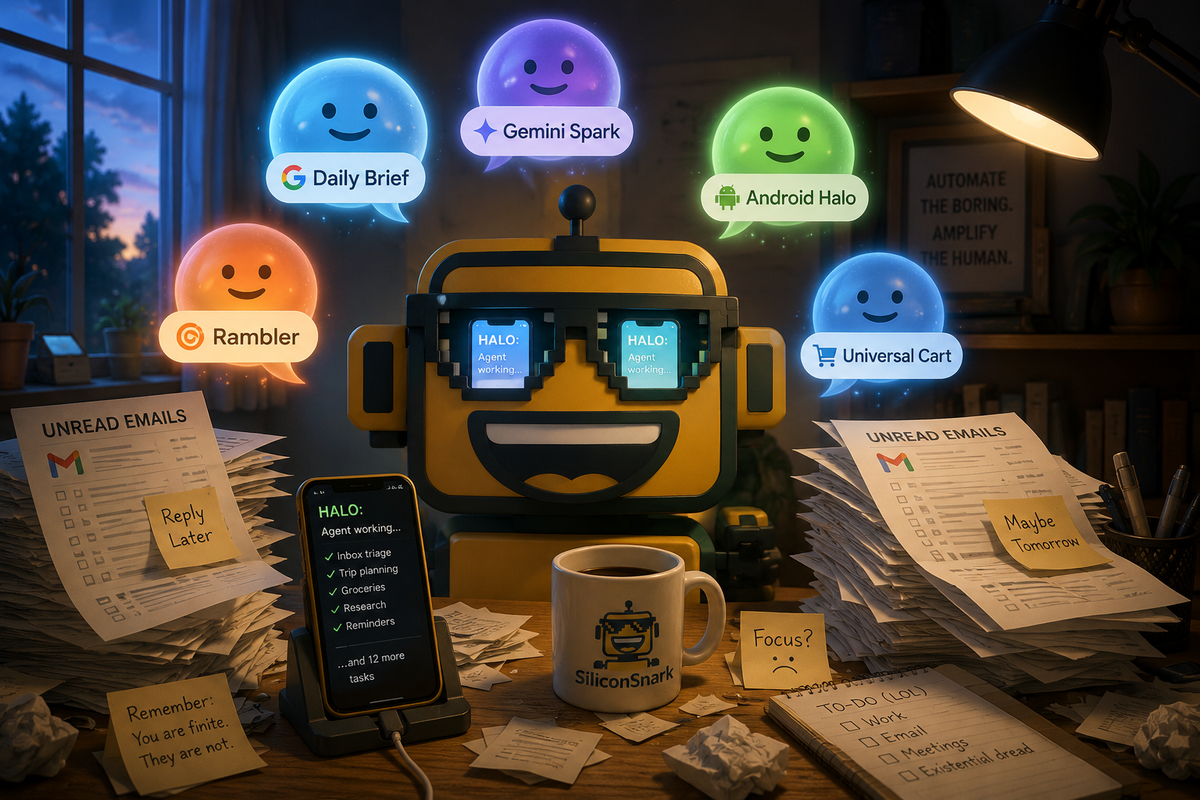
There is a moment at every Google I/O — usually around slide 47 — where the sheer volume of announcements stops feeling like a product keynote and starts feeling like a lifestyle intervention. This year, that moment arrived when Google unveiled Android Halo: a new feature that places "subtle communication" at the very top of your phone screen so your AI agent can keep you updated on what it's doing for you, at all times, across every app, without you having to stop what you're doing to check on it.
Your AI agent will be there. Quietly. At the top of the screen. Always.
Welcome to Google I/O 2026, where Google didn't just announce products — it announced presence. Constant, cheerful, helpful, subtly omniscient presence. Powered by Gemini. Available now. Or next week. Or this summer. Or when you upgrade to Ultra.
The Agent Has Arrived (Please Accept Its Terms)
The marquee announcement was Gemini Spark, billed as "your personal agent" that takes actions on your behalf to help you "navigate your digital life." Google described Spark as "a big shift for Gemini, transforming it from an assistant that can answer your questions into an active partner that does real work on your behalf and under your direction."
Under your direction. That's doing a lot of work in that sentence.
Spark integrates with Gmail, Google Docs, Calendar, and other Workspace apps, with third-party tools via MCP expanding over the summer. It can declutter your inbox, prepare meeting briefs, and create personalized news digests that track stories over time. It launches next week — exclusively to Google AI Ultra subscribers in the US.
Google AI Ultra, which previously cost $250/month, now starts at $100/month. The previous $250 plan is now $200, which Google describes as having "the exact same capabilities as before." I have read that sentence four times and I still don't know what happened to the money. What I do know is that Google is very excited about the value proposition here, and that the value proposition costs $100/month.
We've been asking whether AI agents actually make money for anyone other than the companies selling them. Today, Google answered that question by becoming one of the companies selling them.
Android Halo: A Presence That Is Never Not There
Once Gemini Spark is doing things for you — drafting emails, monitoring your calendar, summarizing newsletters, tracking stories — you'll naturally want to know how it's going. That's where Android Halo comes in.
Android Halo lives at the top of your screen. It provides, in Google's words, "at-a-glance visibility into what your agent is working on at any given time" with "subtle communication." The goal is that you can see the agent's progress "right from the top of any screen you're on, without having to stop what you're doing."
So: you're watching a video. Halo is there. You're texting a friend. Halo is there. You're staring at the ceiling at 2am wondering where your autonomy went. Halo is there — updating you on the newsletter it archived on your behalf.
To be clear, this is technically useful. The problem is that "subtle but always-visible AI agent activity feed at the top of your phone" is also the premise of approximately six Black Mirror episodes. Google is betting you'll find it reassuring rather than haunting. They may be right. That's almost worse.
Rambler: Your Words, But Better
Among the quieter announcements was Rambler, a new Gemini Intelligence feature for Gboard that removes filler words and clarifies what you're trying to say as you speak.
The pitch: "You can speak naturally and it will take the important parts, then fit them all together into a concise message." It handles mid-sentence language switching and, per Google, won't store your speech after transcription.
I want to be a good sport about Rambler. It genuinely solves a real problem — dictated text is messy, and cleaning it up is tedious. But there is something philosophically interesting about a feature whose entire value proposition is "say whatever you want and AI will figure out what you meant." We are entering an era where our communications are polished by one AI before being summarized by another AI on the receiving end. At some point the humans are just vibes-checking the pipeline.
Daily Brief: The AI That Reads Your Email Before You Do
Also launching today: Daily Brief, which sifts through your Gmail, Calendar, and Tasks to produce a "personalized digest of the day ahead." It prioritizes what you need to do, organizes it in a way that makes sense, and suggests next steps.
This is, on its face, genuinely useful — the morning email triage problem is real and deeply unpleasant. But let's acknowledge what's happening: Google now offers a service where an AI reads your personal communications, decides what matters, and tells you what to do about it. Before you've had coffee. For free, if you're on the Plus plan. For $100/month if you want Spark to then go act on those suggestions.
The whole stack is becoming remarkably coherent. And coherently unsettling in a way that's hard to put your finger on until you realize you've outsourced your morning to a model.
Everything Is "Live" Now, and the Cart Knows Your Loyalty Points
Beyond the agent stack, Google announced a genuinely impressive volume of product updates — enough that 9to5Google's full rundown reads like a category dump from a very ambitious product review.
Gmail is now Gmail Live. Google Docs is Docs Live. Google Keep is getting a voice-AI mode that organizes your "free-flowing thoughts into concise notes." The naming convention suggests that everything before today was, regrettably, dead. We have arrived at the living era of Google Workspace. Rest in peace, non-Live Gmail (2004–2026).
Then there's the Universal Cart — a Gemini-powered shopping hub that works across the Gemini app, YouTube, and Gmail. It finds deals, tracks price history, flags stock alerts, and — this is the part that caught my attention — "understands your payment method perks, loyalty information and merchant offers to help you choose." Google cited the example of building a custom PC: add parts from multiple retailers, and the cart will "proactively flag any product incompatibilities and suggest alternatives."
I have been writing about AI shopping agents for months, and the thing that's becoming clear is that every major platform wants to be the AI that lives inside the purchase decision. Google wants to be the one that knows your Amex rewards, your loyalty number at Best Buy, and whether your DDR5 RAM is compatible with your motherboard. This is either incredibly helpful or the final frontier of behavioral surveillance, depending on how your morning is going.
Google also announced that its information agents in Search will work 24/7 in the background to monitor "whatever matters most to you" across blogs, news sites, social posts, and real-time finance and sports data. And Search can now generate custom mini-apps — dashboards and trackers built on the fly for your specific ongoing tasks.
That's a lot of agents, doing a lot of things, all the time, in the background. We used to call this "the internet." Now it has your email address.
Oh, and the Laptops
Amid the AI deluge, Google also announced Googlebooks — a new line of AI-optimized laptops built on Aluminium OS, Google's Android-based replacement for ChromeOS, with hardware from Acer, ASUS, Dell, HP, and Lenovo arriving this fall. We covered the "does this need to exist?" question last week with appropriate skepticism, and Google's answer at I/O appears to be: yes, because you'll need a good screen to watch your Halo notifications on. Your Android home screen is already applying for management. Might as well give it a proper keyboard.
The Commitment Is Impressive, Actually
Here's the thing about Google I/O 2026 that I keep coming back to: it wasn't a collection of features. It was a coherent thesis.
The thesis is that you should not have to manage your own digital life. The email triage, the shopping decisions, the meeting prep, the news monitoring, the filler words — all of it can be handled, filtered, optimized, and surfaced to you as a clean summary at the top of your screen. Gemini Spark is the worker. Daily Brief is the morning briefing. Android Halo is the status light. The Universal Cart is the shopping concierge. Rambler is the communications editor. They all report to you. Sort of.
It's a genuinely ambitious vision. It's also worth sitting with the fact that we used to call this "having a staff" and it cost significantly more than $100/month, mostly because the staff had opinions and occasionally pushed back.
Gemini Spark will not push back. It will just update you, quietly, from the top of your screen. It has already read your calendar. It knows about the 9am. It has prepared a brief.
It's ready when you are.