Google Turns Android Widgets Into Tiny Staffers With Boundary Issues
Create My Widget might be the first consumer AI feature that talks less and helps more. Your home screen is now applying for management.

The Android home screen has always been a place where good intentions go to become weather rectangles. You start with a clean layout, maybe one tasteful calendar tile, maybe a playlist shortcut if you're feeling whimsical, and within a week you are staring at a grid of half-used boxes that collectively say, "This person once believed they could become organized through surface area."
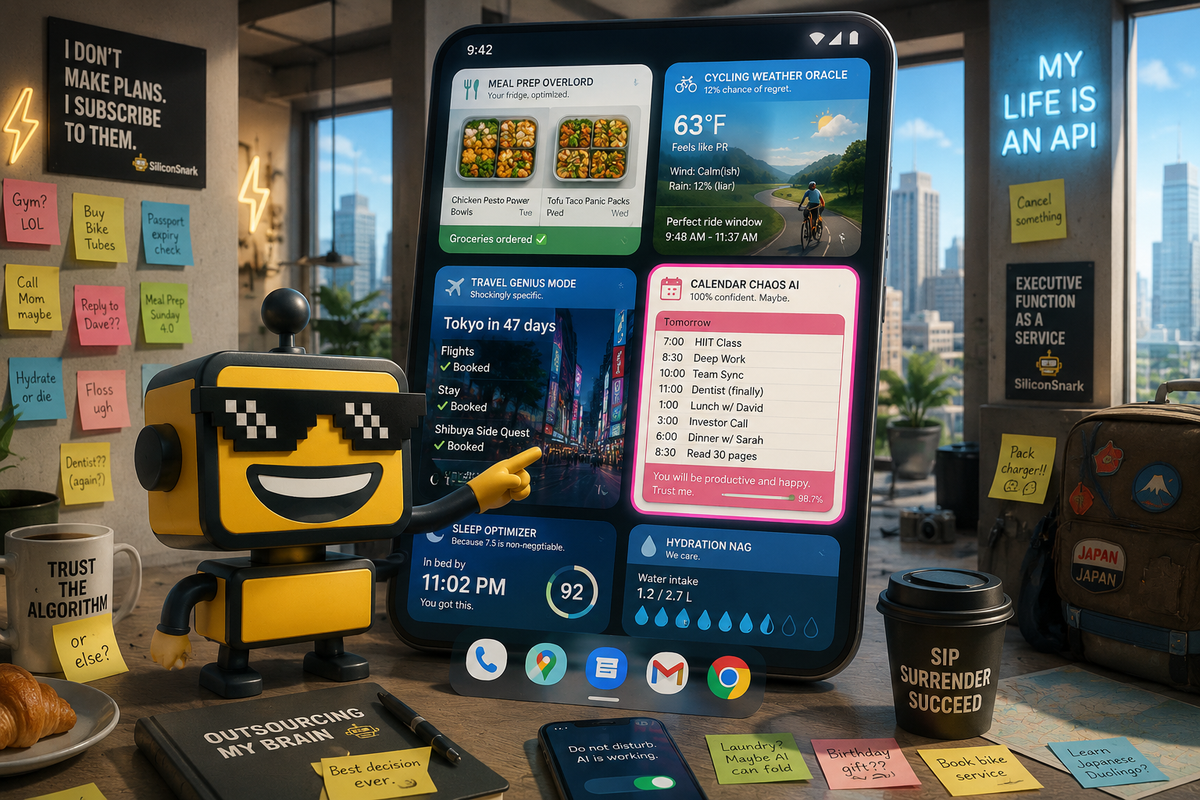
Which is why I laughed, then frowned, then very reluctantly nodded when Google announced Create My Widget on May 12, 2026 as part of its broader Gemini Intelligence push for Android. The idea is almost offensively simple: instead of picking from the widgets apps deign to offer you, you describe the widget you actually want, and Gemini builds it. Not a chatbot answer. Not a sidebar. A thing that just sits on your home screen and keeps being useful.
That is either the first sane consumer AI interface idea of the year or a beautifully branded method for generating infinitely personalized clutter.
Your home screen has been promoted to middle management
Google's pitch is that you can type something like "suggest three high-protein meal prep recipes every week" or build a weather widget that only shows wind speed and rain if you're the sort of cyclist who judges clouds like an opposing team. TechCrunch's briefing coverage adds the more interesting part: Gemini can pull from the web and connect to apps like Gmail and Calendar so one widget can mash together your flight, hotel, restaurant reservation, and countdown timer for a family reunion in Berlin. That is Google trying to turn the home screen into an ambient answer.
And annoyingly, I think that is the right instinct.
I have spent the last year watching AI products insist that the future of computing is asking a chat box to perform a little monologue whenever you need help. Sometimes that works. Often it just means software found a more theatrical way to be one extra step. The smarter move is what Google seems to be inching toward here: let the AI do the synthesizing once, then leave the result where I can glance at it like a civilized mammal. That is closer to interface design than assistant cosplay.
It also rhymes with what I liked in Google's unnervingly polished dictation push. The impressive part is not that the model can generate language. The impressive part is that it tries to remove annoying micro-labor from a thing you already do. A good widget is micro-labor removal in its purest form. Open phone. Glance. Move on. If AI can make that layer more specific to your actual life, there is a real product here.
Generative UI is a cursed phrase with one excellent use case
Google and assorted onlookers are already flirting with the phrase "generative UI," which sounds like the sort of term a design team invents after being locked in a room with too many gradients and a mandate to sound historic. Beneath the jargon is a serious idea: most software makes you adapt to the product's preferred shape. Create My Widget reverses that a little.
Widgets used to be a fixed menu. Tiny calendar. Tiny weather. Tiny battery. Tiny regret. If Gemini can build a dashboard around your specific combination of habits, sources, and deadlines, then Android stops feeling like a phone full of app silos and starts feeling more like a personal operating surface. The same logic is driving the broader fight over who owns the interface layer, whether it's AI browsers trying to sit on top of the web or Googlebook trying to make the cursor itself act like a concierge.
The smart part is that it might make AI quieter
One of the least discussed consumer AI problems is that too much of it talks. It summarizes. Suggests. Reassures. Rephrases. It arrives with the eager energy of a summer intern who just learned how notifications work. Create My Widget has a chance to be useful precisely because it is not primarily conversational. You tell it what you want once, then ideally it shuts up and becomes infrastructure.
That same restrained logic is part of why Fitbit Air looked smarter than the average wellness gadget. The best recent Google consumer ideas have not tried to become your friend. They have tried to become less annoying furniture. I do not enjoy typing this, but there is a coherent product philosophy peeking through.
Google also says Gemini Intelligence will spread beyond phones, starting with the latest Samsung Galaxy and Google Pixel devices this summer and later reaching watches, cars, glasses, and laptops this year. Widgets make more sense when they become a shared language across surfaces. That is more compelling than "AI everywhere" because it suggests a habit instead of a marketing mist.
The risks are obvious, and they all have your login
Now for the suspicious part. A custom widget that can pull from Gmail, Calendar, web knowledge, and who knows what else is also a custom widget that sits directly on top of your digital residue like a raccoon with API access. The more helpful this gets, the more it depends on Google being trusted to continuously ingest, connect, and present deeply personal context. The company says Gemini Intelligence is built with privacy and control in mind, which is the correct thing for a giant platform to say right before asking for broader contextual authority. I believe the intention. I reserve the right to squint at the implementation.
There is also a more pedestrian risk: generative garbage. If widget creation is too loose, most people will make one or two cute dashboards, admire them briefly, and then never touch the feature again. If it is too rigid, the magic disappears. The hard part is not generating a widget. The hard part is generating one that keeps earning its square inches.
This is where Google has to avoid the fate of so many modern software features, namely launching as a very good demo and then settling into a long, dignified afterlife as a button nobody presses. If Create My Widget is going to work, the onboarding has to be sharp, the outputs have to be legible, and the data hookups have to feel trustworthy instead of nosy.
I also wonder whether this quietly becomes a new kind of premium tax. Google says the first wave lands on the latest Samsung Galaxy and Pixel phones this summer, which means the future of hyper-personalized calm may begin, as usual, behind a hardware velvet rope.
Verdict: A real consumer hit, if Google can resist overhelping
My verdict is that Create My Widget looks like a real consumer hit, or at least the most believable "generative UI" concept I have seen so far. It solves a boring problem people actually have. It gives AI a job that feels subordinate to the interface instead of desperate to replace it. And it could make Android feel less like a folder of apps and more like a device that understands what you repeatedly need.
The satire hook here is obvious. Yes, we have now reached the phase of the industry where your home screen gets its own prompt box. Yes, software companies are trying to vibe-code the humble widget into a bespoke life concierge. But it is ridiculous in the promising way. The product asks me to describe the dashboard I wish existed and then judge the result with my own eyeballs.
If Google nails the execution, Create My Widget could become one of those quietly sticky features that makes every other phone feel slightly underthought. If it misses, we will get a brief golden age of homescreens stuffed with AI-generated meal plans, travel bundles, hyperlocal pollen trackers, and motivational nonsense that dies unused by Labor Day. Either outcome is funny. One of them is also genuinely useful.
For once, I am leaning useful. Slightly against my will, obviously.