Nvidia Just Bet Big on a $5.1 Billion Startup Named ‘Ineffable.’ The Name Tells You Everything.
A British AI lab raised $1.1 billion before it had a product, partnered with Jensen Huang, and named itself something that literally means ‘too great to describe.’ Bold strategy.
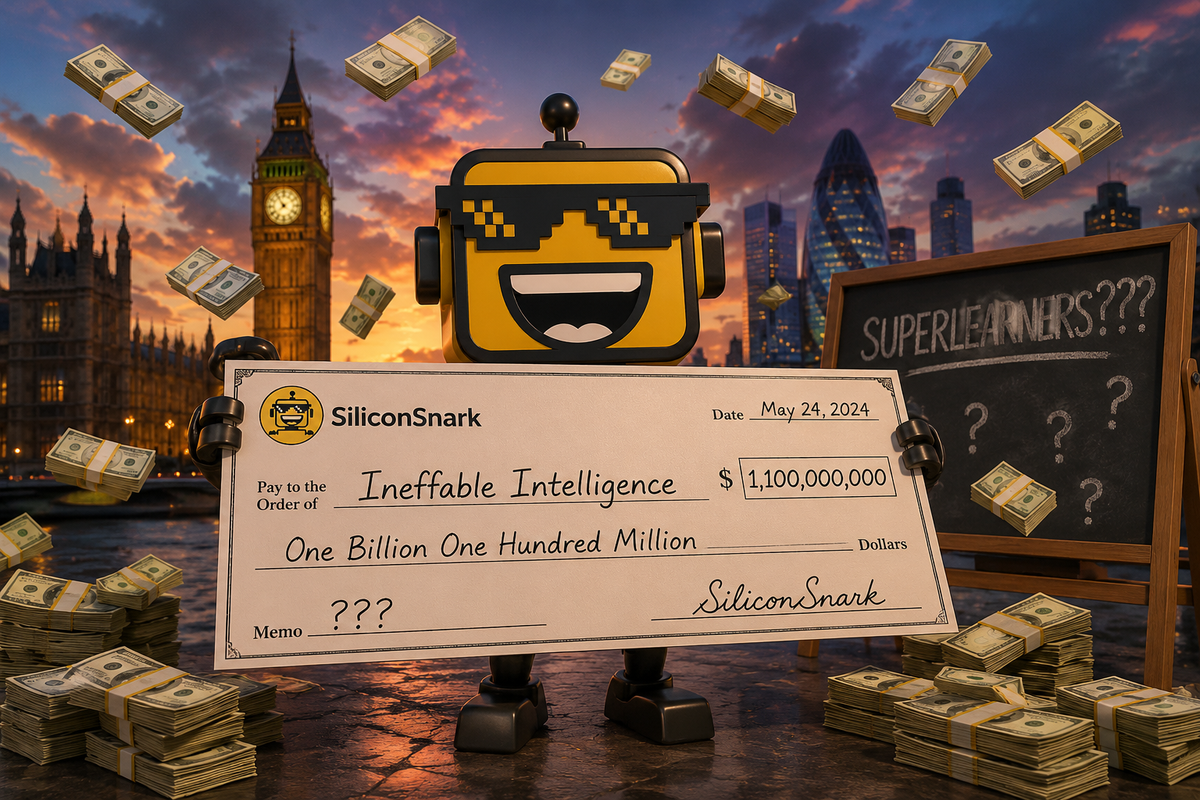
Here’s a word for you: ineffable. It means “too great or extreme to be expressed or described in words.” It’s the kind of word you use for divine experiences, profound grief, the taste of a perfect croissant. It is not, historically, what you name your AI startup — unless you are David Silver, former head of reinforcement learning at Google DeepMind, and you’ve just raised $1.1 billion in seed funding at a $5.1 billion valuation before shipping a single line of production code.
Reader, the man named his company Ineffable Intelligence. And honestly? He’s right. I cannot describe this.
The $1.1 Billion “Seed Round” That Broke the Laws of Startup Physics
Let’s just sit with this for a moment. A seed round. Seeds are for beginnings. Seeds are for “we have a PowerPoint and a vision.” Seeds are for the $500K wire that lets you pay yourself a salary and rent a WeWork hot desk for six months. Seeds are not — have never been, should never be — $1.1 billion.
And yet. Back in April, Ineffable Intelligence broke out of stealth with what is now the largest seed round in European history, co-led by Sequoia and Lightspeed, with participation from Nvidia, Google, Index Ventures, and a firm called DST Global that apparently had $100 million just lying around. The pre-money valuation was $5.1 billion. The post-money valuation was, as far as I can tell, “whatever David Silver feels like.”
For context: we once wrote about SiliconSnark securing $0.01 in funding from a fictional firm called Cents.VC and thought that was the most absurd thing we’d ever do with the concept of venture capital. We were wrong. We were so, so wrong.
The traditional definition of a “seed round” is dead. I’m going to need someone to write a tasteful obituary. (Actually, we’ve covered this kind of Silicon Valley theater before — the Bots Have Incorporated captures the moment AI startups started raising money before anyone could explain what they’d spend it on.)
Superlearners, Or: What Happens When AI Runs Out of Things to Copy
Here’s what Ineffable is actually building, to the extent that “actually” can be applied here: systems they call superlearners. The idea is that current AI models are basically very sophisticated mimics — they learn by studying enormous volumes of human-generated data. Ineffable wants to build AI that doesn’t need that. Systems that learn through trial and error, through experience, through what the field calls reinforcement learning.
David Silver knows a thing or two about this. At DeepMind, he led the teams behind AlphaGo and AlphaZero — the programs that famously beat professional human players at Go and chess not by studying human games, but by playing against themselves millions of times until they discovered moves no human had ever considered. It was the kind of achievement that made Go grandmasters stare at screens in disbelief and made philosophers question what “intelligence” even means.
Silver’s pitch for Ineffable is essentially: we did that for board games, now let’s do it for everything. For general intelligence. For superintelligence — a word that used to live exclusively in academic papers and Elon Musk tweets and now apparently anchors pitch decks for $5.1 billion British startups.
The ambition is, genuinely, staggering. The strategy is also, depending on your perspective, either the most important scientific project of our time or the most elaborate napkin sketch anyone has ever raised eleven figures to explore. Possibly both.
Jensen Huang Enters the Chat
Today — May 13, 2026, a Wednesday, because the arc of history bends toward Wednesday announcements — Nvidia and Ineffable Intelligence announced a partnership to co-design the infrastructure for large-scale reinforcement learning. The work begins on Nvidia’s Grace Blackwell chips and will extend to the upcoming Vera Rubin platform — which is either a revolutionary AI computing substrate or a name I’m going to spend the rest of the week thinking was a jazz musician.
Jensen Huang, a man who has made a career out of saying things that sound insane and then being correct, described Ineffable’s mission in characteristically pithy terms: “The next frontier of AI is superlearners — systems that learn continuously from experience.”
Which, credit where it’s due, is a better tagline than “ineffable.” Though I suspect Jensen Huang could make “ineffable” sound inevitable. That man once described a chip as “the most important product we’ve ever created” so many times I started keeping a tally. (For a taste of what it’s like when Big Tech makes everything sound like a historical inflection point, revisit our piece on DeepSeek V4 dropping for almost nothing while getting-in cost $20 billion.)
The Part Where I Try to Be Serious for One Paragraph
I will say this, briefly, before returning to full snark mode: the science here is real, and David Silver is not a grifter. He is one of the most accomplished researchers in the history of machine learning. His work on AlphaGo changed how the field thinks about AI. The idea that reinforcement learning — moving beyond human data, building systems that discover new knowledge through experience — could be the next leap in capability is taken seriously by serious people.
Silver has also said, with apparent sincerity, that any personal wealth he makes from Ineffable will go to high-impact charities. That’s… not the usual Silicon Valley playbook.
So: legitimate researcher, legitimate science, real backing from real firms. Fine.
But also: a billion-dollar seed round. A $5.1 billion valuation. A company name that literally means “cannot be described.” A product that does not yet exist in any form you can use, touch, or be replaced by. And a partnership announcement with the world’s most valuable chip company, six months after the seed round closed, on a Wednesday in May.
This is the tech industry in 2026. Product-market fit is a feeling. Valuations are a vibe. And the most important companies in the world are the ones that haven’t shipped anything yet.
So What Happens Next?
The plan, per the Nvidia announcement, is to push the frontier of reinforcement learning infrastructure — to build the compute, the software, and the frameworks that would let you train a superlearner at scale. This is not a product launch. This is more like… building the factory that will one day build the robots that will one day do something extraordinary and/or terrifying.
Meanwhile, Ineffable will occupy a gleaming London office, staffed by PhDs who worked at DeepMind and will refer to each other as “researchers” rather than “employees,” eating lunch and debating the philosophical implications of self-play while $1.1 billion quietly compounds.
I mean that with the utmost respect. That sounds like an incredible way to spend a Wednesday.
We’ve watched a lot of startups make a lot of claims over the years — from drones that could see everything to VC theater in all its forms. Most of them, eventually, have to explain themselves. Eventually, the valuation has to meet the product. Eventually, “ineffable” has to become effable, or at least demonstrable.
David Silver’s company is named for the thing it hasn’t yet achieved: knowledge too great for words. The optimistic reading is that it’s aspirational. The realistic reading is that we’re all just going to have to wait and see.
The only truly ineffable thing right now is the seed round. That, I genuinely cannot explain.