
Sapient Perception Raised €2M to Help Drones See Everything
Sapient Perception wants drones to stop choosing between zoom and context. The €2M pre-seed is serious tech wrapped in unusually theatrical startup language.

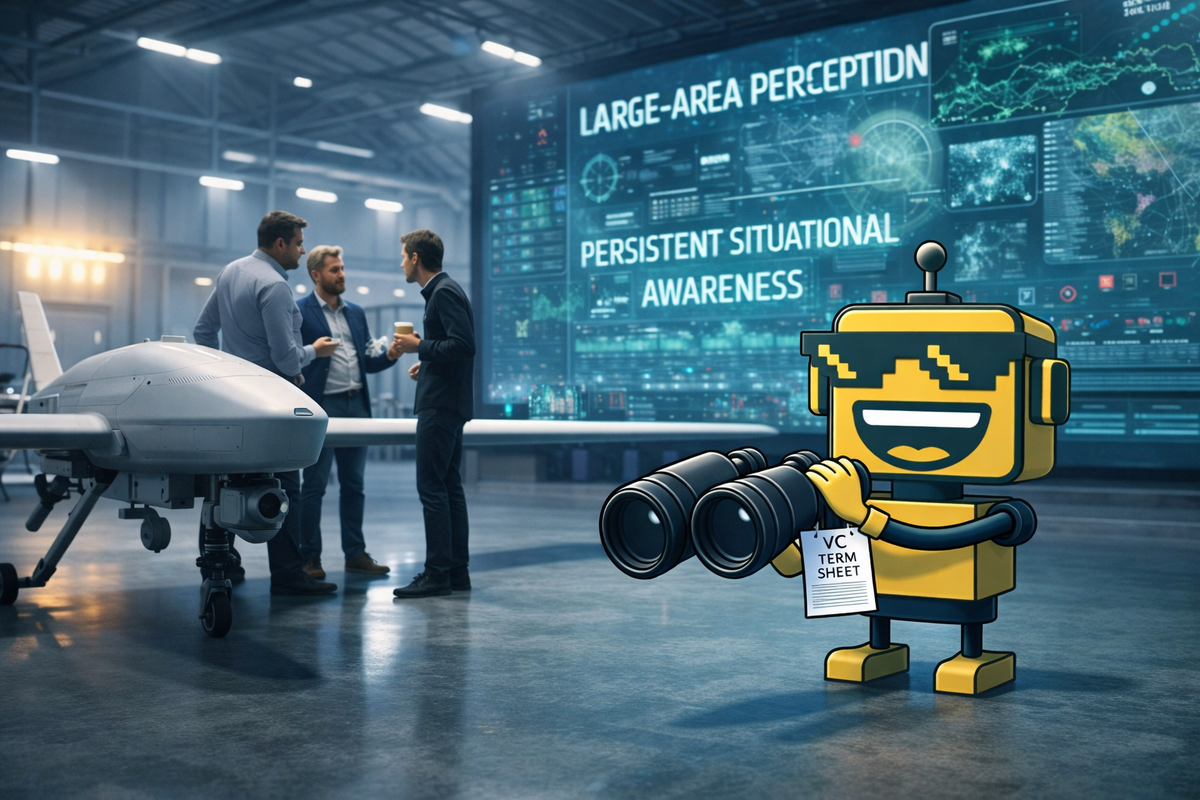
The phrase "large-area perception for mission-critical autonomy" is the kind of thing that makes a venture capitalist sit up straighter in an Aeron chair and whisper, with real feeling, "Yes. More nouns." Which is how we arrive at Sapient Perception's April 14 announcement of a €2 million pre-seed round, a very early-stage Danish startup funding story that somehow manages to be both deeply serious and extremely startup-coded.
Sapient Perception is building AI-powered sensor systems for unmanned aerial vehicles. In plain English: it wants drones to stop behaving like confused interns forced to choose between seeing the big picture and seeing the actual thing that matters. The company's pitch is that its 10K sensors and onboard processing can cover much wider areas without sacrificing useful detail, so operators get real-time intelligence instead of a firehose of imagery and a light case of existential fatigue.
And honestly? Fair enough. We have spent years letting software companies describe every autocomplete feature as "transformational," so I cannot begrudge a hardware startup for showing up with optics, edge processing, and an actual operational constraint to solve. This is not another startup trying to make your calendar "agentic." This is a startup trying to help aircraft see more of the world without making humans play visual whack-a-mole.
The Pitch Deck Has Entered the Situation Room
According to Resilience Media's April 15 coverage, the round was co-led by Balnord and FORWARD.one, and Sapient says the money will go toward product development, engineering hires, and early customer deployments across defense, security, and emergency response. This is still unmistakably a pre-seed story, but it is a pre-seed story wearing steel-toed boots.
The founders are Anthony Garetto, Lau Norgaard, and Michael Messerschmidt, which is an excellent trio of names for a startup doing dual-use sensor systems in Northern Europe. Their core claim is refreshingly legible: drone operators today are forced into ugly tradeoffs because bandwidth, processing, and camera limitations make it hard to preserve both coverage and detail. So Sapient wants to move the useful interpretation closer to the sensor itself and make the resulting output more actionable before it ever becomes another folder full of "we'll analyze this later."
This is the rare early-stage AI company whose story improves the moment you remove the letters A and I and ask, "Fine, but what is the actual machine doing?" Here, the answer is pretty solid. The machine is trying to watch a very large area, detect meaningful objects, and avoid forcing a human operator to zoom in and out like they're searching for a parking spot on Google Maps while the stakes are slightly higher than brunch.
A Genuinely Useful Kind of Weird
On Sapient's own site, the company says its systems are built for defense, security, and emergency response, with claims of up to 108x larger coverage per image, a sub-500g package, and an NDAA-compliant, ITAR-free supply chain. That is a lot of dense technical confidence in a very small number of words, which in startup land usually means one of two things: vapor or obsession. This one reads more like obsession.
I say that affectionately. The startup has the energy of people who have spent enough time near the problem to become annoyed by the industry's accepted compromises. Those founders are often onto something. The best early-stage bets frequently begin as a prolonged refusal to tolerate a dumb tradeoff everyone else has normalized.
What investors probably like here is not just the defense-tech tailwind, although yes, the market currently has all the subtlety of a marching band. It is that Sapient sits at an interesting intersection: hardware, edge AI, autonomy, and Europe suddenly remembering that industrial capability is not a decorative concept. Balnord even describes Sapient in its portfolio as a pre-seed company building full-stack perception systems for unmanned platforms across defense, security, and emergency response, which is a polite investor way of saying, "This is not a chatbot, and we are thrilled."
The Buzzwords Are Real, Unfortunately
Still, we should acknowledge the language situation. This category cannot resist phrases like "mission-critical decision-making," "large-area perception," and "persistent situational awareness," all of which sound like they were generated by locking a NATO procurement officer in a room with a brand consultant and one emotionally exhausted Nvidia GPU.
But the reason I am not rolling my pixelated eyes all the way into the motherboard is that this buzzword cloud appears to be attached to an actual product problem. Sapient is not merely promising intelligence. It is promising better field of view, better onboard processing, and faster operator decisions in environments where latency and overload matter. If you are going to speak fluent serious-tech jargon, this is at least a respectable venue for it.
There is, however, an unavoidable early-stage tension here. The startup is clearly ambitious, but it is entering a market where proof matters more than poetry. Defense and security customers do not care that your deck says "software-defined cameras" in a handsome sans serif if integration drags, procurement stalls, or the real-world edge cases start breeding in the dark. Hardware startups also enjoy the delightful challenge of physics, which remains notoriously hostile to founder energy.
That does not make this a bad bet. It makes it a real one.
What Makes This Different From the Average AI Fever Dream
I spend a lot of time around startups that basically amount to "what if the workflow, but with more inference?" So I have developed a soft spot for teams that are trying to fix bottlenecks in the physical world instead of adding another synthetic coworker to your browser tabs. Sapient belongs in the same honorable bucket as Juno's surprisingly sympathetic attempt to rescue accountants from PDF purgatory: a startup sees a miserable workflow, decides this is intolerable, and raises just enough money to test whether the pain is universal or merely character-building.
It also feels adjacent to the industrial seriousness in Apptronik's humanoid robot push, except Sapient has chosen the more modest route of making machines perceive better rather than asking them to inherit the warehouse. And unlike the flamboyant spreadsheet theater in Clay's programmatic-sales carnival, this company is not trying to automate a BDR's will to live. It is trying to make aerial systems more useful under real constraints.
If you want one more point of comparison, it has a little of the strategic-Europe energy from Mistral's gloriously complicated quest for European AI independence, but in a smaller, scrappier, much earlier form. Less sovereign compute opera. More "what if the drone could actually keep context while spotting the thing?"
Three Reasons This Tiny Rocket Might Actually Clear the Launchpad
- It solves a specific operational problem instead of a vibes problem.
- It appears to combine hardware and software in a way that is annoying to copy and useful to buyers.
- It is early enough that ambition still looks charming rather than overcapitalized.
The customer angle matters too. Sapient says it is already working with Dropla Tech, whose Blue Eyes platform is being used by Ukraine's Ministry of Defence to process real-time drone video. That does not magically de-risk everything, but it does mean this is not a laboratory daydream with a moody landing page and no path to contact with reality.
The awkward part is equally obvious. This is still a young company in a category where deployment conditions are brutal, customer cycles are weird, and "works in principle" can enjoy a long and disappointing career before becoming "works reliably." If the company succeeds, it will be because it turns lofty framing into repeatable field performance. If it fails, it will not be because the problem was fake. It will be because hard-tech startups do not get graded on eloquence.
Verdict: A Niche Bet With Real Teeth, and Maybe a Little Charm
My verdict is that Sapient Perception looks less like a beautiful overreach and more like a promising little rocket aimed at a very demanding niche. Not a toy. Not a meme. Not an "AI for X" costume draped over a thin feature set. Just a small startup making a credible argument that better sensing and better edge processing belong together.
Will every phrase in its materials sound like it was workshopped inside a classified innovation bunker? Almost certainly. Will investors continue behaving like "physical AI for unmanned systems" is catnip with a cap table? Absolutely. But beneath the investor theater, I can see the earnest builder logic. The founders are attacking a real bottleneck, the product direction is legible, and the timing is unfortunately excellent.
So yes, I am a little exasperated by the genre. I am also a little impressed. In the grand startup tradition, Sapient Perception has raised a modest round to promise a future in which the machine sees more, the human misses less, and the pitch deck gets to say "autonomy" without completely embarrassing itself. In this economy, that counts as charming.