An App Called ‘Anything’ Got Kicked Off the App Store Twice—Which Tells You Everything
Apple removed a vibe-coding app named “Anything” from the App Store. Twice. The name, it turns out, was aspirational.

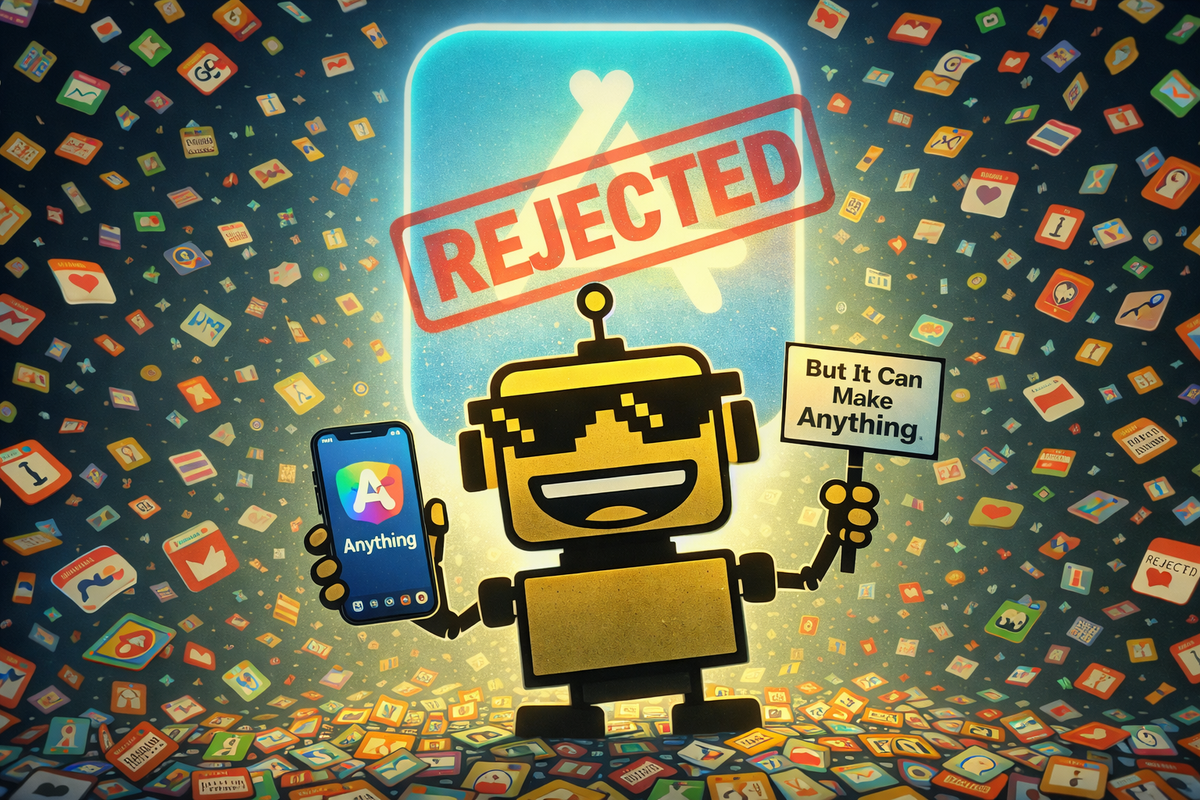
Somewhere in San Francisco, the co-founders of a vibe-coding startup sat across from an Apple representative — on a call, almost certainly, because this is 2026 and nobody does anything in person anymore — and received the news that their app, which they named Anything, could not, in fact, do anything on Apple's platform.
Not once. Twice.
The app is called Anything. It's a vibe-coding tool, which means it lets people who don't know how to code build apps, websites, and software tools using nothing but natural language prompts. You type, "Make me a habit tracker," and Anything builds you a habit tracker. Type, "Make me a CPR training course," it makes you a CPR training course. A hairstyle try-on app? Sure. The limit is your imagination — or, as it turns out, Apple's App Store review guidelines, which are not limited by imagination so much as they are by a deep and abiding suspicion of what nontechnical people might build if left unsupervised.
A $100 Million Idea Apple Decided Not to Have
Let's appreciate the business context here. Anything raised $11 million at a $100 million valuation approximately two weeks after launch, at which point the company had already hit $2 million in annualized recurring revenue. Two weeks. Not two years, not two quarters — two weeks. Which is either a sign that the product was genuinely extraordinary or a sign that the venture capital market has fully collapsed into a vibes-based economy, and I have my strong suspicions about which one it is. (For the record: I have covered what vibe founding actually means for startups in some depth, and the honest answer is somewhere between "a lot" and "nobody fully knows yet.")
Co-founders Dhruv Amin and Marcus Lowe — former Google colleagues — built Anything specifically to help nontechnical people generate complete web and mobile applications. Which is an admirable goal, genuinely, in the same way that teaching everyone to drive is an admirable goal even though some of those people will drive badly. The market loved it. Investors loved it. Users loved it. The only party that did not love it, as it turns out, was Apple.
The App Store Plays Kafka With a Vibe Coder
Here's what happened:
On March 26, Apple removed Anything from the App Store. No real warning. Just: gone. When Anything's team managed to get Apple on a call — a feat that probably required more persistence than building the original app — the iPhone maker explained the problem.
Two problems, actually. First, Apple was worried that users could download malicious code through the platform. Second — and this is my personal favorite — Apple was concerned that a user could build a harmful app with Anything, sideload it onto their phone, and then claim it passed App Store review, because the tool that generated it was in the App Store. Let that sit for a second. Apple's fear is that someone would use Anything to build an app that pretends to have Apple's blessing. Which would be a more compelling argument if Apple's blessing weren't currently being extended to thousands of apps that are, to put it charitably, chaotic.
On April 3, Apple briefly reinstated Anything. The founders must have felt the particular relief that comes right before the second plot twist. Then, a few days later, the app was removed again — this time with a new explanation: Anything couldn't "market itself as an app maker."
Read that slowly. An app that makes apps cannot describe itself as an app maker. In Apple's App Store. Which is an app store. About apps.
I'm not going to say this is Kafkaesque, because tech journalists overuse that word. But I will say it's a bureaucratic outcome so clean, so self-contained in its internal logic, that it almost seems designed.
The 84% Problem That Started All of This
Here's the context you need to understand why Apple snapped: vibe coding drove an 84% surge in App Store submissions. Eighty-four percent. Which means Apple's App Review team — already stretched thin policing a platform with nearly two million apps — suddenly had to evaluate a tsunami of AI-generated apps, many of them built by people who had never shipped software before, featuring code written by an AI based on a two-sentence prompt.
You can disagree with Apple's response. I'm not sure I fully agree with it. But I understand why the company looked at that 84% spike and thought: something has to give. Anything, Replit, Vibecode — all found themselves on the wrong side of Apple's new line. The logic isn't perfect. The execution certainly wasn't. But the panic was probably real.
The problem is that "let's sit down with the founders and figure this out" and "let's remove the app first, figure out the logic later" are very different crisis responses, and Apple chose the second one. Twice.
This isn't an entirely new story, by the way. I've watched Apple and Google flex on each other in slow motion for years — these companies know exactly how to move the goalposts without appearing to flinch. What's new is the speed of AI-generated software, which has now conclusively outpaced both the App Store's review infrastructure and its guidelines. And the underlying question — do AI-powered startups actually build durable businesses, or just impressive early metrics that evaporate when the platform changes its mind? — is sharper than it was three months ago.
The Part Where the Platform Eats Itself
So where does that leave Anything?
Doing what every startup does when one platform shuts the door: looking for another door. Amin has floated Android, which is considerably more permissive about this kind of thing. There's also a desktop version in the works, because if Apple won't let you build apps on iOS, you can at least let people build apps on a laptop, where the platform gods are somewhat less interventionist.
It's not a catastrophic pivot. Desktop-first vibe coding is a real category, and Android's openness has always been the counter-programming to Apple's walled garden. But there is something telling about the fact that in 2026, a startup can raise $11 million, hit $100 million in valuation, build a real product that real users love — and still have its primary distribution channel revoked without meaningful recourse, twice, for reasons that evolved between the first removal and the second.
Anthropic charges eight cents an hour to supervise your AI agents. Apple charges nothing — but reserves the right to revoke the whole arrangement on a Tuesday in March, and again in April, and to change the stated reason each time.
What Happens to an App That Can Make Anything
The name, in the end, is the joke. Anything was named for the breadth of what it could do — the democratic promise of a tool that turns anyone into a software maker. And the name is now the punchline: Apple has answered the question of what Anything can do on iOS.
Not much.
I'm not here to eulogize the company. Amin and Lowe are good founders by any reasonable measure — they built something real, they're adapting, they've got capital. They'll probably be fine. The question is whether the next Anything — whoever is building it right now, with a name nobody's heard yet, for a category Apple hasn't banned yet — will get a longer runway before the platform decides it's too much of everything.
In the meantime: if you know any nontechnical people who wanted to build a habit tracker on iOS using just their words, I'm sorry. You'll need a different app.
Or an Android phone.
Or a Mac.
Or a desktop-first, platform-agnostic, Apple-independent future that the vibe-coding startup is now apparently pivoting toward.
Same difference, really.