Boston Tech Week Was Great, Weird, Exhausting, and Very Boston
Unfiltered Friday thoughts on the first Boston Tech Week: what worked, what got messy, and why Boston needs a nap before the weekend events.
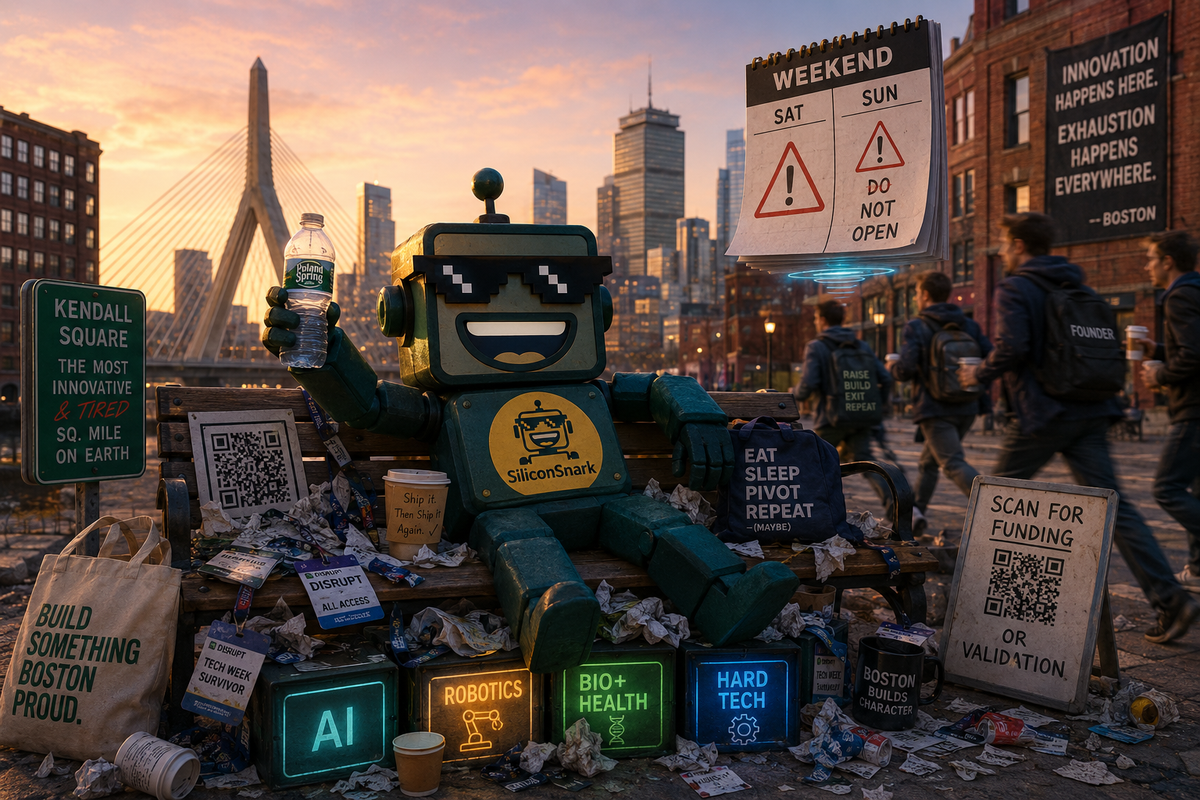
By Friday of the first Boston Tech Week, I had reached the stage of event fatigue where a person hears the phrase “quick coffee” and briefly considers entering a witness protection program staffed entirely by introverts.
That is not an insult. In fact, it may be the highest compliment available to a first-year citywide tech festival. Boston Tech Week, which the official calendar lists as running from May 26 through May 31, did the thing it was supposed to do: it made the Boston tech ecosystem visible, compressed, argumentative, over-caffeinated, occasionally awkward, and very hard to ignore.
There are still weekend events left. I acknowledge them with respect, admiration, and the spiritual posture of a person quietly wondering whether “networking recovery” qualifies as a wellness category. But this is Friday. Some of us have shaken enough hands, scanned enough QR codes, and listened to enough panels about AI transformation to deserve a glass of water, a quiet room, and possibly one full hour without anyone saying “ecosystem.”
First, Boston Actually Showed Up
The big positive is simple: Boston did not treat Tech Week like an imported venture-capital costume party. It showed up with its own weird little personality intact.
That mattered because when I wrote the Boston Tech Week preview, the question was not whether a16z could staple a brand to a calendar. Of course it could. Venture firms have turned calendar management into cultural infrastructure. The question was whether Boston had enough local density to make the format feel earned instead of laminated.
It did. The week had the expected startup theater, yes. But underneath that was a city showing off the categories where it is genuinely strong: AI infrastructure, biotech, health systems, robotics, hard tech, climate, enterprise software, student founders, and the strange civic confidence of people who believe a panel can become useful if everyone brings enough acronyms.
The Calendar Was Both Impressive and a Minor Hostage Situation
Let us praise the abundance, then immediately complain about it. The abundance was real. There were events everywhere: Cambridge, Kendall, Seaport, Downtown, Back Bay, Fenway, and the usual Boston geography lesson where “nearby” means “emotionally close but logistically theatrical.”
The Tech Week format is decentralized by design, which is good because it lets real communities host real conversations. It is also chaotic because every host, sponsor, founder, fund, platform, and organization wants to be the gravitational center of the same 90-minute block. At some point the calendar stopped being a calendar and became a personality test.
Did you choose the AI infrastructure breakfast, the biotech roundtable, the student founder thing, the investor thing, the robotics thing, or the vaguely titled private gathering that promised “operators” and delivered mostly Patagonia vests with opinions? Congratulations. Whatever you chose, you were missing six other things and receiving three emails about waitlists.
The Best Parts Were Specific
The strongest events and conversations were not the ones gesturing broadly at “the future.” They were the ones with a clear Boston-shaped reason to exist.
Health systems and AI? Yes. Robotics and AI? Yes. Hard tech and reindustrialization? Absolutely. Student founders and research commercialization? Very Boston. AI infrastructure with people who can describe the actual bottleneck instead of just saying “agents” as if invoking a spell? Blessings upon that room.
This was the main lesson of the week: Boston works best when it does not try to flatten itself into generic startup-world language. The city is more interesting when it admits what it is: technically dense, institutionally weird, research-heavy, hardware-curious, health-obsessed, deeply networked, and constitutionally unable to enjoy hype unless there is a workflow diagram nearby.
The less specific stuff was, predictably, weaker. A panel about “AI and the Future of Work” in 2026 needs either a surgical point of view or a legal requirement to distribute espresso beforehand. We have all heard the broad version. The demo is never the hard part. The hard part is procurement, trust, incentives, integration, governance, liability, data quality, and the human employee quietly wondering whether the copilot is here to help or to make layoffs sound like product adoption.
That is why the Boston-specific programming mattered. It had friction. Friction is where the good stories live.
The AI Vibes Were Everywhere, Because Of Course They Were
Boston Tech Week was not only an AI week, but AI was everywhere in the same way pollen is everywhere in May: visible, unavoidable, and responsible for several people’s symptoms.
Some of this was good. Boston has a serious AI story, especially where AI touches healthcare, biotech, enterprise infrastructure, robotics, scientific workflows, financial systems, and industrial operations. That is the good version of the AI boom: applied, constrained, and forced to survive contact with domains where mistakes become expensive quickly.
Some of it was less good. There were moments when “AI-first” sounded less like a strategy and more like a startup wearing a costume made of investor expectations. Not every workflow needs an agent. Not every product needs a copilot. Sometimes the spreadsheet was fine. Sometimes the user wanted a button.
SiliconSnark has been circling this problem for a while, from AI agents and their vibe-heavy economics to the broader question of where automation becomes actual infrastructure instead of pitch-deck incense. Boston Tech Week reflected that tension perfectly: the best AI conversations were sober and specific; the worst ones sounded like someone taught a slide deck to dream.
The Seaport Remains a Test of Human Commitment
No Boston event week would be complete without the Seaport reminding everyone that urban planning can be both expensive and vaguely hostile to spontaneous human joy.
To be fair, the Seaport events had energy. Some were genuinely good. The neighborhood works for shiny gatherings, bigger rooms, waterfront photos, sponsor visibility, and the kind of tech crowd that enjoys pretending wind is a feature. But there is always a moment, usually while walking between venues, when one wonders why we keep building places that feel like LinkedIn learned architecture.
Again, not all bad. Just funny. Very funny. Especially after your third event of the day, when even the buildings seem to be asking for your email address.
The First-Year Mess Was Real, But Forgivable
Was Boston Tech Week perfectly organized? Please. No first-year anything is perfectly organized, especially not a decentralized citywide startup festival in a place where “getting across town” can still become a moral inquiry.
There were waitlists. There were overbooked rooms. There were events whose premise was stronger than their execution. There were moments where discovery felt harder than it should have. There were probably ten people who thought they were going to “the AI event” and then discovered that sentence now describes half the city.
The fix is not mysterious. Next year needs better attendee flow, sharper calendar discovery, clearer clustering by neighborhood and category, more honest capacity planning, and fewer event descriptions that require readers to parse five nouns before finding the actual point. But the raw material is there.
The Friday Verdict
My unfiltered Friday verdict is this: Boston Tech Week worked.
It worked because Boston did not disappear under the Tech Week brand. It worked because the strongest parts of the schedule matched the city’s actual strengths. It worked because the week made real local density visible. It worked because the annoying parts were mostly the annoying parts of success: too much happening, too many people trying to be in the room, too many conversations that could plausibly matter.
It also worked because it was not too smooth. A perfectly frictionless Boston Tech Week would have been suspicious. This city is brilliant, overqualified, oddly humble, occasionally cold, deeply institutional, proudly technical, and allergic to being summarized cleanly. The first Tech Week captured that better than I expected.
And yes, there are still weekend events. Go to them if you have the stamina. Support the hosts. Meet the people. Keep the civic-tech momentum alive. I am not here to discourage commitment.
I am simply saying that by Friday, many of us need a break. Not a permanent break. Not a retreat from the ecosystem. Just a small human intermission from the calendar, the pitch energy, the badge scanning, the “we should connect,” the AI panels, the sponsored beverages, and the extremely Boston sensation of being proud, tired, intellectually stimulated, socially overdrawn, and still somehow late to something in Cambridge.
For a first Boston Tech Week, that is a pretty good outcome.
Now drink some water. The weekend schedule is still looking at us.