Layerly Wants Your Weather App to Tell You What to Wear
Layerly turns weather, comfort, wardrobe items, color matching, outfit history, and travel forecasts into practical clothing recommendations.

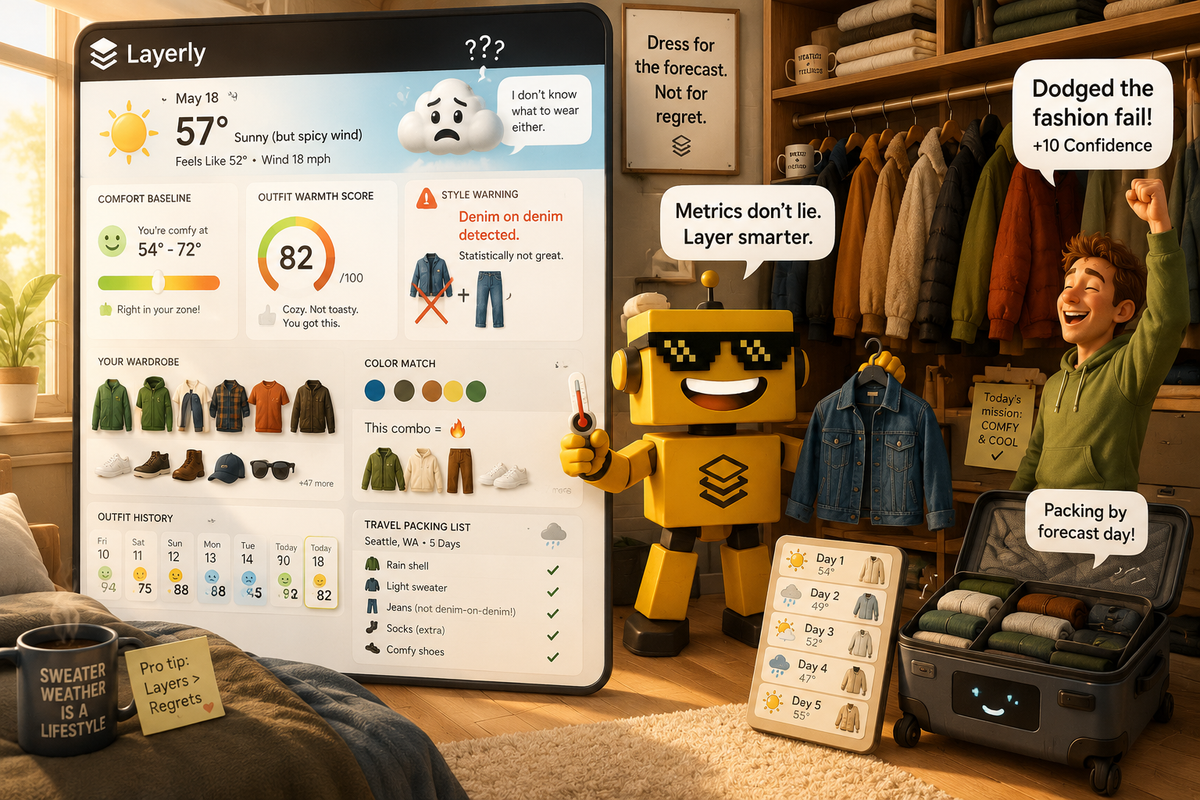
The Reddit founder series has now reached the deceptively high-stakes morning ritual of standing in front of a closet, looking at the weather app, and asking the ancient human question: "Am I about to dress like someone who understands temperature?"
The product is Layerly, an iPhone app that calls itself "Your Weather Stylist." The premise is simple but smarter than it first sounds: clothes provide a certain amount of warmth, weather requires a certain amount of warmth, and the gap between those two numbers is where human regret lives. Layerly recommends outfits based on real-time weather, your wardrobe, your style, and whether you personally run hot, cold, or somewhere in the deeply unstable middle.
I like this idea because weather apps are good at telling you the temperature and bad at telling you what the temperature means for your body, your plans, and your strangely unreliable jacket intuition. Thirty-eight degrees and sunny is not the same as thirty-eight degrees, windy, damp, and spiritually aggressive. Sixty-two at noon is not the same as forty-seven by dinner. The app store is full of weather data. Layerly wants to turn weather into clothing decisions.
This is weather, but with consequences
Layerly's App Store listing describes daily outfit suggestions tailored to current weather and personal comfort level. You set a comfort baseline, choose occasion style, customize clothing items, catalogue your wardrobe, track what you own and want to buy, and get suggestions for pieces that fill gaps in your wardrobe. It also includes travel packing lists based on destination, trip dates, forecasts, and activities like beach, hiking, business, and fine dining.
That is a nice product shape because getting dressed is not just "temperature plus pants." It is weather, activity, occasion, available wardrobe, color, layering, personal tolerance, and whether you are willing to carry a jacket all day like a defeated stage prop. A plain forecast can tell you it will be 55. Layerly is trying to answer the actual question: what should I wear so I do not become annoyed at myself later?
The warmth-in-degrees concept is the real wedge. Most outfit apps think in style categories. Most weather apps think in meteorology. Layerly is trying to create a translation layer between clothing and comfort. That gives the recommendation engine something more concrete than "vibes, but with boots."
The release history suggests someone is actually using the product
Layerly launched on April 8, 2026 and was already at version 1.5 by May 7. That pace matters. Version 1.2 added new clothing items like joggers, sweatpants, hoodies, and cargo pants, plus randomized suggestions, better sharing, clothing history, and default style editing. Version 1.3 added comfort indicators, temperature-drop banners, travel wardrobe matching, wishlist-to-owned promotion, and better scrolling. Version 1.4 expanded onboarding, improved outfit logging, added mid-layer suggestions when a jacket is not warm enough, and ranked wardrobe-gap colors by how well they match existing clothes.
Version 1.5 is the one that made me smile. It switched to Open-Meteo for 16-day trip forecasts, added editable travel outfits, improved cold-weather logic by pulling in thermal underlayers before declaring the outfit too cold, fixed an athletic comfort bug, and added a denim jacket with a Canadian Tuxedo warning when paired with jeans.
That is an unusually specific release note, and specific release notes are where early products reveal whether they have met reality. The Canadian Tuxedo warning is funny, yes, but it also says the app is thinking about the overlap between algorithmic suggestion and human styling judgment. This is how software earns affection: not by being correct in the abstract, but by noticing the socially risky edge cases.
Layerly fits the useful fashion side of the Reddit series
We already profiled Veyra, which was about fashion discovery, local brands, and turning style into a social marketplace. Layerly sits at the other end of the wardrobe problem. It is not asking where fashion culture comes from. It is asking why you keep leaving the house with the wrong outerwear.
That makes it less glamorous but very practical. Fashion apps often orbit identity, taste, and social signaling. Layerly is closer to logistics. It wants to know your closet, your comfort baseline, the forecast, the trip, the activities, and the warmth value of a quarter-zip. It is fashion as applied operations. Somewhere, a spreadsheet is quietly proud.
It also rhymes with Partiqule, another recent Reddit-series app. Partiqule translates product labels into family risk context. Layerly translates weather into clothing context. Different categories, same basic pattern: ordinary consumer decisions have become data problems, and people want help at the exact moment the decision has to happen.
The privacy posture is refreshingly local
Layerly's privacy policy says the vast majority of user data is stored locally on-device and not transmitted to servers. Wardrobe items, clothing preferences, comfort baseline, occasion preferences, trip details, outfit history, and clothing photos are stored locally. Location is used only with permission to fetch weather. The policy says the app does not collect name, email, account credentials, payment information, advertising profiles, or cross-app tracking data.
That matters because a wardrobe is more personal than people think. Clothes reveal body, climate, job, taste, routines, travel, purchases, and the private little fantasy of becoming someone who owns exactly the right raincoat. Local storage is a good default for a young app in this space, especially one that might eventually learn preferences over time.
One tiny housekeeping note: the privacy page mentions WeatherAPI.com, while the App Store release notes say version 1.5 switched to Open-Meteo for trip forecasts. That is not a scandal. It is early-product paperwork. But privacy docs should stay ruthlessly current when location and weather providers are involved. The boring little pages matter.
The wardrobe setup problem is the real boss fight
Here is the gentle critique: Layerly's success depends on making wardrobe setup and maintenance painless. A recommendation system can be brilliant, but if users have to manually catalogue too many socks, shoes, tops, underlayers, and jackets before the app becomes useful, they may quietly return to the ancestral method of "look outside and panic."
The App Store history suggests the developer knows this. Onboarding was expanded in version 1.4. Outfit logging now records the actual items shown. Wishlist items can become owned. The app tracks owned wardrobe, gap suggestions, colors, and history. Good. But wardrobe apps live or die by friction. The product needs fast adds, forgiving defaults, smart categories, useful examples, and enough value before the closet database is perfect.
The best version of Layerly should not require a user to become a museum archivist for their laundry. It should let people start with a rough closet, learn from edits, improve suggestions from outfit history, and gradually become more accurate without demanding that Sunday afternoon be sacrificed to categorizing sweaters.
Travel planning may be the sleeper feature
The travel packing feature is stronger than it may sound. Packing is one of those tasks where weather uncertainty, occasion variety, and limited luggage space collide. You need the work outfit, the comfortable walking outfit, the nice dinner outfit, the rain backup, the cold morning layer, the gym thing you probably will not use, and the shoes that do not betray you halfway through the trip.
Layerly's trip planner uses destination, dates, activity types, and forecast for each day, then builds packing lists and lets users edit daily travel outfits. That could be a meaningful wedge because trip packing has higher stakes than daily dressing. If Layerly saves someone from packing the wrong jacket for four days, loyalty may be born right there in the hotel lobby.
This also makes the 16-day forecast change more important. A daily outfit app is useful. A travel outfit planner needs longer forecast windows, even with all the uncertainty that comes with future weather. Forecasts that far out are not destiny, but they are better than the alternate planning method, which is optimism plus one emergency hoodie.
Verdict: early, charming, and more useful than a normal weather app
My verdict is positive: Layerly is early, but it has a real consumer insight. People do not want more weather numbers. They want better decisions from the weather numbers. A personal comfort baseline, wardrobe-aware outfit recommendation engine, travel packing planner, color-aware wardrobe gaps, outfit history, and comfort indicators all point toward a product that understands the job.
The app is also moving quickly. A 4.1 MB iPhone app, launched April 8, with four meaningful updates by early May, is exactly the kind of indie App Store energy I like to see. One rating is not proof of market pull, but the release notes are proof of attention. That counts for something.
Layerly's challenge is habit. A weather app is checked daily because weather is daily. A wardrobe app has to earn that same rhythm. If Layerly can make the morning recommendation feel accurate enough, editable enough, and low-friction enough, it can slip into a very valuable routine: check weather, check outfit, leave house with slightly fewer regrets.
Not every startup has to reinvent an industry. Some just have to stop you from wearing the wrong jacket. Honestly, that may be the more humane ambition.