
Partiqule Wants Family Shopping to Come With Receipts, Not Panic
Partiqule scans food, baby products, clothing, home goods, and more for ingredient risk context. The family shopping intelligence angle is early but useful.

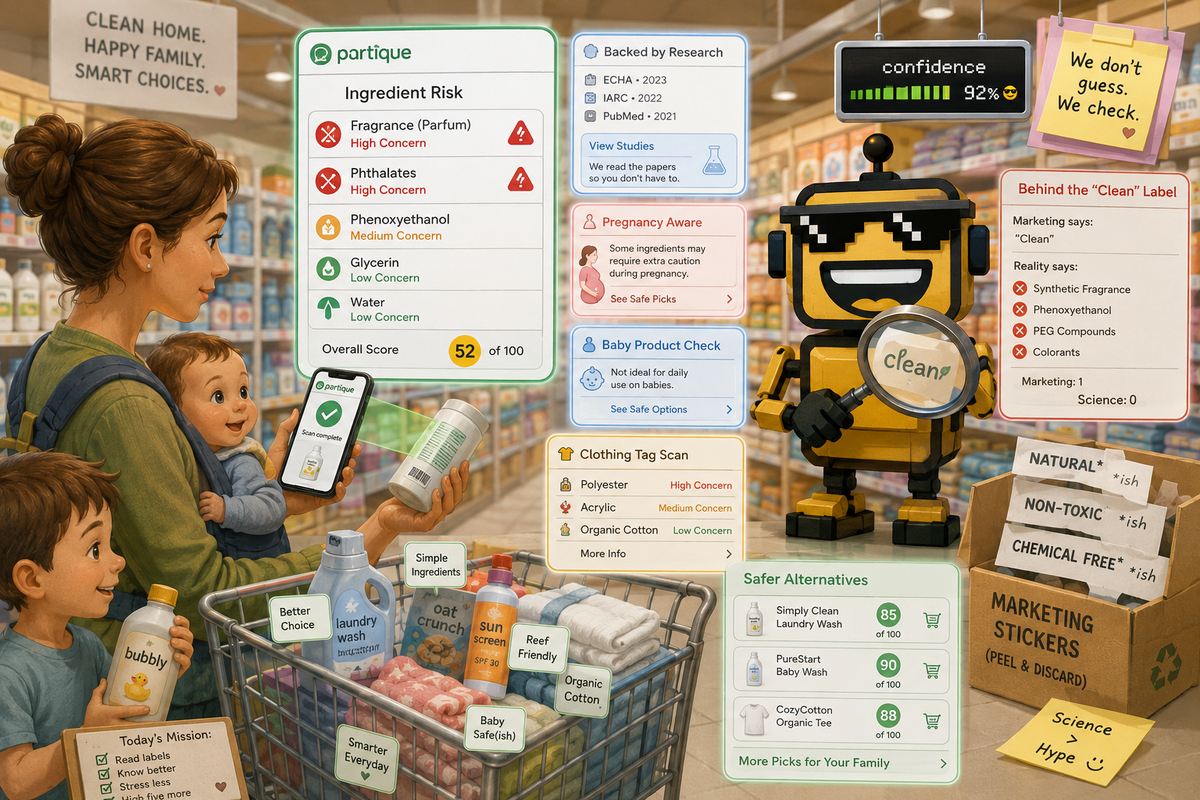
The Reddit founder series has now reached the grocery aisle, the baby aisle, the clothing tag, the home-goods label, and the exact moment where a tired parent is holding a bottle of something marketed as "gentle" while wondering whether the ingredient list was written by a chemist, a marketer, or a committee trying to make anxiety downloadable.
The product is Partiqule, an ingredient and risk scanner for food, clothing, home goods, personal care, baby products, and more. The founders, a husband-and-wife team, describe the current product as targeted especially at parents and pregnant women, with a roadmap toward a full shopping intelligence platform for families.
That is a strong direction because family shopping is increasingly absurd. A normal person trying to buy a snack, detergent, lotion, baby bottle, couch cushion, or "non-toxic" pan now has to interpret claims around BPA, PFAS, microplastics, fragrances, dyes, preservatives, sustainability, packaging, allergens, endocrine disruption, ultra-processing, and whatever "clean" means this week. Retail packaging has become a confidence performance. Partiqule wants to be the sober friend standing nearby with research notes and a camera scanner.
Parents do not need more panic. They need faster context.
The best version of this category is not fear-as-a-service. Nobody needs an app that turns every supermarket trip into a courtroom drama about crackers. Parents and pregnant people already have enough ambient advice circling them at all times, much of it contradictory, much of it delivered with the emotional warmth of a warning label.
The useful job is different: reduce uncertainty without pretending to remove it. Partiqule's public site says it lets users scan any product to understand risks for health, home, and planet, with scoring across materials, exposure, packaging, sustainability, and manufacturing. The App Store listing is more specific: Partiqule scores products from 1 to 10, supports food, personal care, baby products, home goods, and clothing, and breaks down flagged substances by severity, including high, medium, and low concern. It also says no brand can pay to change a score, no advertising, and no sponsored results.
That no-sponsored-results posture matters. A family shopping intelligence product cannot become useful if its answer is quietly for sale. If the premise is "what is actually in this," then trust is the product, not a nice decorative throw pillow for the About page.
This fits the consumer transparency lane we keep coming back to
Partiqule sits naturally beside CouponPicked, one of the stronger recent entries in the Reddit series. CouponPicked was about price transparency: is this sale real, or did the retailer just dress up a worse price in a red sticker? Partiqule is about product transparency: is this "natural" or "safe" claim meaningful, or is the label doing interpretive dance around the ingredient list?
Both products are consumer tools pointed at the same cultural exhaustion. Shoppers are not short on options. They are short on trustworthy interpretation. The modern retail shelf is a swarm of claims: clean, plant-based, hypoallergenic, baby-safe, eco-friendly, dermatologist-tested, non-toxic, sustainable, ultra-soft, parent-approved, and whatever else survived legal review. A scanner that can translate those claims into actual substance-level context has obvious value.
It also connects to our larger AI shopping agents guide. Everyone wants AI to buy things for us, compare things for us, and recommend things at the moment of purchase. But if the underlying product data is weak, the agent becomes a very confident assistant to confusion. Partiqule's long-term family-shopping-intelligence roadmap is interesting because it starts with the ingredient/risk layer. Before an AI can recommend better, it has to know what "better" means for this family, in this context, with these constraints.
The App Store details suggest a fast-moving early product
Partiqule is live on the App Store under Paul Christian Miller, category Health and Fitness, with in-app purchases and version 1.4 already out as of May 24, 2026. Recent notes mention reliability fixes, better skeleton loading states, hardened substance matching to prevent false-positive ingredient claims, and photo-first scanning that reads actual ingredients from labels. The release notes also include a line I liked: when the app does not have the full ingredient list, it says so instead of pretending.
That kind of humility is not glamorous, but it is vital. Ingredient scanning products can go wrong in two ways. They can fail to read the label, which is annoying. Or they can pretend they read the label and confidently flag something that was not there, which is worse. In a pregnancy or child-safety context, false confidence is not just a UX bug. It can produce real anxiety or bad decisions.
So I like seeing "hardened false-positive prevention" show up in the release history. That sounds like a team learning from the messy reality of labels, lighting, packaging, OCR, product databases, and all the little ways real-world scanning enjoys making software look naive.
The scoring layer is where the product either earns trust or loses it
Partiqule says every score runs two independent research passes grounded in peer-reviewed science from publications such as NEJM, Nature Medicine, and The Lancet. It also says scans show flagged substances with research behind each flag, while the website describes AI-powered health scoring across exposure, packaging, materials, sustainability, and manufacturing.
That is exactly the right ambition and exactly the place where the product has to stay careful. Ingredient science is complicated. Dose matters. Exposure route matters. Frequency matters. Pregnancy changes the risk model. Kids are not just smaller adults. Food, cosmetics, textiles, baby products, and cleaning supplies have different regulatory and toxicological contexts. Even a perfectly identified ingredient can be hard to score fairly without overcompressing uncertainty into a single number.
This is why Partiqule's family-shopping roadmap is interesting but delicate. A 1-to-10 score is useful because busy humans need compression. It is risky because compression can hide nuance. The best version of the app pairs the simple score with clear explanations, source links, confidence levels, and a plain statement of what the score does and does not mean. Tell the user enough to act, not enough to spiral.
Family shopping intelligence is a better ambition than "ingredient scanner"
Ingredient scanner is the entry point. Family shopping intelligence is the bigger idea. That distinction matters because families do not only ask, "Is this ingredient bad?" They ask, "Is this worth avoiding for us?" "Is there a safer alternative?" "Is the risk meaningful or theoretical?" "Does this conflict with a pregnancy concern, allergy, sensitivity, sustainability preference, budget, or house rule?" "Is this brand marketing to me with fog machine language?"
That is where Partiqule could become more than a label decoder. It could become a decision layer: family profiles, pregnancy-aware filters, child age ranges, allergen preferences, textile and home-material risks, product swaps, household history, retailer availability, price context, and maybe even the kind of transparency receipts we praised in CouponPicked. The family shopping stack is not just nutrition. It is health, budget, logistics, values, and the daily math of "can I make this decision in eight seconds while someone needs a snack?"
This is also why Partiqule belongs in the same family as SafeCircle, even though the domains are different. SafeCircle is about protecting kids online without turning privacy into collateral damage. Partiqule is about protecting families in the marketplace without turning shopping into paranoia. Different surfaces, same underlying challenge: give people safety context without making the tool itself a new anxiety machine.
One gentle critique: make methodology impossible to miss
My main critique is a friendly but important one: Partiqule should make its scoring methodology extremely visible. Not buried. Not implied. Not "science-backed" as a vibe. Show how severity is defined, how conflicting evidence is handled, how pregnancy-specific flags are separated from general-population concerns, how exposure and dose are modeled, how substances are matched, how often the corpus updates, and what confidence level the app has in each scan.
That would not make the product feel less approachable. It would make it more trustworthy. A parent scanning a baby product does not need a literature review before checkout, but they do need to know whether the app is saying "avoid," "consider," "low concern," or "we are uncertain because the label is incomplete." The difference between those states is the difference between clarity and stress with better typography.
Partiqule already seems aware of this. The App Store notes about honest best guesses and false-positive hardening are good signs. The next step is making that scientific humility part of the brand.
Verdict: early, useful, and aimed at a very real family problem
My verdict is positive: Partiqule is early, but it is pointed at a problem that is only getting louder. Families are drowning in product claims, fragmented ingredient information, wellness marketing, and safety uncertainty. A scanner that can translate labels into clear, source-backed risk context across food, personal care, baby products, home goods, and clothing is a useful idea.
The challenge is to be calm. This category can easily slide into alarmism, and alarmism converts well right up until it makes users miserable. Partiqule should resist that. The product will be strongest if it is precise, transparent, and practical: here is what we found, here is why it matters, here is how confident we are, here are alternatives if you care, and here is where you should talk to a medical professional instead of outsourcing pregnancy decisions to a score.
That is not a smaller ambition. It is the better ambition. A family shopping intelligence platform should not make parents feel like every purchase is a moral exam. It should help them make faster, more informed choices with less noise.
If Partiqule can keep building in that direction, it could become a genuinely helpful layer between families and the increasingly theatrical world of product marketing. The packaging can say whatever it wants. The scanner should bring receipts.