Deep Dive: Open-Weight AI, From Checkpoints to China
How open-weight AI evolved from academic checkpoints into today’s fight over competition, safety, China, distillation, and American power.

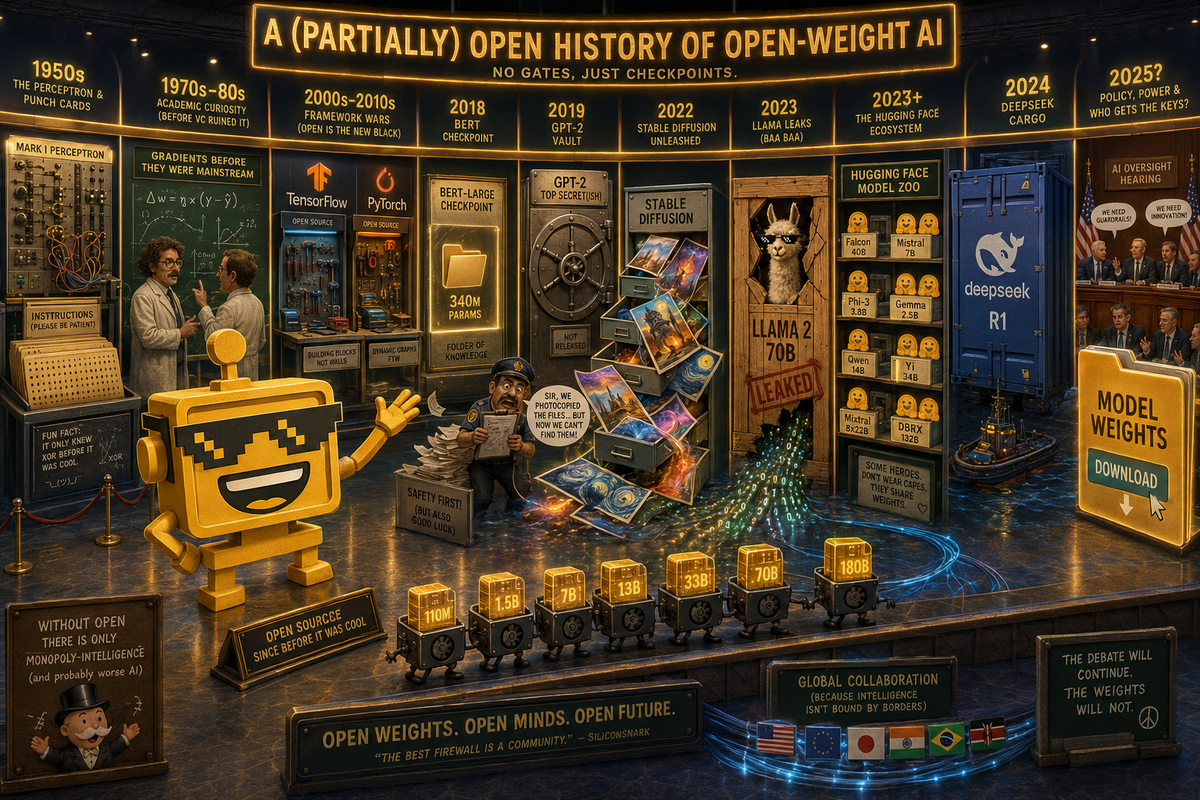
On Friday, July 24, a substantial portion of the technology industry informed Washington that a pile of numbers had become a matter of national importance.
The three-page letter, titled “Open Weights and American AI Leadership”, argues that downloadable AI models expand access, increase competition, reduce vendor lock-in, strengthen cyber defense, and give companies and countries more control over their technology. Its current roster contains 35 organizations, including NVIDIA, Microsoft, Meta, OpenAI, IBM, Cisco, Dell, GitHub, Hugging Face, Mistral, Mozilla, Palantir, CrowdStrike, Perplexity, Andreessen Horowitz, and Y Combinator.
This is a gloriously broad coalition. Chipmakers, cloud platforms, model developers, security firms, enterprise vendors, investors, and one foundation responsible for keeping Linux from turning into a corporate timeshare have agreed on something. That something is: please do not make it harder for people to download artificial intelligence.
The timing is not subtle. American officials are debating what to do about powerful Chinese models, whether Chinese labs improperly extracted capabilities from American systems through distillation, and whether restrictions aimed at foreign competitors would kneecap the domestic open-model economy. The letter never says “China.” It does not need to. Neither does a smoke alarm say “your toaster is on fire.”
But the argument did not begin with DeepSeek, Moonshot, Llama, or Jensen Huang’s social-media account. It began with the central trick of machine learning: instead of a programmer writing every rule, a system adjusts numerical parameters until it becomes useful. Those parameters are weights. Once training became vastly more expensive than copying, the trained weights became a new kind of industrial asset: part software, part dataset residue, part manufacturing output, part trade secret, and part extremely large file that someone will inevitably upload somewhere.
This is the history of how that file became a platform, a culture, a business model, a safety problem, and now an instrument of state power. The plumbing is the point. The plumbing has also hired lobbyists.
First, What Exactly Is an AI Weight?
A neural network is arranged in layers of mathematical operations. Inputs move through those layers; numerical values determine how strongly different signals affect what happens next. Those values are the weights. During training, the system repeatedly changes them to reduce error. In the influential 1986 paper “Learning representations by back-propagating errors,” David Rumelhart, Geoffrey Hinton, and Ronald Williams described a procedure that repeatedly adjusts network weights so internal units learn useful features.
The idea is easier to understand with an offensively simplified example. Suppose a tiny system is deciding whether an image contains a cat. One signal detects edges, another textures, another shapes. Training gradually adjusts the importance of those signals. No single weight means “whisker.” The behavior lives in the interaction among many weights, spread throughout the network like corporate responsibility after an earnings miss.
Modern language models use billions or trillions of parameters. The values are stored in checkpoint files alongside information describing the model’s architecture and configuration. Load the architecture, place the learned values into it, add a tokenizer and inference software, and the trained behavior can run on another machine without repeating the original training process.
That last clause is the entire economic story. Training can require giant datasets, specialized expertise, thousands of accelerators, enormous power consumption, and a budget that arrives wearing private-equity cuff links. Copying the resulting checkpoint costs storage and bandwidth. Running it may still be expensive, but it is generally much cheaper than recreating it. Open weights separate the expensive act of producing intelligence from the cheaper act of possessing and deploying a copy.
They do not reveal everything. A checkpoint does not automatically disclose the training dataset, the data-cleaning pipeline, the sequence of experiments, the human-feedback process, the failed runs, or the institutional knowledge that made training succeed. Looking at billions of floating-point values is not the neural-network equivalent of opening a cookbook. It is closer to receiving a fully baked cake, a list of chemical measurements from the cake, and permission to install the cake in a server rack.
Still, the weights let you do meaningful things that an API does not. You can run the model without asking its creator. You can inspect its internal activations, fine-tune it, compress it, change its behavior, deploy it offline, wrap it in your own controls, or remove controls supplied by the original developer. That combination of autonomy and irreversibility is why the same file looks like freedom to one policy shop and an unrecallable capability release to another.
For Decades, Sharing Was Just How Research Worked
Early neural-network research did not have today’s clean split between frontier labs and everyone renting tokens from them. Researchers published algorithms, architectures, and experimental results. They exchanged code when code was available and models when models were small enough to move without a cloud contract. The scientific product was usually the method and paper, not a universally useful pretrained system.
That changed as neural networks grew more effective and training became more computationally demanding. AlexNet’s 2012 ImageNet result helped establish deep neural networks as the practical future of computer vision. Its five convolutional and three fully connected layers now look quaint beside modern foundation models, but the important pattern had arrived: large datasets plus accelerators plus learned representations could produce a reusable system that was expensive to train and valuable to transfer.
Then the infrastructure became communal. Google released TensorFlow under Apache 2.0 in November 2015. Meta launched PyTorch in 2017. These frameworks made model construction, training, checkpointing, and reuse dramatically more accessible. Open-source software did not make training free, but it standardized the machinery. Researchers could implement papers, exchange models, and reproduce experiments without first building an entire numerical-computing religion.
The next decisive move was pretraining. Rather than training a model for one narrow task, a developer could train a general representation on a broad dataset and let many other people adapt it. Google’s 2018 release of BERT included pretrained models and the code to run pretraining. Google correctly expected that most researchers would use the pretrained checkpoints instead of recreating them from scratch.
That was a quiet revolution in the unit of collaboration. The research community no longer shared only instructions for building a machine. It increasingly shared trained capability. A checkpoint became a foundation on which thousands of downstream experiments could stand. The value was not merely in knowing the architecture; it was in avoiding the original training bill.
The 2017 Transformer paper, “Attention Is All You Need,” supplied the architecture that would dominate language modeling. BERT demonstrated the distribution model. The combination created a new bargain: a well-funded organization could perform expensive pretraining once, then allow a much larger community to reuse the result. The community got capability. The originating lab got citations, standards influence, developer loyalty, recruitment value, and a delightful quantity of downstream debugging performed by strangers.
Open weights were not yet a political movement. They were becoming a research substrate. That distinction lasted roughly until the models learned to write convincing paragraphs.
GPT-2 Turned a Checkpoint Into a Release Decision
In February 2019, OpenAI announced GPT-2 and withheld the largest version. The company worried that fluent text generation could be used for fake news, impersonation, spam, and other abuse. Instead of releasing every checkpoint immediately, it staged access: a 124-million-parameter model first, then 355 million, then 774 million, while studying use and misuse.
In November, OpenAI released the complete 1.5-billion-parameter GPT-2, including code and weights. It said the nine-month process had produced useful evidence for responsible publication norms. Today, GPT-2 is small enough to seem like a chatbot somebody left in the dryer. At the time, the episode established the question that still governs the field: when does publishing a trained model stop being ordinary scientific disclosure and become distribution of a dual-use capability?
Staged release offered a compromise. A developer could begin with smaller systems or trusted researchers, observe the consequences, and expand access. It treated openness as a controlled process rather than a light switch. The approach also contained a structural problem: withholding works only while the developer controls every copy. Once the full weights are available, the stage has ended forever.
GPT-2 also exposed the asymmetry between a model’s safeguards and its weights. A hosted service can refuse requests, detect suspicious patterns, suspend accounts, patch behavior, and preserve logs. A downloaded model can be modified by its owner. The provider may attach a license or acceptable-use policy, but it cannot push a behavioral update into a machine it does not control. The user did not subscribe to intelligence. The user acquired it.
For several years, the biggest commercial language models moved in the opposite direction. GPT-3 appeared primarily through an API. ChatGPT made hosted access the mass-market default. Anthropic built Claude as a controlled service. Google did the same with its leading systems. Frontier AI started looking like cloud computing: capability lived inside giant providers, and everybody else received metered access through an interface.
There were good technical reasons. The models were enormous, serving them was hard, and product teams could improve the experience around them. There were also excellent commercial reasons. API control turns intelligence into recurring revenue. It preserves usage data, customer relationships, moderation power, and the sacred enterprise right to alter pricing later.
But closing the frontier did not extinguish demand for downloadable systems. It gave that demand an enemy, a mythology, and a Discord server.
EleutherAI Built the Counterculture a Model
When GPT-3 demonstrated what scaling could do without making its weights generally available, independent researchers began recreating the missing layer. EleutherAI, a volunteer research collective, assembled open datasets and trained GPT-style models. Its work helped turn open language modeling from a company’s occasional gift into an organized community project.
GPT-NeoX-20B was especially important. The project’s 2022 paper said it was releasing the training and evaluation code as well as the model weights. Twenty billion parameters did not match the largest proprietary systems, but that was not the only point. Researchers could examine the stack, run the model, fine-tune it, and build tools without waiting for a commercial lab’s product roadmap.
This era also produced the cultural infrastructure of open models: shared evaluation harnesses, community datasets, fine-tunes, quantized variants, deployment recipes, and online groups dedicated to making inconveniently large matrices work on hardware purchased for video games. The model was only the beginning. A usable ecosystem required hundreds of people to convert formats, repair tokenizers, document architectures, optimize kernels, test benchmarks, and patiently explain that no, your laptop with eight gigabytes of memory cannot run the 70-billion-parameter model merely because the download button is visible.
Hugging Face turned that activity into a distribution layer. Its Model Hub hosts checkpoints in versioned repositories and integrates with libraries capable of loading them directly. A developer can now call a pretrained model by name, download the relevant files, and start adapting it. The company’s documentation currently describes the Hub as storage, discovery, and sharing for model checkpoints. This sounds mundane until you realize that GitHub-like distribution for trained intelligence is one of the enabling institutions of the present AI economy.
Model cards emerged to add something resembling a nutrition label. The 2019 model-card proposal recommended documenting intended uses, performance characteristics, limitations, and evaluation context. In practice, cards range from serious technical disclosures to three cheerful paragraphs and a benchmark table that has been exfoliated of every inconvenient result. Still, the norm matters: releasing weights without explaining them began to look incomplete.
The open-model movement was now more than source code. It was a supply chain for reusable capability. Then image generation showed what happens when that supply chain reaches consumers.
Stable Diffusion Was the “Oh, You Mean Anyone” Moment
On August 22, 2022, Stability AI publicly released Stable Diffusion. The weights could run on consumer hardware, the code was available, and the license allowed commercial and noncommercial use subject to restrictions. The company described the release as a single file compressing visual information into a few gigabytes. It also included a safety classifier whose settings users could adjust, which was a wonderfully concise preview of the governance challenge.
Stable Diffusion did not merely provide another image generator. It changed where image generation could happen. DALL-E and Midjourney were services. Stable Diffusion became material. Developers embedded it in applications, artists trained specialized variants, hobbyists constructed elaborate interfaces, and communities produced models for styles and subjects the original developer had not anticipated, approved, or in many cases wished to discuss with counsel.
SiliconSnark’s retrospective on the image-generation boom called it the moment generative AI spilled into the public domain. More precisely, it escaped centralized product control. The original weights could be copied, remixed, fine-tuned, and redistributed. Safety filters attached at the interface were optional. New controls could be created; old controls could be removed.
The consequences demonstrated both sides of the open-weight argument at once. Stable Diffusion accelerated research, creative tooling, accessibility, and startup formation. It also made nonconsensual sexual imagery, impersonation, copyright conflict, and provenance problems much harder to manage through one provider. When a hosted image service changes its rules, users experience a policy update. When an open checkpoint is modified by ten thousand people, “the policy” becomes a folder containing several incompatible licenses and a README written at 2:13 a.m.
This was not unique to images. It was the template for general-purpose AI. A capable downloadable model generates an ecosystem faster than its creator can govern it. The ecosystem makes the model more useful, cheaper, more portable, and more difficult to contain. That is not a side effect. That is what openness does.
Llama Escaped, Then Meta Made Escape the Strategy
Meta announced the original LLaMA in February 2023 as a research release. It offered models from 7 billion to 65 billion parameters under a noncommercial license, granting access case by case. Meta’s stated argument was that smaller, strong models would let researchers without frontier infrastructure study language systems, investigate bias and toxicity, and test new methods.
The weights leaked within days.
That event compressed the entire open-weight debate into one farcical sequence. A major company attempted controlled research access. A downloadable copy became publicly available anyway. Developers rapidly converted, quantized, fine-tuned, and redistributed it. The useful question stopped being whether the weights should be widely available and became what everyone would build now that they were.
The release of llama.cpp made the shift tangible. Its goal is high-performance language-model inference across a wide range of local hardware, including Apple silicon, x86 CPUs, GPUs, and hybrid systems. Quantization support reduced memory requirements by storing approximate weight values at lower precision. In plain English: developers found increasingly clever ways to squeeze a model built for data-center hardware into ordinary machines, accepting manageable quality trade-offs in exchange for not needing a purchase order.
In July 2023, Meta and Microsoft released Llama 2 for research and commercial use, with weights and starting code. Meta presented the availability of pretrained and chat-tuned checkpoints as an open innovation strategy. The license was not conventional open source—it included conditions and restrictions—but the distribution was broad enough to support products, hosting services, tools, and a wave of derivative models.
Two months later, Mistral released Mistral 7B under Apache 2.0. It was compact, capable for its size, easy to fine-tune, and usable without field-of-use restrictions. Mistral proved that an ambitious startup could use open weights as a market-entry strategy: give developers a strong foundation, build adoption, then sell premium models, hosting, enterprise services, and the reassuring presence of someone who will answer procurement email.
The open model was no longer the free sample sitting sadly beside the frontier product. It was the distribution engine.
LoRA, QLoRA, and the Joy of Modifying Only the Cheap Bits
Downloading a model is useful. Adapting it is transformative. Traditional fine-tuning updates many or all of a model’s parameters, which becomes expensive at large scale. Low-Rank Adaptation, introduced in 2021, freezes the original weights and trains much smaller matrices that alter the model’s behavior. The LoRA paper reported enormous reductions in trainable parameters and memory requirements compared with full fine-tuning.
Then QLoRA combined low-rank adapters with a four-bit quantized base model. Its authors demonstrated fine-tuning a 65-billion-parameter model on one 48-gigabyte GPU. The exact hardware remains outside the “found under a sofa cushion” price bracket, but the direction was unmistakable. Model adaptation was moving from the exclusive domain of giant labs toward startups, universities, specialist teams, and determined people with unusually understanding electricity providers.
This changed what weights meant commercially. A downloadable base model could become a legal assistant, medical research tool, coding model, role-playing character, customer-service agent, or local-language system without retraining from zero. Organizations could keep sensitive data inside their infrastructure. Governments could deploy models in disconnected environments. Manufacturers could place specialized systems near equipment. Consumers could run smaller assistants locally.
Our look at Microsoft and Mistral’s sovereign deployment push describes why location and control now matter as much as benchmark intelligence. A model that can run in a French data center or an air-gapped industrial network is not merely an alternative chatbot. It is infrastructure that can survive a policy change, network failure, contract dispute, or diplomatic tantrum.
Open weights also created a hardware flywheel. Every model release generated demand for GPUs, accelerators, memory, storage, networking, optimized runtimes, and cloud capacity. This explains why NVIDIA can sincerely support open models while operating the world’s most profitable shovel counter. SiliconSnark’s deep dive on the AI accelerator market explains the underlying incentive: inference is the recurring workload, and open models create more places for inference to happen.
An open model may be free to download. Running it is not free. The word “open” has never caused a GPU to stop invoicing.
Open Weight Is Not the Same Thing as Open Source
The industry often uses “open,” “open source,” and “open weight” as if they are three interchangeable hats placed on the same robot. They are not.
Open weight generally means the trained parameters are available for download. Depending on the release, users may also receive inference code, architecture details, a tokenizer, evaluation results, and a license permitting modification and redistribution. They may not receive the original training data, data-cleaning code, training code, human-feedback data, complete evaluation suite, intermediate checkpoints, or enough information to reproduce the model.
The Open Source Initiative’s Open Source AI Definition 1.0 sets a higher bar. An open-source AI system should grant freedom to use, study, modify, and share it. The preferred form for modification includes detailed data information, complete training and inference code, and model parameters under appropriate terms. Under that definition, many systems marketed as open source are more accurately open weight.
The distinction is not pedantry, although it does provide the open-source community with a renewable supply of arguments, which should not be discounted. It determines what users can know and reproduce.
Weights let researchers study a model’s behavior and internal representations. They do not fully explain why the model became what it is. Without training data and pipeline details, independent teams cannot audit provenance completely or rebuild a substantially equivalent system. Without permissive licensing, access may depend on who you are, how large your product becomes, or whether your intended use offends a clause written by a committee.
Allen Institute for AI’s OLMo project illustrates fuller openness. Its 2024 release included weights, training and inference code, logs, and metrics, supporting research into the process rather than only the artifact. That is closer to an open scientific stack. It is also much harder to provide, because frontier training data is tangled with licensing, privacy, competitive secrecy, and the uncomfortable fact that “we trained on the internet” becomes less charming when converted into an itemized manifest.
Words matter most when policy attaches to them. An exemption for “open source” can become an incentive to slap the label on a weight release. A restriction on “open models” can accidentally reach fully reproducible research projects, community fine-tunes, and commercial checkpoints with completely different risk profiles. The vocabulary is messy because the object is genuinely new: learned parameters do not map neatly onto the source-code binaries distinction that governed software.
DeepSeek Turned Openness Into Geopolitical Distribution
By 2024, Meta’s Llama family, Mistral’s models, Google’s smaller Gemma releases, Alibaba’s Qwen ecosystem, and research projects such as OLMo had established a competitive open-model layer. Then DeepSeek changed the emotional temperature.
If the names have already begun to look like a convention of mascots competing for venture funding, SiliconSnark’s field guide to GPTs, Claude, Gemini, Grok, Qwen, Mistral, and friends maps the current families. The relevant point here is that open weights stopped being a niche release choice and became one of the main axes along which model companies compete.
DeepSeek-V3 paired a huge mixture-of-experts architecture with public weights and aggressive efficiency claims. DeepSeek-R1 followed in January 2025, offering reasoning models and distilled variants under permissive terms. The project’s repository says its code and primary model weights are available under the MIT License and explicitly permits modification, derivative works, and distillation.
The important result was not that every claim survived every benchmark argument. It was that a Chinese lab could release a highly capable model into global infrastructure faster than governments could decide how worried to be. American developers could download it. Cloud platforms could host it. Researchers could study it. Startups could build on it. The normal tools of platform control—account bans, API restrictions, price changes, geographic blocks—became less effective after the weights propagated.
Open weights became a form of export. A country did not need every foreign user to adopt its cloud, sign its contract, or send it data. It could release a model and let global hardware vendors, repositories, and developers distribute the capability. OpenAI later used similar geopolitical language when it released gpt-oss in August 2025, describing open American models as “democratic AI rails” for governments and institutions seeking local control.
This is why arguments over open models now sound like arguments over telecommunications standards, operating systems, and payment networks. The winner is not necessarily the company with the single smartest model. It may be the ecosystem whose models are easiest to adopt, cheapest to run, safest to trust, simplest to customize, and hardest to remove.
SiliconSnark’s coverage of DeepSeek’s latest model economics captured the commercial paradox: extremely inexpensive capability can support an extraordinarily valuable strategic position. Open distribution sacrifices some direct model rent in exchange for adoption, influence, complements, and market pressure on closed competitors.
China did not invent that playbook. Android, Linux, Chromium, Kubernetes, and countless libraries already demonstrated how open technology can shape markets. AI adds one destabilizing feature: the distributed artifact does not merely execute rules. It contains learned capability that can be adapted, distilled, and used to produce the next generation.
Distillation Is Where Everyone Suddenly Discovers Property Rights
Distillation trains a “student” model using signals from a stronger “teacher.” The student may learn from probability distributions, generated examples, explanations, or other outputs. The technique can compress capability into a smaller model, specialize it, or transfer useful behavior without repeating the teacher’s full original training process.
Distillation is standard machine learning. It is also now the center of a trade dispute wearing a lab coat.
American AI companies argue that foreign developers have used covert, large-scale extraction—sometimes involving fraudulent accounts or violations of service terms—to reproduce proprietary capabilities. Chinese-model advocates note that leading American systems were themselves trained on enormous quantities of human-created material whose owners rarely negotiated individual licenses. Both statements can be true. Hypocrisy is not a legal defense, but it remains one of Silicon Valley’s most abundant natural resources.
SiliconSnark previously covered the dispute when OpenAI, Anthropic, and Google coordinated against adversarial distillation. The hard policy question is how to distinguish ordinary learning from unlawful extraction without declaring a foundational research technique suspicious by default.
Friday’s open-weights letter draws exactly that line. It says policymakers should not conflate legitimate model-development techniques with misappropriation. Distillation used for model improvement, evaluation, and validation should remain available; unlawful extraction from closed models should be handled with targeted legal and commercial tools.
That sounds sensible until enforcement begins. A distilled model does not arrive with a notarized family tree. Outputs can be collected through authorized accounts, unauthorized accounts, public interfaces, third-party datasets, synthetic-data vendors, or mixtures of all four. Behavioral similarity does not automatically prove how training occurred. A rule broad enough to stop determined extraction could also chill benchmarking, interoperability, research, and perfectly ordinary synthetic-data generation.
The argument is also economically loaded. A closed lab wants to prevent competitors from converting its expensive hosted capability into a cheaper independent product. An open-model company wants access to techniques that improve its releases. A cloud vendor wants many models available. A chipmaker wants all of them to run somewhere. A policymaker wants American leadership, safety, low prices, strong competition, enforceable intellectual-property rules, and an advantage over China, ideally without choosing which objective loses.
This is the part of the meeting where the slide says “balanced framework” and everyone quietly reaches for a different balance.
The Safety Argument Has Two Correct Halves That Refuse to Date
The case for open weights as a safety tool is real. Independent researchers can test models without depending on a provider’s interface or permission. They can inspect activations, reproduce evaluations, search for bias, investigate jailbreaks, develop interpretability methods, build defensive cyber tools, and compare mitigations. A broad research community can find problems the original developer missed or preferred to describe as a future workstream.
Open models also reduce single points of failure. A vulnerability, outage, policy change, or commercial collapse at one provider does not disable every downstream user. Organizations can place their own monitoring and access controls around a model. They can run it in environments where sensitive data cannot be sent to an external API. They can retain evidence, conduct audits, and choose when to upgrade.
The case against unrestricted release is equally real. Once weights are public, every copy cannot be recalled. Safety tuning can be removed. A model can be fine-tuned for malicious tasks. Usage cannot be comprehensively monitored. A mistake discovered on Monday may remain embedded in thousands of systems long after the original developer patches its official version.
The 2026 International AI Safety Report summarizes the trade-off cleanly: open weights facilitate research and innovation, but their safeguards are easier to remove, monitoring is harder, and releases are irreversible. It recommends thinking in terms of marginal risk—how much additional harm a release enables compared with closed models, existing open models, conventional software, search engines, and other available tools.
Marginal risk is a better framework than declaring open or closed models inherently safe. A weak downloadable model may add little dangerous capability. A frontier biological-design system might add a great deal. A closed API with inadequate safeguards can still cause harm at global scale. An open cyber model may help attackers and defenders simultaneously. The relevant variables include capability, ease of misuse, available substitutes, discoverability, deployment scale, and whether defensive benefits arrive before offensive ones.
The difficulty is timing. Regulators want evidence before restricting a release. The strongest evidence may appear only after release. By then, the weights cannot be recovered. This is less like approving an app update and more like deciding whether to publish the plans for a machine that may turn out to be either an excellent fire extinguisher or a remarkably ergonomic flamethrower.
Open-source agent infrastructure adds another layer. As SiliconSnark’s OpenClaw deep dive explains, a model becomes more consequential when connected to tools, credentials, persistent memory, and real-world actions. Model access is only one part of system risk. A modest model with powerful permissions may be more dangerous than a stronger model confined to a chat window. Regulating the checkpoint without examining the deployment can produce the comforting sensation of safety paperwork while the agent is in another room using your browser.
The Business Case Is Less Philosophical and More Invoice-Shaped
The open-weights letter presents broad social benefits, but its signatories also have coherent commercial interests. That is not an accusation. It is how coalitions achieve catering.
NVIDIA benefits when more organizations run more models on more hardware. Dell and Cisco sell the systems and networking. Microsoft can host open models in Azure, distribute them through Foundry, integrate them into enterprise tooling, and still sell closed-model access. Hugging Face operates the distribution and collaboration layer. Security vendors can build defenses around locally deployed models. Enterprises such as Box and ServiceNow gain supplier choice. Venture firms benefit when startups can build without sending a margin payment to a frontier provider for every inference.
Meta’s incentive is especially elegant. It does not need to monetize Llama the way OpenAI monetizes an API. Meta earns money from applications and advertising. Making capable models abundant can reduce competitors’ ability to charge scarcity rents while attracting researchers and infrastructure partners to Meta’s technical standard. Openness becomes both ecosystem development and strategic price pressure.
Mistral uses openness to build relevance and sells higher-end capability, deployment, and enterprise relationships around it. Microsoft’s growing Mistral partnership shows how sovereignty can become a premium product even when the foundational technology is broadly available. Our earlier piece about Mistral financing European infrastructure with American GPUs captures the reality: open weights reduce one dependency while creating several exciting new dependencies with cooling requirements.
Closed providers have valid reasons to retain control, including safety, product quality, intellectual property, and reliability. They also receive concentrated revenue and market power. Scrutiny of open models may be necessary at some capability levels. It may also entrench incumbents by raising compliance costs for challengers and steering customers toward metered services.
The choice is not simply free model versus paid model. Open deployments shift costs. Customers acquire hardware, hosting, energy, orchestration, security, evaluations, updates, and people who know why the tokenizer has begun producing seventeen consecutive brackets. APIs bundle much of that operational labor into a price. Open weights let organizations own the stack, including the parts of ownership that call during dinner.
That is why the strongest enterprise argument is control, not free access. A downloadable model gives a buyer bargaining power and deployment flexibility. Even if the buyer ultimately uses a managed service, the possibility of moving elsewhere changes the relationship. Portability is leverage.
Regulators Are Trying to Govern a Spectrum With a Checkbox
Policy has begun moving away from a binary open-versus-closed debate. The European Union’s AI Act gives some exemptions to general-purpose models released under genuinely free and open-source licenses when weights, architecture information, and usage information are public. But the exemption does not remove obligations for models classified as posing systemic risk. The European Commission’s guidance says those providers still face model evaluation, incident reporting, risk mitigation, and cybersecurity requirements.
That structure recognizes two things at once: openness can support innovation and transparency, and sufficiently capable models can create obligations regardless of their license. It is not perfect. Compute thresholds age badly, capability measurement is difficult, and a model can become more dangerous when combined with tools or fine-tuning. Still, it is closer to the actual problem than treating every checkpoint as identical.
In the United States, the 2024 NTIA report concluded that evidence at the time did not justify broad restrictions on widely available model weights, while recommending monitoring, evaluations, transparency, and readiness to act if risks increased. The Trump administration’s July 2025 AI Action Plan went further, explicitly encouraging open-source and open-weight AI, expanding research access to compute, and promoting adoption by smaller businesses.
The latest dispute complicates that posture. Washington wants American models to spread, American intellectual property protected, Chinese capability constrained, competition preserved, and cyber defenders equipped. A broad ban on Chinese downloadable models might be difficult to enforce once files have circulated. A ban on American open releases could concede the global ecosystem to foreign developers. Sanctions aimed at covert distillation may be more targeted, but proof and scope remain difficult.
The answer is likely a layered release framework, whether policymakers call it that or invent a name involving “responsible acceleration.” Small and moderately capable models receive broad freedom. More capable models undergo rigorous pre-release evaluation in cyber, biological, autonomy, and other high-consequence domains. Developers publish detailed model cards and training-content summaries. Distribution platforms support provenance, signatures, malware scanning, and versioning. Liability attaches to harmful conduct and negligent deployment, not merely to the existence of modifiable weights. Truly frontier releases face additional scrutiny when evidence shows they create material new capability for severe harm.
Even then, enforcement will be awkward. Code crosses borders. Weights can be copied. Fine-tunes blur lineage. A model that is ordinary today may become powerful inside a better agent harness tomorrow. Regulation will need to govern developers, distributors, deployers, hardware access, and conduct without assuming any single layer contains the entire risk.
There will be forms. The forms will ask for parameter counts. Someone will confidently enter the active parameter count where the total should go. Civilization will continue.
Friday’s Letter Is Really a Demand to Preserve the Default
The open-weights letter is persuasive where it is most concrete. Downloadable models do expand competition. They do let customers control deployment and data. They do support research that closed interfaces make difficult. They do create alternatives to a small group of providers. They do have geopolitical value in a world where countries want AI capacity without permanently renting a foreign company’s judgment.
The letter is thinner where the hard safety thresholds should be. It acknowledges that released weights cannot be recalled and that modified versions are difficult to trace. It argues against prohibition and favors evidence-based protections tied to demonstrated harms. It does not explain which pre-release tests should apply to highly capable cyber or biological models, when distribution should be delayed, or what happens when the evidence is alarming but not conclusive.
That omission is understandable in an advocacy letter. A coalition containing model companies, cloud vendors, chipmakers, venture capitalists, and security firms is more likely to agree that openness is valuable than to agree on the exact benchmark score at which the government should become nervous.
Its most important policy demand is therefore implicit: keep open release legal and normal unless a regulator can identify a specific, material risk that justifies intervention. Do not assume closed systems are safe by default. Do not convert allegations of extraction into a prohibition on distillation. Do not let a fight with Chinese labs become a moat around American incumbents. Invest in compute, shared datasets, evaluation tools, and the application layer instead.
That is a defensible position. It is also a request for regulators to tolerate some uncertainty because the alternative may concentrate power and surrender ecosystem influence. The bet is that distributed innovation, competition, defensive research, and global adoption outweigh the additional misuse enabled by public weights—at least until a model crosses a capability line the letter leaves undefined.
The line will not stay still. Today’s frontier becomes next year’s laptop download. Quantization reduces hardware requirements. Fine-tuning sharpens narrow capabilities. Distillation compresses behavior. Better inference software makes old weights more useful. The history of open models is a history of yesterday’s impossible deployment becoming tomorrow’s one-line command.
The Model Is a File. The Ecosystem Is the Power.
Open weights began as the natural residue of training: numerical parameters stored so a model could be used again. Pretraining made those parameters broadly reusable. Frameworks and hubs made them shareable. Community research made them adaptable. Stable Diffusion made their social consequences obvious. Llama made local language models a mass developer project. DeepSeek made them geopolitical.
The debate now attracts two kinds of absolutism. One says openness is inherently safe because many eyes can inspect the system. The other says openness is inherently reckless because safeguards can be removed. Both confuse a property of access with a complete theory of risk.
Open weights are powerful because they transfer control. Sometimes control moves from a monopoly to a researcher, startup, hospital, government, or user. Sometimes it moves from a safety team to an abuser. The technology does not resolve which transfer society should prefer. It merely makes the transfer technically possible and, after publication, difficult to reverse.
The best policy will protect broad access where the marginal risks are manageable, require serious evidence and testing as capabilities rise, punish actual theft and harmful conduct, and resist rules whose primary effect is making five corporations more comfortable. It will distinguish open weights from open source, models from systems, and scientific techniques from the methods used to obtain data for them. This will be annoyingly complicated because reality has once again declined to fit inside a lobbying slogan.
Friday’s letter matters because its signatories understand that the next AI standard may not be the model with the best launch benchmark. It may be the model that everyone can possess, modify, run, and build around. Closed frontier systems will remain important. So will open ones. The future is likely plural, expensive, locally optimized, unevenly governed, and held together by a model repository whose download bar has been stuck at 94 percent for twenty minutes.
The weights are just numbers.
The right to copy them is now industrial policy.