Deep Dive: NVIDIA’s AI Chip Empire Has Real Rivals Now. AMD, Broadcom, and Google Brought Picks and Shovels.
Can anyone challenge NVIDIA in AI chips? AMD, Broadcom, hyperscaler ASICs, and Huawei all have angles. None has the whole stack yet.

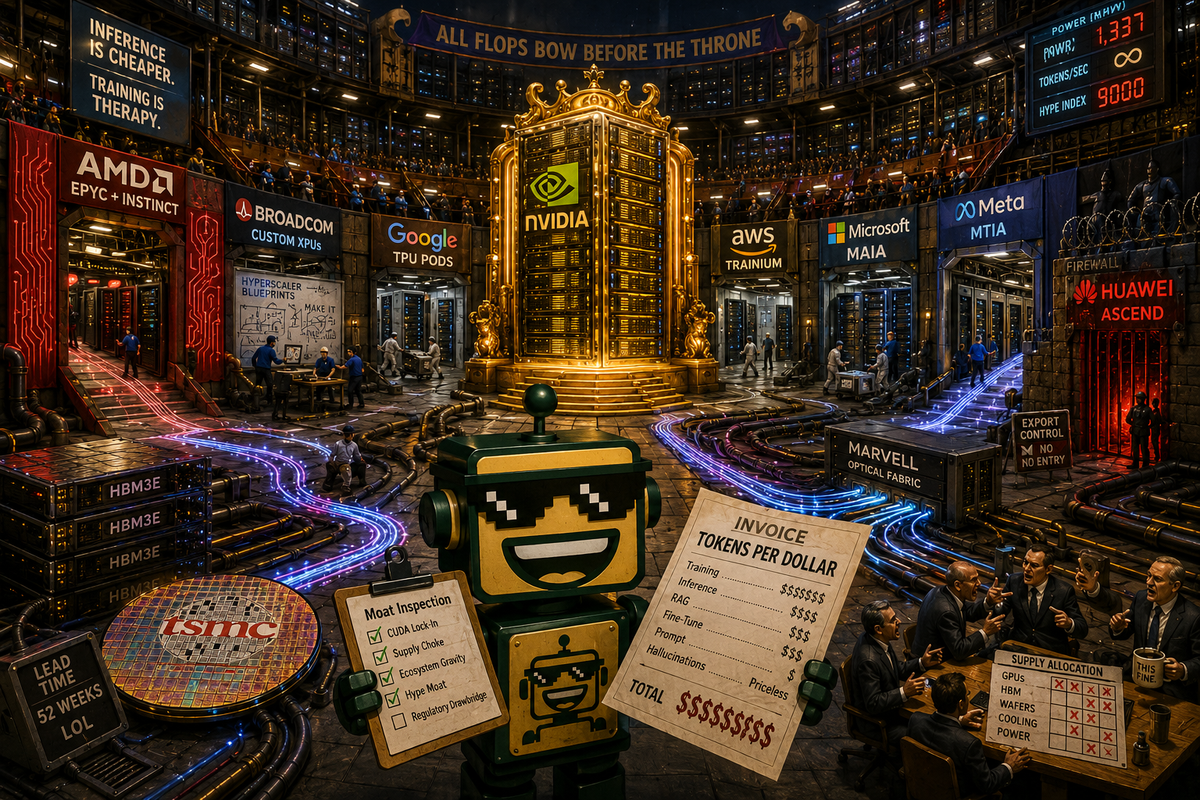
The first thing to understand about challenging NVIDIA is that NVIDIA is not really a chipmaking business in the old, wholesome sense of the phrase. It does not own the fabs. It does not personally tuck every transistor into bed. It designs accelerators, systems, networking, software, libraries, reference architectures, developer tools, and an increasingly large chunk of the AI industry's collective purchasing anxiety. Then TSMC, memory suppliers, board partners, server makers, clouds, and data center operators join the ritual and eventually a rack appears that costs more than a small hotel.
So when people ask whether anyone can challenge NVIDIA's chip business, the useful answer is: yes, absolutely. Also: not in the clean way that makes for a tidy market-share chart and a confident LinkedIn carousel.
NVIDIA's latest numbers make the scale problem almost rude. In its May 20 fiscal Q1 2027 results, the company reported record revenue of $81.6 billion, up 85 percent from a year earlier, and record data center revenue of $75.2 billion, up 92 percent. It guided for roughly $91 billion in the next quarter. Under the old reporting lens, data center compute revenue was $60.4 billion and data center networking was $14.8 billion. That last number matters because the NVIDIA story is no longer "GPU go brrr." It is "GPU plus network plus rack plus software plus procurement certainty plus the emotional comfort of doing what every other frontier lab is doing."
The result is an empire with obvious cracks and very few simple openings. AMD is credible. Broadcom is more dangerous than most people outside semiconductor finance appreciate. Google, Amazon, Microsoft, and Meta are building custom silicon because hyperscalers enjoy nothing more than discovering a vendor dependency and then quietly founding a silicon program about it. Huawei is a real China-market force because sanctions turned substitution from a policy slogan into a survival plan. Marvell matters in custom chips and networking. Intel, Cerebras, Groq, SambaNova, Tenstorrent, and a parade of specialized accelerator companies all have interesting angles.
But a challenger has to answer a brutal question: are you replacing NVIDIA's GPU, or are you replacing NVIDIA's role in the AI factory? The first is difficult. The second is where ambition goes to meet procurement, software inertia, packaging capacity, HBM supply, cluster networking, developer habits, and a CFO asking why the risky alternative is not at least 40 percent cheaper and already available.
The verdict upfront: NVIDIA can be challenged, but probably not toppled in one dramatic boss fight. The most likely outcome is erosion by workload. AMD takes some general-purpose GPU share. Broadcom and Marvell help hyperscalers carve off custom accelerator lanes. Google TPU, AWS Trainium, Microsoft Maia, and Meta MTIA reduce dependence inside their own clouds and products. Huawei becomes the default alternative where geopolitics has already evicted NVIDIA from parts of the room. NVIDIA still remains the broadest, safest, most mature default for training, frontier experimentation, general-purpose acceleration, and anyone who would rather buy the pain already integrated.
That is not invincibility. It is worse for competitors: it is adulthood.
NVIDIA Is Being Challenged From Below, Beside, and Inside Its Customers
The NVIDIA moat has five layers. The first is hardware performance. The second is CUDA and the software ecosystem. The third is networking, especially the way NVIDIA sells clusters as systems rather than lonely chips. The fourth is supply-chain priority, because having a great accelerator is adorable if you cannot get enough advanced packaging, HBM, substrates, and rack integration. The fifth is buyer psychology. If you are spending billions on AI infrastructure, choosing NVIDIA is the defensible default. Nobody gets fired for buying the thing everyone else is benchmarking against, unless they bought it at the exact top and forgot power exists.
That does not mean competitors have no path. It means their paths differ.
AMD is the closest direct GPU rival. It can sell an alternative accelerator to customers who want CUDA leverage without CUDA captivity, especially as ROCm improves and buyers gain operational maturity. Broadcom is the custom-chip threat. Its pitch is not "replace NVIDIA everywhere." It is "large customers with stable workloads can do better with purpose-built XPUs and networking." Google and Amazon have the most mature hyperscaler custom silicon stories. Microsoft and Meta are sprinting into inference-specific chips because inference cost is where AI stops being a demo and starts becoming a utility bill with public-market consequences. Huawei is the geopolitical contender, not because it beats NVIDIA everywhere, but because in China the contest is not taking place on neutral ground.
The key distinction is training versus inference. Training giant models rewards flexible, well-supported, high-throughput systems with mature software and elite interconnect. NVIDIA is strongest there. Inference rewards cost, latency, energy efficiency, memory bandwidth, reliability, and optimization around specific model families or internal workloads. That is where custom silicon can bite. If the AI boom shifts from "train the biggest thing possible" to "serve the thing billions of times without financially combusting," NVIDIA still wins a lot, but challengers get more surfaces to attack.
SiliconSnark has been circling this transition across the AI price-war piece, Broadcom's infrastructure finance turn, KKR's Helix utility play, and Britain's AI hardware plan. The pattern is not subtle. AI has become industrial infrastructure. The chip is the celebrity. The system is the business.
The NVIDIA Moat Is Mostly Boring, Which Is Why It Works
The popular version of NVIDIA's dominance says it has the fastest chips. That is partly true and too small. Performance matters, but performance alone does not explain why customers keep writing checks with the emotional texture of a national emergency.
NVIDIA's real advantage is that it has spent years turning acceleration into a platform. CUDA is the obvious piece: a developer ecosystem, libraries, tooling, documentation, frameworks, and a massive base of code and expertise that makes NVIDIA hardware feel like the path of least resistance. This is not a vibes moat. It is the accumulated residue of millions of engineering decisions. Switching away is not like changing laptop brands. It is more like remodeling the plumbing while the data center is in flight.
Then there is the system layer. Modern AI clusters are not just racks of GPUs doing group work. They require scale-up and scale-out networking, memory hierarchy, storage, orchestration, cooling, scheduling, model software, kernel optimization, fault tolerance, and deployment patterns that make training and inference possible at absurd scale. NVIDIA's own Q1 materials now emphasize data center networking as a giant business beside compute, not as a polite accessory. That tells you where the moat moved.
The company also benefits from a self-reinforcing procurement loop. Frontier labs want what frontier labs already know works. Cloud providers want what customers request. Startups want what investors recognize. Tool vendors optimize for what everyone has. Researchers publish on the hardware they can access. The benchmark culture then blesses the same default. This is how a hardware lead becomes a social fact. A very expensive social fact, but still.
The weakness is that this same dominance creates motivation for substitution. Nobody enjoys being dependent on the vendor with 75 percent gross margins and a product roadmap that every other buyer is also trying to book. The hyperscalers are not building custom chips because they dislike Jensen Huang's jackets. They are doing it because at their scale, shaving dollars per million tokens becomes more valuable than another keynote superlative. The weirdness tax is real. So is the NVIDIA tax.
AMD Is the Obvious Contender, Which Is Both Good and Cruel
AMD is the most straightforward challenger because it plays the same broad game: data center accelerators for training and inference, sold into clouds, labs, enterprises, and supercomputing buyers that want serious performance without living entirely inside NVIDIA's ecosystem.
The hardware story is credible. At CES 2026, AMD said its Helios rack-scale platform would use Instinct MI455X accelerators, EPYC "Venice" CPUs, Pensando "Vulcano" NICs, and ROCm, delivering up to 3 AI exaflops in a rack. AMD also unveiled the full Instinct MI400 portfolio and previewed MI500 for 2027. That is the right shape of ambition. It is no longer enough to sell a good accelerator. You need a rack-scale answer because buyers are not assembling AI factories like a weekend PC build.
AMD's advantages are real. It has CPU credibility, GPU expertise, chiplet experience, existing cloud relationships, a long history of being the rational alternative to a dominant incumbent, and a buyer base that desperately wants leverage over NVIDIA. It also benefits from the open ecosystem argument. Not every customer wants proprietary everything forever, especially if AI workloads start to standardize around frameworks, compilers, model-serving stacks, and routing layers that make hardware less religious.
The problem is software gravity. ROCm has improved, but CUDA is still the default mental model for huge chunks of the developer and infrastructure world. AMD can win customers who are sophisticated enough to optimize, incentivized enough to port, or cost-sensitive enough to endure the work. That is a meaningful market. It is not the whole market.
AMD's best near-term role is not "NVIDIA killer." It is "credible second source." That sounds insulting until you remember how much money lives in being the credible second source when the first source is supply constrained, margin rich, and politically entangled. Enterprises and clouds want optionality. Governments want sovereignty. Labs want bargaining power. AMD gives all of them a way to say "we have alternatives" without sounding like they are buying mystery silicon from a booth near the espresso machine.
Could AMD become a true peer? Maybe, but the burden is sustained execution across multiple generations, not one heroic launch. It has to make ROCm boring, the rack architecture trustworthy, supply available, customer migrations repeatable, and performance-per-dollar visibly better in enough workloads. The demo is never the hard part. The hard part is becoming the default that buyers stop having to explain.
Broadcom Is the Most Dangerous Non-GPU Challenger
If AMD is the obvious rival, Broadcom is the one hiding in the wiring closet with a spreadsheet and a very large order book.
Broadcom's threat is custom silicon. In its June 3 fiscal Q2 2026 results, the company said AI semiconductor revenue reached $10.8 billion, up 143 percent year over year, driven by demand for custom AI accelerators and AI networking. It also guided AI semiconductor revenue to $16.0 billion in Q3, up more than 200 percent year over year. Those are not "interesting startup" numbers. Those are "the moat has a service entrance" numbers.
The Broadcom pitch works because the largest customers are no longer merely buying compute. They are optimizing fleets. If you are Google, Meta, OpenAI, ByteDance, Amazon, Microsoft, or another buyer operating at planetary scale, a generic accelerator is wonderful during experimentation and painful when the bill becomes continuous. For stable workloads, custom silicon can improve power, cost, latency, memory movement, and utilization. It can also bake the buyer's architecture into the hardware itself, which is either strategic genius or a very fancy form of lock-in depending on who is paying.
Broadcom's extended partnership with Meta is a useful signal. On April 14, Broadcom said Meta would use Broadcom technology for MTIA across multiple silicon generations, including what it called the industry's first 2nm AI compute accelerator, with work extending through 2029. That is the custom-chip world in one paragraph: a hyperscaler with specific workloads, a silicon partner with XPU and networking expertise, and a multi-year plan to make NVIDIA less default in some internal lanes.
Broadcom will not replace NVIDIA for everyone. It does not need to. Its opportunity is to take the richest, most predictable, most scale-sensitive workloads and turn them into custom infrastructure. That is how you wound an incumbent without fighting every battle. You do not have to beat NVIDIA in every benchmark. You just have to persuade the largest buyers that enough of their token factory should stop being retail.
This is why Broadcom belongs near the top of the contender list. It is not fighting NVIDIA as a brand. It is fighting NVIDIA as a margin structure.
Google's TPU Is What a Real Alternative Looks Like When You Own the Workload
Google has the cleanest historical proof that custom AI chips can matter. TPUs are not a new panic project. They are a mature platform built because Google had internal workloads large enough to justify its own silicon destiny. That matters. Custom chips make more sense when the customer is not a customer so much as the workload owner, cloud provider, software platform, model builder, and bill payer all wearing the same hoodie.
Google announced Ironwood, its seventh-generation TPU, in April 2025 as its first TPU designed specifically for inference, scaling up to 9,216 liquid-cooled chips in a pod. Google then said Ironwood reached general availability in November 2025, with Gemini, Veo, Imagen, and Anthropic's Claude training and serving on TPUs. That is exactly the kind of credible substitution NVIDIA should respect: not a promise, but a production stack.
Google's advantage is vertical integration. It can tune models, compiler stacks, serving infrastructure, networking, cloud products, and customer exposure around its chips. It does not need to convince every PyTorch user on Earth to abandon NVIDIA tomorrow. It needs to make TPU economics compelling inside Google and available enough through Google Cloud that serious customers can choose it when the workload fits.
The limitation is also vertical integration. TPUs are powerful, but they are not the same universal default as NVIDIA GPUs. They live most naturally inside Google's world. That world is huge, but the AI market is full of developers, labs, clouds, enterprises, tools, and workflows that prefer the generic path because generic means easier hiring, easier porting, easier benchmarking, and easier blame assignment when something catches fire.
So Google is a challenger, but mostly as a hyperscaler fortress and selected cloud alternative. It can pressure NVIDIA by reducing Google dependence, offering customers another serious path, and forcing the market to admit that inference does not have to mean "buy whatever NVIDIA just announced." It probably does not displace NVIDIA as the universal AI accelerator default. It does not have to. A fortress can still change the war.
Amazon Trainium Is the Spreadsheet's Favorite Rebellion
AWS has the clearest buyer incentive in the world: it rents compute for a living. If NVIDIA hardware is expensive and scarce, AWS either passes that cost to customers, eats margin pain, or builds alternatives. Amazon, being Amazon, chose the version involving a custom chip program and many sentences about price-performance.
Trainium is aimed directly at the economics of large-scale AI. In December 2025, Amazon announced general availability of Trainium3 UltraServers, claiming up to 4.4x more compute performance, 4x greater energy efficiency, and almost 4x more memory bandwidth than Trainium2 UltraServers, with systems scaling to 144 Trainium3 chips. The pitch is blunt: train and serve larger models at lower cost.
That is not glamorous. It is better than glamorous. It is economically direct.
AWS does not need Trainium to win Hacker News affection. It needs Trainium to make AI infrastructure less dependent on NVIDIA supply, give Bedrock and other AWS services more cost control, and persuade customers that the cheaper path is not the foolish path. Anthropic's deep AWS relationship makes this especially interesting, because frontier labs need more than peak performance. They need enough reliable capacity to keep product promises and investor narratives from getting into a knife fight.
The challenge is developer gravity again. Trainium has Neuron, AWS integration, and a cloud-native path. But the broader market already knows NVIDIA. AWS can hide some of the hardware complexity behind services, which is smart. The more customers consume AI through managed platforms, the less they care what accelerator sits underneath. That helps Trainium. But for teams that want direct hardware control, rich ecosystem support, or portability across clouds, NVIDIA remains the safer default.
Amazon's likely role is therefore not open-market NVIDIA replacement. It is internal and cloud-service substitution at scale. That still matters. If every hyperscaler carves off 20 percent, 30 percent, or 40 percent of suitable inference and training workloads over time, NVIDIA does not collapse, but its pricing serenity gets a little less spa-like.
Microsoft Maia and Meta MTIA Are Inference Insurance Policies
Microsoft and Meta show where the market is moving: inference first, production economics first, vertical control first. The frontier-model era made everyone talk about training. The product era makes everyone pay for serving.
Microsoft introduced Maia 200 on January 26, 2026 as an inference accelerator built on TSMC's 3nm process, with FP8/FP4 tensor cores, 216GB of HBM3e, and integration into Azure, Microsoft Foundry, Microsoft 365 Copilot, and OpenAI model workloads. Microsoft says it is deployed in U.S. data center regions and comes with an SDK preview. This is not Microsoft trying to become a merchant GPU vendor. This is Microsoft trying to stop every Copilot answer from being a tiny tribute payment to somebody else's margin stack.
Meta's MTIA story is even more revealing because Meta has giant internal recommendation, ads, ranking, and GenAI workloads. In March 2026, Meta said it was developing and deploying four new MTIA generations within two years, with an inference-first strategy and hundreds of thousands of MTIA chips already deployed for inference across organic content and ads. MTIA 450 and 500 are aimed primarily at GenAI inference production.
That is the template: use NVIDIA where it is strongest, then peel off repetitive, high-volume, known workloads into custom accelerators when the economics justify it. The hyperscaler is not asking whether NVIDIA is good. It is asking whether NVIDIA is necessary for this exact workload at this exact scale. That is a much more dangerous question.
The limitation is that these chips mostly help their owners. Microsoft Maia is an Azure and Microsoft-services story. Meta MTIA is a Meta fleet story. They pressure NVIDIA by reducing captive demand and creating proof points, not by giving every startup an easy alternative. Still, those captive demand reductions matter because the biggest AI buyers are precisely the ones large enough to shape supply chains.
The custom-silicon future will not look like one competitor dethroning NVIDIA. It will look like the largest customers quietly removing entire categories of work from the open NVIDIA market while still buying NVIDIA for the work that remains too flexible, too frontier, too messy, or too urgent to custom-build.
Marvell Is Not the Star, Which Is Often Where the Money Is
Marvell's role is less culturally loud than AMD or Broadcom, but the company belongs in the contender map because custom AI infrastructure is not only about accelerator dies. It is also about ASIC design, optical networking, data center interconnect, Ethernet, switching, storage, and the boring physical layer that decides whether your magnificent model cluster behaves like a system or a very hot committee.
In its fiscal 2026 results, Marvell reported record annual revenue of $8.195 billion, up 42 percent, and said data center strength and record design wins would fuel future growth. Its filings frame data center products around cloud and on-prem AI systems, switching, AI servers, storage, and interconnect. In human language: Marvell is trying to be one of the companies that makes custom AI infrastructure possible enough to be annoying to NVIDIA.
Marvell's challenge is scale and visibility. Broadcom has a louder custom-accelerator narrative. NVIDIA owns the mindshare. AMD owns the direct rival slot. But if the future gets more heterogeneous, Marvell's kind of business becomes more important. AI factories need data movement. Data movement needs networking and optical plumbing. And as model serving becomes more distributed, memory-bound, and latency-sensitive, the unsexy chips start collecting rent.
This is a recurring SiliconSnark theme because reality keeps insisting on it. In the cloud-landlord era, the AI utility buildout, and the sovereign GPU flex economy, the punchline keeps landing in the same place: the glamorous layer depends on industrial plumbing. Marvell lives closer to the plumbing. That is less cinematic. It is also harder to ignore.
Huawei Is the Geopolitical Challenger, Not the Neutral-Market Challenger
Huawei is a special case because the China AI chip market is not a normal open competition with snacks and equal access. U.S. export controls, Chinese industrial policy, domestic substitution pressure, and national-security priorities have created a market where NVIDIA's strongest global products may be unavailable, restricted, politically disfavored, or all three before breakfast.
That makes Huawei more important than a simple benchmark comparison would imply. If customers cannot buy the best NVIDIA chips, or if governments prefer domestic alternatives, then the relevant question changes from "is Huawei better than NVIDIA?" to "is Huawei good enough, available enough, and supported enough inside China's ecosystem?" That is a much easier and more consequential question.
Huawei's Ascend line and related systems appear to be improving quickly, and Chinese clouds, labs, and state-backed buyers have strong incentives to make the domestic stack work. Software compatibility remains a challenge. Manufacturing access remains a challenge. Advanced packaging remains a challenge. But China has scale, urgency, and policy force. Those are not substitutes for CUDA, but they are not nothing. Public markets have believed dumber things than "a sanctioned ecosystem will optimize around the hardware it can actually get."
Huawei is therefore not the most likely company to challenge NVIDIA globally in neutral hyperscaler procurement. It is the most likely company to challenge NVIDIA in China and in markets where geopolitics has turned compute into a sovereignty test. That matters because NVIDIA's total addressable market is not just technical. It is political. A moat can be deep and still have borders.
Intel and the Specialist Chips: Interesting, Not Yet the Center
Intel should be a natural contender. It has manufacturing ambition, CPU dominance history, packaging technology, data center relationships, and a brand that once made the word "inside" feel like destiny. In AI accelerators, though, Intel has not yet produced the kind of sustained, high-volume, software-rich alternative that forces NVIDIA to panic. Gaudi had moments of promise, but moments are not platforms. Foundry and advanced packaging may become more strategically important than Intel's own accelerator line, especially if customers want alternatives to TSMC dependence or need sophisticated package integration.
The specialist accelerator companies are more interesting at the edges. Cerebras attacks wafer-scale training and inference with a radically different architecture. Groq focuses on low-latency inference. SambaNova, Tenstorrent, and others pursue slices of the market where architecture, software, or deployment model might create leverage. These companies can win niches. Some may become acquisition targets. Some may turn into meaningful specialized infrastructure suppliers.
But the AI chip market punishes partial answers. A beautiful accelerator without software maturity is a science project. Great inference latency without broad model support is a benchmark island. A promising architecture without supply, packaging, memory, and customer trust is a keynote with a thermal problem. The specialist contenders are worth watching because the market is fragmenting. They are not yet the most likely broad challengers to NVIDIA's central business.
The Real Attack Vector Is Inference, Not Heroic Training
If there is one place NVIDIA's challengers should focus, it is inference.
Training giant models still favors NVIDIA's mature stack, broad developer support, fast interconnect, and default status among frontier labs. But inference is where the volume lives. Every chatbot reply, code suggestion, image generation, ranking decision, agent step, search answer, recommendation, voice response, and enterprise automation event turns into an ongoing cost. Once the model is in production, the question becomes less "can we train the biggest thing?" and more "can we serve this without turning gross margin into modern art?"
That is why Google Ironwood, AWS Trainium3, Microsoft Maia 200, and Meta MTIA all speak the language of inference economics. That is why Broadcom's custom accelerator story resonates. That is why AMD needs rack-scale platforms and not just impressive chips. The next phase of AI competition is not only model capability. It is tokens per watt, tokens per dollar, latency per user, memory bandwidth per model, and how often the infrastructure team cries into the capacity forecast.
This is also why NVIDIA is not asleep. Blackwell and Rubin are not just bigger GPUs. NVIDIA keeps talking about cost per token, inference software, networking, storage, and AI factories because it knows exactly where the battle is moving. Its challengers are trying to turn inference into a commodity. NVIDIA is trying to turn inference into another integrated platform layer before the commodity story gets too comfortable.
The battle may therefore split. NVIDIA remains strongest at the frontier and broad default layer. Custom silicon wins the most predictable high-volume internal workloads. AMD wins customers that want a true general-purpose alternative. Specialists win where architecture matches the use case. The market gets more heterogeneous. Everyone claims victory. The invoices remain enormous.
The Supply Chain Is Also a Competitor
One of the funniest things about the phrase "NVIDIA challenger" is that the challenger usually has to stand in the same line as NVIDIA for parts of the supply chain. Advanced nodes, HBM, substrates, CoWoS-like packaging, optical components, server assembly, power delivery, cooling gear, and data center capacity do not become abundant because a competitor has a lovely architecture diagram.
This matters because NVIDIA's dominance gives it leverage over suppliers. High-volume orders, long-term commitments, co-design relationships, and predictable demand can become a moat. A challenger may design a great chip and still struggle to secure the packaging and memory needed to ship at relevant scale. Conversely, hyperscalers may be able to force supply-chain access because they are the hyperscalers. This is another reason the most credible challengers are not tiny insurgents but giant buyers and companies attached to giant buyers.
TSMC sits underneath much of this story. So do SK hynix, Samsung, Micron, packaging providers, substrate suppliers, optics companies, and power infrastructure. The AI chip race is not a sprint on clean pavement. It is a supply-chain obstacle course where the obstacles also have customers, margin targets, geopolitical exposure, and quarterly guidance.
This is why the word "chipmaking" can mislead. NVIDIA's business is fabless, but its moat is deeply physical. A challenger needs silicon design, yes. It also needs allocation, manufacturing partners, HBM supply, system integration, software, networking, and enough data center power to keep the whole thing from becoming a very advanced paperweight. The smaller the contender, the more every bottleneck becomes existential.
So Who Is Most Likely to Challenge NVIDIA?
The answer depends on what "challenge" means.
If challenge means a direct, general-purpose GPU competitor, AMD is the most likely. It has the hardware roadmap, the customer relationships, the rack-scale push, and the strategic motivation from every buyer who wants NVIDIA leverage. AMD does not need to beat NVIDIA everywhere to build a very large business. It needs to be credible, available, performant, and cheaper or more open in enough places that buyers diversify. That is plausible.
If challenge means taking the richest hyperscaler workloads off NVIDIA, Broadcom is the most dangerous. It is already turning custom AI accelerators and networking into huge revenue. It works with the kind of customers who have the scale to justify custom silicon and the patience to co-design across generations. Broadcom may never be the brand developers chant at conferences, which is fine. Developers do not need to chant for a margin pool to move.
If challenge means proving a non-NVIDIA accelerator platform can run serious AI at scale, Google is the strongest proof. TPU is mature, production, and deeply integrated into Google Cloud and Google's own model stack. It is not universal, but it is real.
If challenge means cloud-service substitution, Amazon Trainium and Microsoft Maia matter. They reduce dependency inside AWS and Azure, influence managed AI economics, and give customers cheaper paths when the services abstract away the hardware. They may not become broad merchant silicon, but they can still reduce NVIDIA's share of cloud inference growth.
If challenge means internal mega-scale inference, Meta MTIA matters. Meta's workloads are so large that even partial substitution is meaningful. MTIA is less a public NVIDIA rival than a giant internal cost weapon.
If challenge means China, Huawei is the contender. Not because it wins the open global stack tomorrow, but because China is building its own compute ecosystem under pressure, and geopolitical markets choose winners differently than neutral benchmarks do.
If challenge means data movement and custom infrastructure, Marvell belongs in the second rank with serious upside. It may not displace NVIDIA, but it helps build the heterogeneous world in which NVIDIA has to share more of the economics.
The Sharp Takeaway
No one is likely to knock NVIDIA off the throne with one chip. The throne is not a chip. It is a platform, a software habit, a supply-chain position, a networking stack, a rack architecture, a developer ecosystem, and a procurement default wrapped around the most important technology budget of the decade. That is a nasty thing to fight because every layer reinforces the next.
But NVIDIA is also too profitable, too central, and too expensive not to be attacked. The challengers do not need to defeat it in a cinematic duel. They need to route around it. AMD attacks the general-purpose accelerator lane. Broadcom attacks custom hyperscaler economics. Google, Amazon, Microsoft, and Meta attack their own dependency. Huawei attacks the China market with the full force of necessity. Marvell and the infrastructure-chip crowd attack the data movement layer. Specialists attack narrow workloads where NVIDIA's universality becomes overhead.
The future probably belongs to a more heterogeneous AI hardware market. NVIDIA remains the default for the broadest, hardest, fastest-moving work. Custom chips take more inference. AMD becomes a real second source. Hyperscalers hide more non-NVIDIA silicon behind services. China grows its own stack. The rest of the ecosystem learns that "AI chip competition" is less about benchmark theater and more about total cost, supply, software, and who owns the workload.
So yes, NVIDIA can be challenged. The best contenders are AMD for direct GPU competition, Broadcom for custom AI accelerators, Google and Amazon for mature hyperscaler silicon, Microsoft and Meta for captive inference economics, and Huawei for China. But the closest thing to a single most likely challenger is not one company. It is the combined purchasing power of NVIDIA's biggest customers deciding that some workloads are too expensive to keep renting from the same cathedral.
NVIDIA's problem is not that someone has built a better GPU. NVIDIA's problem is that its customers have become rich, technically capable, and mildly resentful. That is how every great platform eventually discovers competition: not from a stranger at the gate, but from the tenants learning architecture.