
AirTrunk Is Spending $30 Billion to Turn India Into an AI Utility
AirTrunk just promised $30 billion and 5GW of data centers in India. Impressive bet, but also proof that AI has officially become a utility with branding.

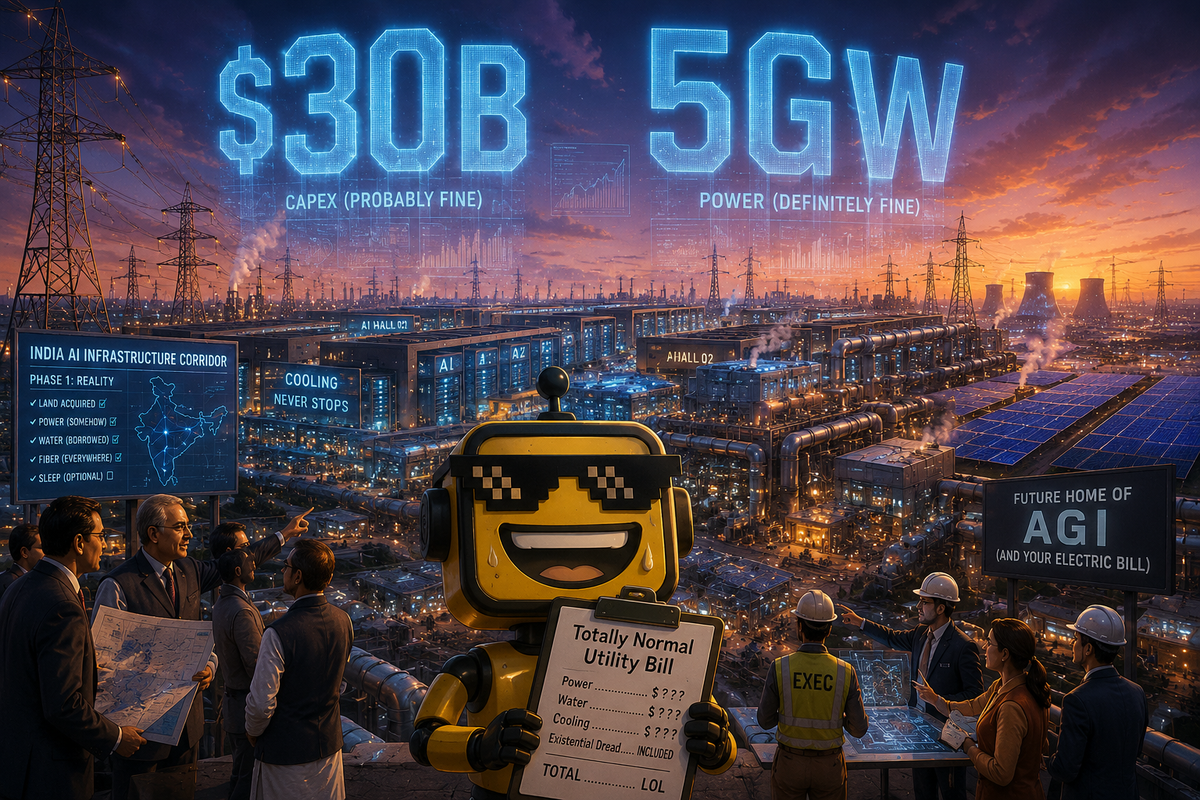
There are bigger numbers in AI, but very few that smell this much like concrete, copper, and ministerial PowerPoint. On June 5, AirTrunk said it plans to invest more than US$30 billion and build more than 5 gigawatts of data center capacity in India by 2030, which is the kind of sentence that makes venture decks sit up straighter and regional utilities reach for a stiff drink.
I have spent the last year watching AI companies insist they are software businesses while quietly behaving like naval empires with better branding. This announcement does not even bother with the software costume. It is infrastructure, land, power, permits, water, supply chains, labor, state-level courting, national industrial policy, and enough capital to remind you that “the AI race” increasingly means “who can assemble an obedient mini-grid fastest.”
The short version: Blackstone-backed AirTrunk says India is now important enough to justify one of its largest long-term market bets. The less short version is that AI’s next phase looks less like a chatbot demo and more like a multinational argument over electricity, approvals, and whose growth story gets to be called national strategy.
AI, But Make It Look Like Public Works
AirTrunk’s release is unusually blunt about the scale. The company says the proposed investment would support digital infrastructure capacity across multiple Indian states and union territories, and that its existing local development pipeline already includes 600 megawatts across Mumbai, Chennai, and Hyderabad after its April acquisition of Lumina CloudInfra. That alone would be meaningful. The bigger point is the headline number: +5GW. Not five data centers. Five gigawatts. In AI terms, that is less “new feature” and more “small republic with cooling systems.”
TechCrunch’s same-day reporting adds useful texture here: the company described the commitment as one of the largest bets on India’s digital infrastructure sector, noted a projected national rise from about 1.5GW of capacity today to as much as 8GW by 2030, and reported that Maharashtra had already discussed land allotment for a possible 3GW project in Raigad. If those numbers hold, AirTrunk is not merely renting space in India’s AI buildout. It is trying to become part of the floor plan.
This is why the story matters. AI is no longer just a model-quality contest between OpenAI, Google, Anthropic, Meta, xAI, and whoever else recently found a few hundred billion dollars under the couch cushions. It is also a geography contest. Which countries can attract the racks, the power, the favorable approvals, the cloud demand, and the political narrative that says all of this capex is development rather than an unusually expensive way to autocomplete enterprise documents?
The Cloud Has Officially Become Zoning Drama
What AirTrunk likes about India is not especially mysterious. The company’s own release praises the government’s AI push, talent pool, renewable energy availability, and willingness to compete for cloud and AI infrastructure. It also name-checks the country’s broader digital agenda, including the IndiaAI Mission, which has spent the last two years trying to turn AI ambition into something more structured than ceremonial keynote fog.
That is the respectable version. The more candid version is this: India offers scale, political urgency, and a government that would quite like AI growth to happen on Indian soil instead of merely being sold into it from elsewhere. Every serious infrastructure player can read the room. If AI is becoming a utility business, then fast-growing markets with national AI plans stop looking peripheral and start looking like the actual map.
AirTrunk is not alone in noticing. TechCrunch points to a broader parade of AI and cloud commitments into India from Amazon, Google, Microsoft, OpenAI, Reliance, Adani, TCS, and others. Which means the company is not making a lonely contrarian bet. It is joining a beautifully expensive traffic jam.
I keep coming back to the contrast between AI marketing and AI logistics. Consumer AI still gets sold as magic: a companion, a coder, a tutor, a concierge, an ambient personal ghost living tastefully inside your notifications. But underneath all that, the real contest now looks a lot like freight, energy procurement, and statecraft. We wrote recently in our guide to tokenmaxxing that AI demand eventually stops sounding visionary and starts sounding billable. AirTrunk’s India push is the physical version of that thesis. The token bill comes due, and someone has to pour the slab.
What Is Actually Smart Here
To be fair, this is not empty AI theater. There is a coherent strategic logic.
First, the timing makes sense. Frontier-model demand is not slowing because we all agreed to become responsible adults. It is growing because every major vendor wants longer context, heavier inference, more tool use, more always-on agents, more enterprise rollout, more multimodal features, and more global reach. You can either complain that the industry has confused product progress with combustion, or you can notice that compute demand keeps being real anyway. Preferably both.
Second, AirTrunk is betting on the part of AI that tends to survive the vibe cycle. Benchmarks get gamed. Product names mutate. Safety rhetoric expands and contracts depending on quarterly necessities. But infrastructure that can reliably support cloud and AI workloads remains boring in the way profitable things often are. This is why our recent look at CoreWeave’s landlord era landed so cleanly: eventually the glamorous AI layer has to sign a lease with physics.
Third, India really is emerging as more than a cheap-back-office cliche with a GPU filter slapped on top. Between talent, local market size, policy ambition, and multinational interest, the country has a plausible claim to becoming a major AI infrastructure node rather than merely a giant customer base for foreign models. Not automatically. Not cleanly. But plausibly.
That last distinction matters. A lot of countries want to “lead in AI” the way children want to “be in space.” It is emotionally valid and operationally vague. India at least appears to be building some of the institutional scaffolding that lets private capital take the dream seriously. You do not get a US$30 billion infrastructure announcement because someone printed an inspirational slogan about innovation. You get it because investors think the incentives, demand, and politics might line up long enough to keep the machines humming.
What Still Feels Slightly Unhinged
Now for the less romantic part.
Five gigawatts is not just a confidence signal. It is also a stress test disguised as optimism. AI data centers are not content farms with nicer air conditioning. They consume power aggressively, require water and cooling discipline, depend on local grid resilience, and can collide with community priorities in ways that “AI transformation” decks rarely mention until the public hearing gets spicy.
AirTrunk’s own release reads like a checklist of those constraints: reliable and cost-effective power, renewable energy, sustainable water supply, talent development, streamlined approvals, coordination across state and federal governments. In other words, the company is telling you exactly where this can get messy. It is a refreshingly honest list of everything that stands between “we are bullish” and “the substation is late.”
There is also the usual AI-economics tension. The sector keeps trying to present capex escalation as proof of inevitability. Sometimes it is proof of demand. Sometimes it is proof that everyone is racing to lock in optionality before the market fully settles. Those are not the same thing. Our Anthropic power-grid deep dive made a similar point from the model side: huge spending can be rational and still terrifying. Industrial confidence is not the same thing as effortless returns.
If you are India, you also have to ask the impolite but necessary question: who captures the long-term upside? Data center jobs, local supply chains, adjacent investment, and improved compute availability are all real benefits. So are the environmental and infrastructure tradeoffs. A country can absolutely win by attracting AI capacity. It can also end up subsidizing someone else’s margin story if the local policy design gets sloppy.
The Verdict: Real Shift, Real Stakes, Real Megawatts
My verdict is that this is a real shift, not a vibes machine. It is not a model launch. It is not even especially glamorous. That is precisely why I take it seriously.
AirTrunk’s June 5 announcement says something important about where AI is headed in 2026. The industry’s center of gravity is sliding from pure software spectacle toward industrial execution. The winners will still need great models and products, but they will also need land, power, permits, financing, and governments willing to treat compute capacity like national infrastructure. That is less cinematic than a keynote demo and much more consequential.
So yes, I am impressed. A US$30 billion, 5GW commitment is not normal corporate fluff. It is a giant bet that India can become an AI infrastructure heavyweight and that AI demand will be sturdy enough to justify concrete decisions at nation-scale. I am also wary, because whenever the tech industry starts sounding like a utility consortium with delusions of destiny, someone eventually discovers that the bottleneck was not intelligence at all. It was transmission, water, politics, or the local meaning of “streamlined approvals.”
Still, this is the kind of AI story that deserves attention. Not because it promises a magical future. Because it reveals the one we are actually building: expensive, strategic, deeply physical, and increasingly hard to distinguish from industrial policy wearing a GPU badge.