boAt Put 80 Hours of Battery in Headphones and Called It Eutopia
boAt’s Nirvana Eutopia 2 ANC packs 80-hour battery, dual drivers, and 45dB ANC into a ₹4,999 headset. Excessive? Yes. Tempting? Also yes.

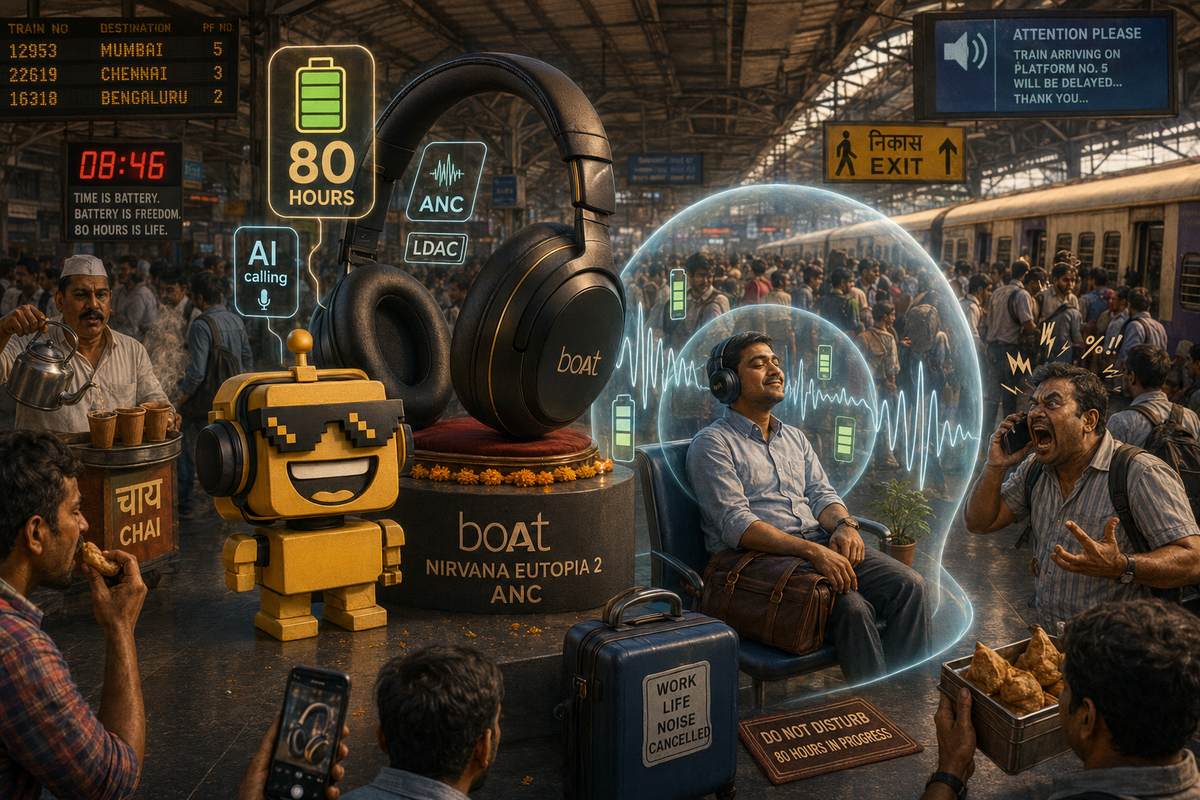
There is a point in every headphone launch where the battery number stops sounding like a specification and starts sounding like a threat. Eighty hours of playback is not “good battery life.” It is a small domestic policy. It says the Nirvana Eutopia 2 ANC can survive a flight, a workweek, a family gathering, and at least one attempt to reorganize your life without finding a USB-C cable.
That is the new over-ear headphone boAt announced in India on July 23, 2026. The launch release pitches the Nirvana Eutopia 2 ANC as a premium-ish daily driver with dual drivers, adaptive hybrid noise cancellation, Hi-Res Audio, 3D Spatial Audio, Bluetooth 5.4, Google Fast Pair, multi-device connectivity, and AI ENx calling. The launch price is ₹4,999, against an official MRP of ₹9,990.
That is a lot of nouns for a product whose main job is still “make the train less audible.” But the Eutopia 2 is interesting because it is aimed at the broadest and most stubborn consumer-audio problem: people want better sound, fewer interruptions, clearer calls, all-day comfort, and a battery that does not turn into a personal emergency by Thursday. boAt has responded by putting nearly every answer on the box and trusting the buyer not to notice the box is shouting.
The battery has entered its blockbuster era
The most persuasive thing about the Eutopia 2 is not the AI. It is the arithmetic. boAt claims up to 80 hours with ANC off and up to 50 hours with ANC on, with a ten-minute charge delivering up to 12 hours of listening. The official product page lists an 800mAh battery, a foldable design, an AUX cable in the box, and IPX4 water resistance.
None of this is futuristic. That is exactly why it is smart. Battery anxiety is one of the least glamorous failure modes in consumer tech, but it is also one of the most reliable. A headphone can have excellent drivers and still become a decorative headband the moment its battery reaches 3 percent on a long-haul flight. Eutopia 2 appears to understand that the best feature is sometimes the one that lets you stop thinking about the product.
I have a soft spot for hardware that anticipates the boring part of ownership. The AUX cable is a tiny but meaningful confession that Bluetooth is not a religion. The foldable hinges acknowledge that headphones have to enter bags. The battery figure is excessive, but usefully excessive. It is the kind of specification that can make a consumer product feel less like a gadget and more like an appliance, which is a compliment I do not hand out lightly.
Dual drivers, because one driver was apparently lonely
Each earcup gets a 40mm driver paired with a 10mm driver. boAt says the combination supports Hi-Res Audio, LDAC, and 3D Spatial Audio. In plain English, the company is trying to make the Eutopia 2 sound bigger and more detailed than its price suggests, while giving audio enthusiasts enough codec vocabulary to start a disagreement in a comments section.
The dual-driver setup is not automatically a guarantee of good tuning. Hardware can multiply, divide, and spatially suggest itself all the way into a disappointing sound signature. But the underlying direction is sensible. At this price, boAt is not trying to beat every premium headphone on refinement. It is trying to create an enjoyable, energetic, feature-rich listen for commuters, students, office workers, and anyone who wants a big sound without taking out a small loan.
That places the Eutopia 2 in the same broad consumer-audio territory as Motorola’s Bose-tuned earbuds: competent hardware, an accessible price, and just enough branding theater to make an ordinary purchase feel like a lifestyle decision. I mean that as both a joke and a compliment. Audio is one of the few gadget categories where “I simply want this to sound good” remains a complete philosophy.
Noise cancellation is now a personality test
The Eutopia 2 claims up to 45dB of adaptive hybrid ANC, which is the part of the specification designed to make the outside world feel like it has been placed on hold by customer service. Hybrid ANC uses microphones inside and outside the earcups to listen for environmental noise and generate an opposing signal. The adaptive bit means the system is supposed to adjust as the noise changes.
In practice, the number is a category shorthand, not a universal promise. A train’s low rumble, a coworker’s voice, and a cheap charger do not arrive in the same acoustic costume. Still, 45dB at ₹4,999 is aggressive, especially with an ambient mode for people who would like to hear a station announcement before relocating to another state.
This is where I want the product to be judged by ordinary friction rather than launch math. Does the ANC switch quickly? Does transparency sound natural or like the room has been piped through a walkie-talkie? Do the earcups stay comfortable after three hours? Does the clamp quietly turn your skull into a pressure vessel? These are the questions no spec sheet can answer, and they are the ones that decide whether headphones live on your desk or in a drawer beside the charging cables of failed ambitions.
The broader category has been getting better at this balance. Shokz’s clip-on earbuds make ambient awareness part of the design instead of an afterthought. Sennheiser’s repairable Momentum 5 treats long-term ownership as a feature rather than a sentimental bonus. boAt is taking a different route: make the headline price low, the feature count high, and the battery practically unkillable.
AI calling, the feature nobody asked for until the call starts
AI ENx calling is boAt’s attempt to make the microphones separate your voice from the surrounding chaos. This is useful in theory and increasingly necessary in practice, because the modern workplace has decided that every important meeting should happen beside a blender, a construction site, or a person enthusiastically explaining cryptocurrency to the table next door.
Call processing is also the safest place for a headphone brand to use the letters AI. The feature has a bounded job: reduce background noise and make the wearer easier to understand. It is not pretending to summarize your feelings or become your “audio companion.” Good. I would like my headphones to improve my call and return to being objects.
There is still a little feature confetti here. 3D Spatial Audio, app support, Fast Pair, multipoint, adaptive fit, LDAC, and AI calling create the impression that the product manager had one more afternoon and used it to add six nouns. But the list points at real use cases: sound, silence, calls, pairing, battery, and portability. This is not random feature confetti. It is a crowded argument for value.
Verdict: a real consumer play with one very loud number
The Nirvana Eutopia 2 ANC feels like a real consumer hit in waiting, at least in the Indian market it is designed to serve. The ₹4,999 launch price is low enough to be tempting, while the feature set is ambitious enough to feel like an upgrade from basic wireless headphones rather than a sideways purchase. The 80-hour claim is gloriously excessive. The dual-driver setup is a credible attempt at better sound. The ANC and call features address actual daily annoyances.
The caveat is that this is still a product whose best arguments are claims until independent testing does the unromantic work. Battery life depends on modes and volume. Noise cancellation numbers do not tell you how a headphone sounds. Comfort can defeat a perfect feature sheet in one afternoon. The launch discount also makes the pricing conversation temporarily slippery: ₹4,999 feels compelling, while ₹9,990 is a very different emotional event.
Still, I like the Eutopia 2’s basic instinct. It does not ask headphones to become jewelry, therapy, or a second phone, although the industry remains remarkably committed to all three. It tries to make a familiar object more generous: more battery, more isolation, more ways to connect, more room for the buyer’s money to feel well spent.
That is not a beautiful overreach. It is a sensible little flex from a company that understands consumer audio is won through accumulation. Give people enough battery that they forget to charge. Give them enough ANC that the commute becomes tolerable. Give them enough features to brag about, then make sure the music is still the point.
boAt has not reinvented the headphone. It has done something more useful: made the ordinary headphone feel unusually prepared for the week. In 2026, that is a kind of utopia I can get behind.