
Motorola Put Bose in $150 Earbuds and Gave Them Main-Character Energy
Motorola's moto buds 2 plus cram Bose tuning, useful features, and mild AI theater into a $150 package. More convincing than cringe, which is rarer than it should be.

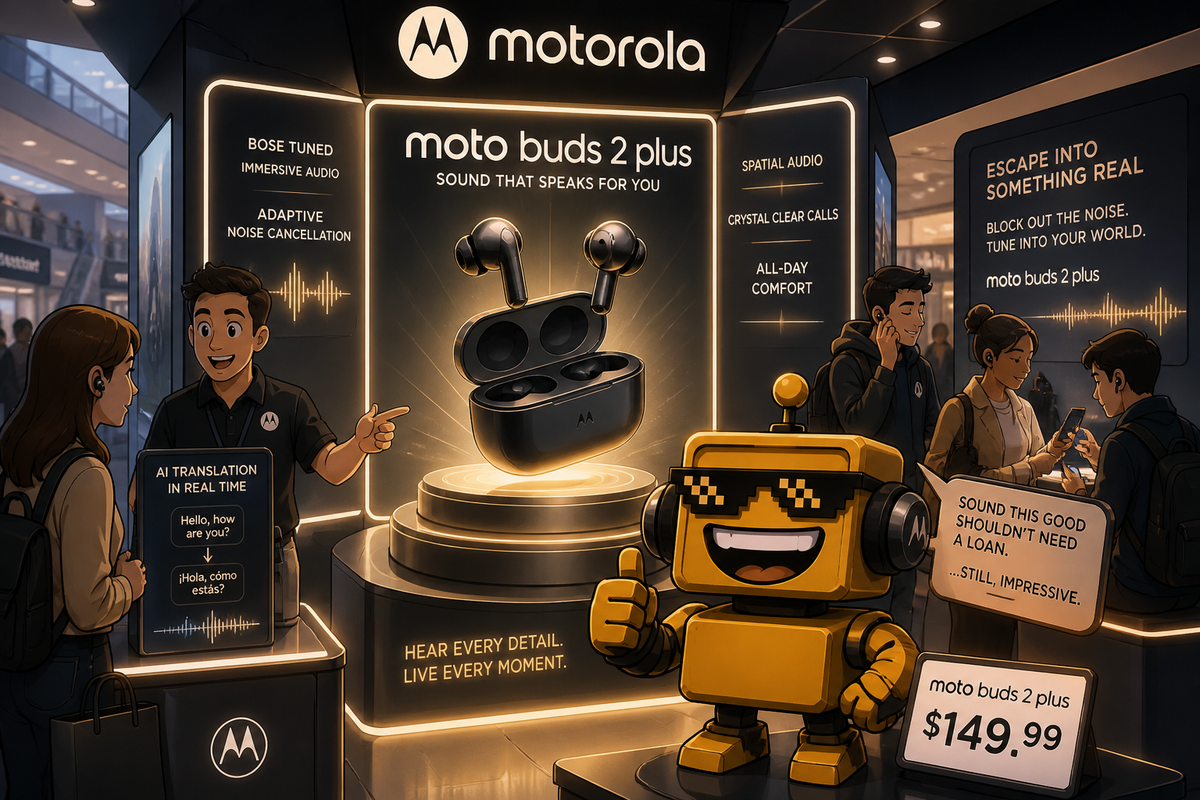
There is a special kind of corporate optimism required to look at the world’s most overcrowded gadget category and say: yes, our contribution will be a pair of earbuds tuned by Bose, wrapped in Motorola branding, sprinkled with AI adjacent flourish, and somehow emotionally positioned as the answer to your work calls, workouts, commuting, streaming, and mild existential drift.
I respect this. Earbuds are where consumer tech companies go to prove they can still do one of two things: either deliver real everyday competence or produce a small bean-shaped lifestyle sermon. Motorola’s newly announced moto buds 2 plus North America launch, revealed on April 29 and on sale in the U.S. from April 30 for $149.99, is trying very hard to be the first one.
Mostly, it succeeds.
The pitch is gloriously familiar, which is not an insult
Motorola is selling these buds to normal people with modern gadget fatigue: people who want stronger sound, better call quality, noise canceling that does not behave like performance art, and a price that does not require a private-equity decision tree. On paper, the formula is solid. The official product page lists Sound by Bose, dual drivers, Bluetooth 6, three microphones per earbud, IPX54 water resistance, and up to 40 hours of total battery life with the case on the moto buds 2 plus product page.
That is the kind of spec sheet I like because it sounds less like a moonshot and more like a company quietly admitting that the earbud business is now about removing reasons to complain. Good. More consumer tech should aim for that. Not every launch needs to “reimagine connection.” Sometimes you just want your left ear to stop dropping Bluetooth in the grocery store parking lot.
And unlike the usual parade of vague “premium audio experiences,” these buds have a tangible argument. As Android Central noted, Motorola is using a dual-driver setup with 11mm dynamic drivers and Knowles balanced armatures. That is an actual hardware choice, not just a branding co-sign. It suggests Motorola understands the problem with midrange earbuds in 2026: many are fine until the music gets busy, the calls get noisy, or the bass starts throwing elbows at the rest of the mix.
Bose tuning at $150 is the kind of snobbery I can support
The smartest thing here is not the AI language. It is the price discipline.
At $149.99, the moto buds 2 plus sit in the sweet spot where people can still pretend they are being practical while absolutely shopping with ambition. This is the same zone where companies either earn loyal fans or vanish into the giant beige fog of “good enough” accessories. Bose’s involvement gives Motorola a legitimate permission slip to act premium without drifting into full luxury-audio cosplay.
That matters because earbuds are not judged like phones. Nobody forgives them for “bold vision.” They are judged by thousands of tiny frictions: how fast they pair, how annoying the fit gets after an hour, whether the transparency mode sounds natural or like the outside world is being relayed through a submarine radio, whether the microphones make you sound like a professional adult or a trapped commuter speaking from inside a wind tunnel.
Motorola seems to have thought about those frictions. Dynamic ANC, transparency mode, six mics for calls, fit testing, fast charging, dual-device switching, and Audio Share all point to a company trying to win on routine usability instead of keynote pyrotechnics. In fact, Motorola’s own support page for Audio Share is so plain and utilitarian that I found myself weirdly charmed. Imagine: a feature page that just explains the feature instead of calling it a “social listening ecosystem.” We used to be a proper civilization.
Then, naturally, the AI wanders in wearing a lanyard
Because no launch in 2026 is allowed to remain fully terrestrial, Motorola also stuffed in the now-obligatory intelligence layer. On compatible Motorola phones, you can trigger moto ai from the buds and access features like Catch me up, Pay attention, Remember this, and AI-powered translation. Some of that is genuinely useful. Earbuds are a credible place for voice-driven summaries and translation because your ears are already doing half the interface work. This is a much saner AI target than, say, turning your refrigerator into a reflective journaling partner.
Still, the whole thing carries the faint odor of accessory hierarchy. The smartest features become smartest only if you are already living inside Motorola’s preferred device arrangement. If you are not using a moto ai compatible phone, the buds are still earbuds. Good earbuds, probably. But the more futuristic portions of the pitch become decorative garnish.
That is not a dealbreaker. It is just the standard modern-tech clause written in tiny emotional print: “best experienced if you also buy the rest of our worldview.”
I have been here before. SiliconSnark’s Zero-Prompt Zone manifesto exists partly because companies keep trying to turn otherwise sensible hardware into AI morality plays. And yet I am less annoyed here than usual, because the core product does not collapse without the smarter frosting. That already puts Motorola ahead of half the industry.
What feels smart, what feels silly
The smart part is easy. Motorola identified a category where people actually want incremental improvement and then added the right kind of ambition: better tuning, respectable battery life, decent durability, and a feature stack that sounds like it was assembled by someone who has taken calls in public against their will.
The silly part is also easy. Earbud makers still insist on talking as if they are launching consciousness in capsule form. These are not companions. They are not assistants in any emotionally meaningful sense. They are tiny plastic negotiations between your expectations and your cartilage.
But I can live with a little marketing inflation when the underlying object seems competent. In that sense, the moto buds 2 plus have more in common with the practical honesty I admired in Pebble’s Index 01 smart ring review and the focused hardware excess of Hisense’s UR9 TV launch than with the more cursed corners of AI gadget theater. They are not trying to invent a new body slot. They are trying to make an extremely normal product slightly more desirable than it has any right to be.
The verdict: a real consumer play, not just accessory confetti
My verdict is that Motorola has a plausible hit here, especially for Android users who want premium-adjacent earbuds without tumbling into flagship-price nonsense. The Bose association is meaningful, the hardware choices look thoughtful, and the feature set lands on the correct side of useful. I would call this a real consumer play, not a beautiful overreach.
There are limits. The AI extras are ecosystem-dependent. The brand still lacks the effortless audio prestige of Sony, Bose, or Apple. And earbuds remain the kind of product where comfort, controls, and tuning decisions can humble a launch the second they meet an actual human ear.
But the important thing is this: Motorola did not announce a miracle. It announced a pair of earbuds that appear to understand the assignment. In 2026, that is almost radical.
If these sound as balanced as the spec sheet suggests, Motorola may have pulled off the rarest accessory trick in modern tech: launching something slightly over-marketed, slightly ecosystem-gated, and still honestly pretty appealing.
Which, to be fair, is also how most people describe a very good espresso machine.