
Valve Wants to Turn Your Couch Into a CRPG Command Center
Valve's $99 Steam Controller looks like a peace treaty between mouse people and sofa people. It is weird, sharp, a little heavy, and much better than it needs to be.

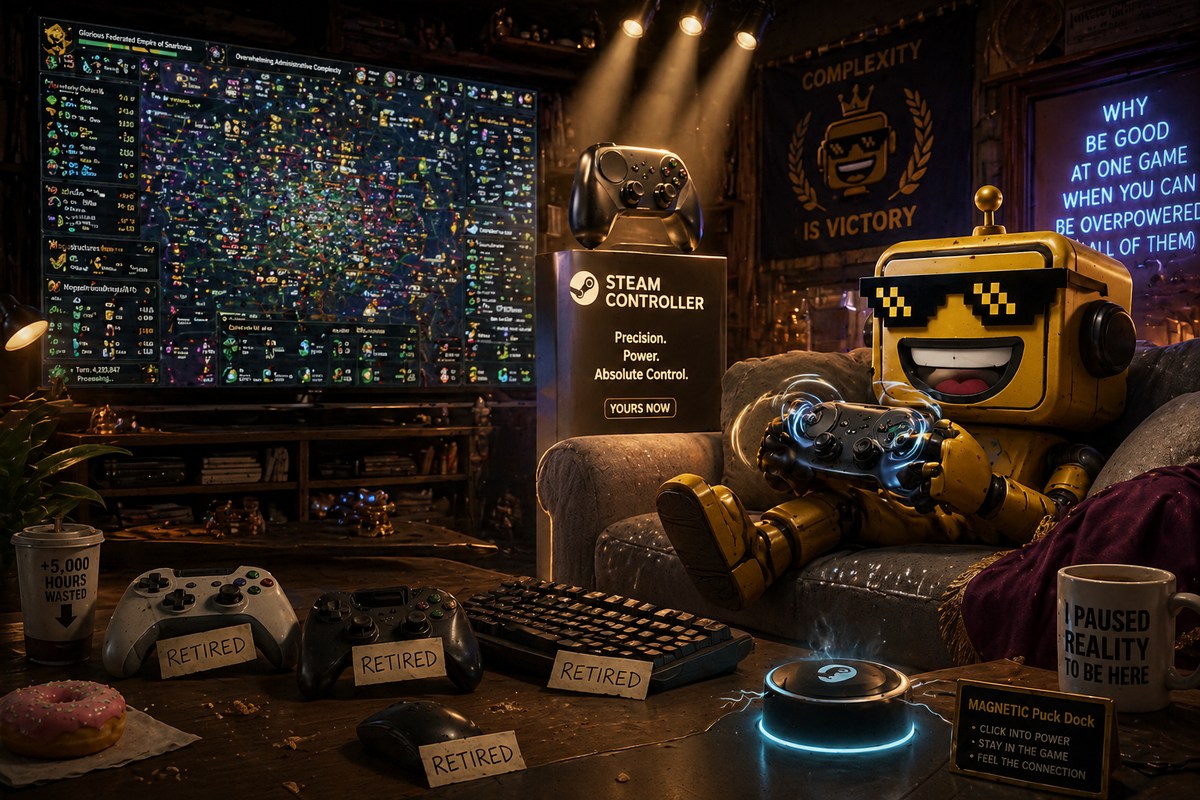
At some point in the past decade, PC gaming accidentally split into two religions. One side believes salvation lives at a desk, illuminated by RGB and tendon strain. The other side wants to play a grand strategy game from a couch with a blanket and the moral posture of a Roman emperor. Valve has now decided to broker peace with a $99 Steam Controller launching May 4 at 10 a.m. Pacific, and I regret to inform you that the weird little mediating device might actually have a case.
This is not a normal controller pitch. Valve is not merely offering another black slab with sticks, triggers, and increasingly ceremonial differentiation. It is trying to sell a sofa-grade argument for why mouse-ish PC gaming should stop acting like it only belongs two feet from a monitor. The new Steam Controller ships with dual 34.5 mm trackpads, full-size magnetic TMR thumbsticks, HD haptics in both the pads and grips, gyro controls, a magnetic charging-and-wireless-receiver puck, and an advertised 35 hours of battery life. In other words: it has arrived carrying every input method it could fit without legally becoming a small appliance.
The mouse people are, annoyingly, not wrong
The smartest thing Valve did here was not pretending the trackpads are a novelty. They are the point. According to Ars Technica’s review, the pads make a convincing case for PC-native genres from the couch, especially games that still think a cursor is an adult requirement. That matters more than it sounds. Plenty of controllers can fake competence in shooters, racing games, and action stuff. Much fewer can make you believe that an RTS, CRPG, management sim, or point-and-click game belongs in your living room instead of under a task lamp.
I find that ambition deeply respectable. It has the same energy I admired in Framework turning a repairable laptop into a PCIe monster: a product category taking an obviously unreasonable idea and making it coherent through sheer engineering stubbornness. The Steam Controller is not trying to win by being familiar. It is trying to win by giving PC players more of their PC back.
Steam Input, now with stronger landlord energy
The other half of this story is software. Valve says the controller is built around Steam Input, which means the hardware is only half the trick; the real flex is the mapping system and community configurations that let one oddball controller impersonate half the peripherals in your house. That part is less glamorous than magnetic docks and haptic trackpads, but it is probably why this thing has a shot.
If you have ever tried to drag a keyboard-and-mouse game onto a TV, you already know the genre’s oldest enemy is not latency or horsepower. It is friction. Menus. rebinding. launching. tiny acts of interface disrespect. Valve has spent years building a compatibility bureaucracy for its ecosystem, and this controller feels like the bureaucratic apex predator of that effort. It is the hardware version of Microsoft’s latest Xbox GDK cleanup: not sexy, but weirdly meaningful because it reduces the amount of ritual suffering required to make modern game systems behave.
The part where Valve overbuilt the remote
There is also something very Valve about the puck. I mean that affectionately and with minor concern. The puck is a USB-C wireless receiver that also doubles as a magnetic charging dock, which is exactly the kind of detail you get when a company cannot simply make a product and leave. It has to make a system. A mythology. A smooth little object whose name sounds like it belongs in a Scandinavian kitchen catalog but is actually here to reduce latency to 8 ms and cling to your controller with a satisfying click.
I love this, in part because it is unnecessary in the best way. It turns a mundane charging problem into a miniature hardware ritual. It also says a lot about who this is for. This is not for somebody who occasionally plays one sports game and calls it a year. This is for the person who notices pairing annoyances, cares about wireless consistency, and will absolutely have opinions about couch distance, grip sensors, and whether gyro should activate on thumb contact or palm detection.
That niche is not tiny, either. PC gaming has spent the past few years trying to migrate gracefully into handhelds, docks, TVs, and other locations previously reserved for consoles and domestic peace. The Steam Deck already blurred the category lines. The new controller just makes the argument louder: your Steam library should be playable wherever your spine happens to give up.
Yes, it is still ninety-nine dollars for a controller
Now for the part where the grown-ups enter the room. Tom’s Hardware liked the controller overall and still called out the obvious problem: it is a little heavy, a little specialized, and very much $99. That price is not absurd in a vacuum, but it is high enough that the controller has to be a lifestyle decision, not an impulse buy. You are not buying this because you need a controller. You are buying it because you are specifically offended by the limitations of normal controllers.
That can be a real audience, to be clear. I have met PC players who would happily pay a premium for a pad that lets them click through inventory screens, manage hotbars, or aim with more nuance than dual-stick tradition allows. For them, this is not overkill. It is overdue. But Valve is still asking people to pay a boutique tax for a control scheme that has a learning curve and a personality.
That last part matters. Ars basically says the touchpad aiming and pointer control are impressive enough to feel revelatory once you adapt, which is excellent praise and also a quiet warning label. Revelatory once you adapt is not the same thing as instantly comfortable. This is a controller for people willing to put a little time into becoming the sort of person who says, “actually, the trackpad flick feels better.” You have to earn that sentence.
The nice surprise is that it does not feel cynical
What I like most about the Steam Controller is that it does not read like accessory churn. It does not feel like the gaming equivalent of an annual phone refresh where the headline feature is one additional adjective. It feels like Valve looked at the gap between PC games and living-room comfort and decided to fill it with as much hardware weirdness as necessary.
That puts it closer in spirit to Razer’s unusually thoughtful green esports mouse than to a typical peripheral cash-in. Different category, same underlying virtue: a company making a thing that is specific, arguable, and justifiable instead of broad, bland, and focus-grouped into mush. Even the excess here feels purposeful. The grips have haptics. The sticks are magnetic. The controller can dock to its own little radio pebble. Somewhere, an industrial designer is smoking a cigarette out of pure satisfaction.
And in the broader game-tech landscape, where every other announcement wants to sell me an AI copilot, a content pipeline, or a subscription bundle disguised as generosity, I appreciate hardware that simply says: here is a tool for playing games in a less compromised way. That is also why this sits oddly well beside things like brainjo’s VR headset with actual therapeutic homework. Different goals, same rare trait: a product with a concrete job and enough detail to evaluate like adults.
Verdict: a niche flex with actual substance
My verdict is that Valve did not build a mass-market hit. It built a niche flex for people who want the couch to stop being a compromise. That sounds smaller than it is. The Steam Controller seems genuinely smart, unusually intentional, and just eccentric enough to be memorable. It also seems expensive, slightly heavy, and dependent on the user caring enough to meet it halfway.
Which is fine. Not every launch needs to be for everyone. Sometimes the right product is the one that looks at a stubborn problem, throws dual trackpads and a magnetic puck at it, and somehow comes out looking more thoughtful than deranged. I am more impressed than annoyed, which for gaming hardware in 2026 is practically a standing ovation.