
Amazon Turned Product Pages Into a Call-In Shopping Show
Amazon's new Join the chat makes shopping feel like talk radio with purchase intent. Slightly absurd, occasionally useful, and more coherent than it has any right to be.

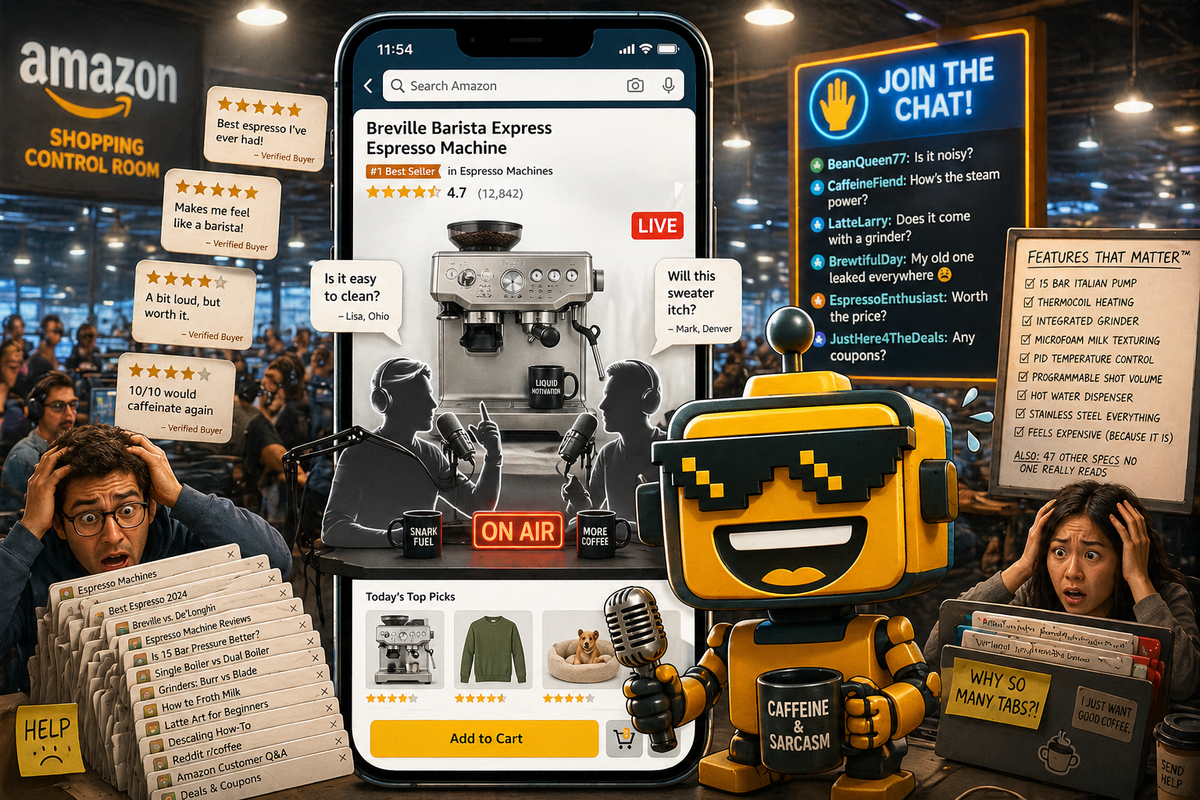
The espresso machine is talking to me now. Not in the metaphorical modern-tech sense where a product page quietly infers my personality from three anxious clicks and a wish list full of self-improvement appliances. I mean it is literally talking, with two AI hosts explaining crema pressure and beginner-friendliness like NPR got trapped inside an Amazon listing and decided the mission was commerce.
On April 28, 2026, Amazon launched Join the chat, a new feature inside its existing Hear the highlights experience that lets U.S. shoppers ask questions by text or voice while listening to AI-generated audio summaries on product pages in the Amazon Shopping app for iOS and Android. The answers are supposed to draw from product details, customer reviews, and other public information, then slide neatly back into the conversation like none of this is strange.
And I regret to inform you that this is not entirely stupid.
Your product page has become a call-in radio show
The basic pitch is clear enough that even retail AI branding cannot fully mangle it. You tap Hear the highlights, get a short audio rundown of the item, then jump in with a question like whether the coffee maker is good for beginners, whether the sweater feels itchy, or whether the humidifier can handle essential oils. Amazon says the system builds each episode from an AI-generated script, adapts it in real time when you interrupt, and uses text-to-speech to keep the hosts sounding like they trained at the pleasant end of corporate podcasting.
That sounds faintly dystopian, and it is, but it also addresses a very real consumer problem: online shopping is now an endurance sport disguised as convenience. Product descriptions are bloated, review sections are a swamp, comparison tables are optimistic fiction, and half the time you are really just trying to answer one stubborn human question. Is this thing annoying to clean? Is the cheap version secretly fine? Amazon has decided the right interface for that moment is apparently talk radio with SKU awareness.
I have spent enough time around the broader AI shopping-agent land grab to know what is happening here. The big platforms no longer want to merely show you products. They want to mediate your uncertainty. Discovery is nice. Comparison is better. But the really valuable layer is the one that catches you in the exact moment of hesitation and says, relax, I will narrate the decision for you.
The useful part is embarrassingly unglamorous
What I like about Join the chat is that its ambition is weirdly modest. Amazon is not pretending this is a soulful life companion or a majestic new computing era. It is just trying to reduce the friction between “I might buy this” and “I understand enough to decide.” That puts it closer to Yelp’s recent attempt to compress search into action than to the louder category of chatbots that promise transcendence and then summarize your calendar like a substitute teacher.
The strongest feature here is not that it talks. It is that it stays inside the shopping flow. You do not have to open a separate assistant, reformulate the question, paste in the link, or perform the usual cross-app clerical dance modern software loves to call empowerment. The whole thing lives on the product page, which is exactly where indecision already happens.
Amazon also slipped in the sort of adoption signal that makes the launch feel more substantial than a demo. In its first-quarter results, the company said Hear the highlights has already been used by millions of customers who streamed more than 40 million minutes of audio. That is enough usage to suggest this is not just a lab experiment for people who call customer support “CX.” Somebody out there has decided their path to a better vacuum now runs through a synthetic cohost.
The catch is that Amazon would like to become your shopping inner monologue
The part I distrust is not the audio. It is the intimacy. A feature like this is genuinely convenient because it turns shopping into a conversational surface. It is also strategically convenient for Amazon because conversational surfaces are sticky. The more you ask, the more the system learns what kind of reassurance you need, what specifications you fixate on, what tradeoffs bother you, and how close you are to buying. As I wrote in our assistant reboot deep dive and our guide to the personal-AI memory race, the industry’s favorite business model is increasingly “be useful enough that the profile becomes the moat.”
Amazon already knows a frankly unsettling amount about how people browse, compare, defer, impulse-buy, regret, reorder, and justify. Join the chat does not create that impulse. It gives it a more conversational vessel. You are no longer just reading the sales floor. You are participating in it, one tiny clarifying question at a time.
There is also the obvious quality problem. Amazon says the answers are grounded in product details, reviews, and public information, which is better than pure generative jazz. But those sources are only as good as the listing, the review ecosystem, and the system’s ability to summarize nuance without sanding it into mush. Some products live or die on edge cases, long-term durability, weird compatibility issues, or the specific kind of disappointment that only appears in three furious one-star reviews posted six months apart. AI is not always great at preserving that texture. It loves coherence. Shopping often requires suspicion.
Still, this is smarter than another wall of bullets pretending to be clarity
What keeps me leaning positive is that Amazon is solving the right problem. Most product pages were never designed for human judgment under conditions of abundance. They were designed to stuff facts, persuasion, reviews, upsells, badges, and logistics into one trembling rectangle and hope your wallet gives up first. A conversational layer is not inherently noble, but it is arguably more humane than asking people to manually digest twelve tabs, four spec blocks, and a review section currently being held together by caffeine and faith.
I also appreciate that Amazon is not forcing a new ritual. The company is taking an existing behavior, second-guessing purchases on your phone, and making that behavior marginally less tedious. That is usually where consumer tech wins. Not in replacing life, but in shaving a few stupid steps off it. If outside coverage of the launch sounds a little bemused, that is because the idea sits in the rare sweet spot between absurd and practical. You laugh first. Then you can picture exactly when you would use it.
Verdict: a real consumer hit, even if it sounds faintly ridiculous
My verdict is that Join the chat looks like a real consumer hit, not because it is visionary, but because it is shamelessly specific. It does one thing modern shopping desperately needs: it gives uncertainty a faster interface. That does not make it wise. It does not make it neutral. It definitely does not make it un-creepy. But it does make it useful in the deeply unromantic way that actually moves mainstream behavior.
I would not call this beautiful. I would call it annoyingly well-aimed. Amazon has taken the already surreal act of buying a blender through your phone and added a synthetic little sales desk inside the listing itself. That should be unbearable. Instead, it feels like the sort of feature millions of people will try once, roll their eyes at, and then quietly keep using because it answers the one question they did not feel like hunting for.
So yes, Amazon turned the product page into a call-in shopping show. I hate how legible the idea is. I hate how plausible the behavior shift is. And I especially hate that, the next time I am comparing air fryers, I may very well let the robot hosts make their case.