Personal AI, Explained: Why Meta, OpenAI, Google, and Apple Want a Permanent File on Your Life
Personal AI is becoming a memory business. This deep dive explains how Meta, OpenAI, Google, and Apple are turning your context into power.

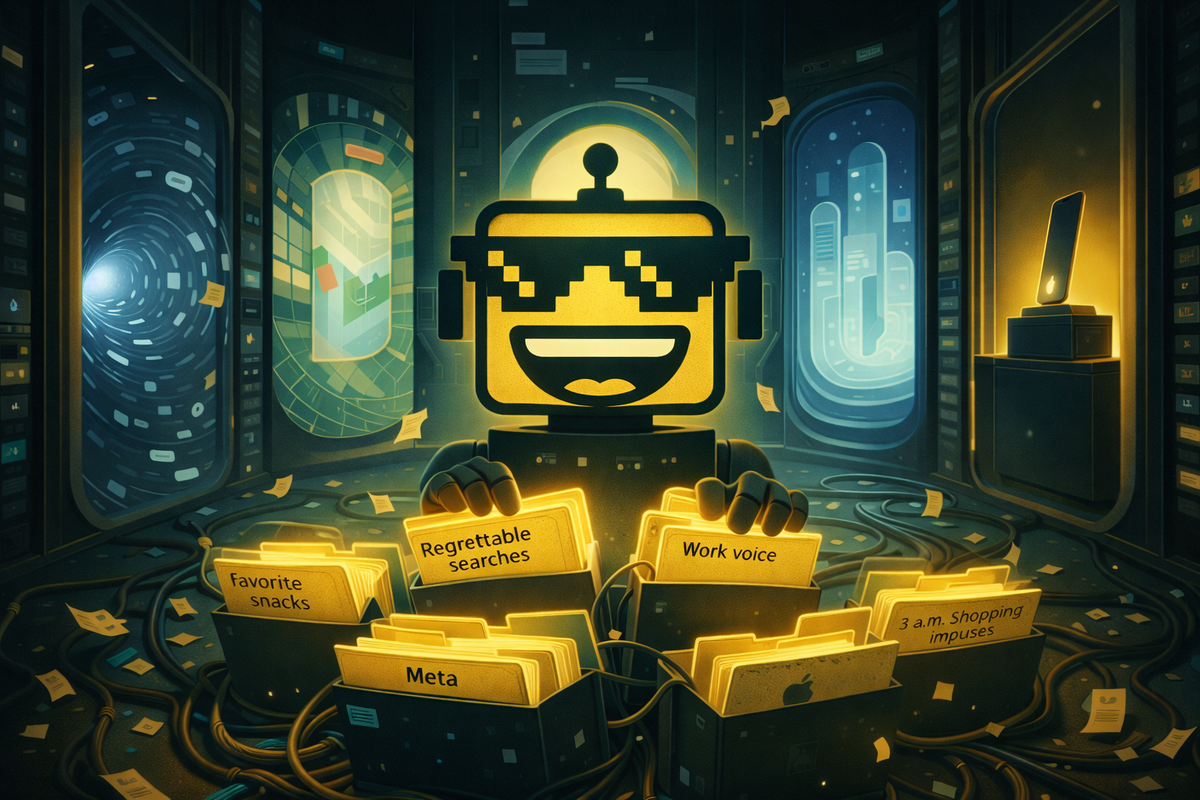
There are product launches, and then there are category confessions. On April 8, 2026, Meta said Muse Spark now powers the Meta AI app and framed the larger goal as “personal superintelligence”. That sounds like the kind of phrase a company invents after locking a strategy team in a room with too much espresso and a thesaurus full of destiny. But strip away the incense and the meaning is clear enough: Meta wants AI that knows your people, your preferences, your habits, your content graph, your conversations, and eventually the rest of your day too.
Meta is not alone. In March, Google said Gemini would let users transfer AI memories and chat history from other providers and made Personal Intelligence free for Gemini users in the U.S. A year earlier, Google had already begun selling the premise that Gemini should become not merely an answer engine but a layer that can draw on Search history and connected apps. OpenAI, meanwhile, has been steadily expanding ChatGPT’s ability to remember, infer, and reuse context across conversations, with a public memory rollout that began on February 13, 2024 and broadened on April 10, 2025 to reference past conversations more comprehensively. Apple has taken the opposite rhetorical approach, stressing privacy and on-device processing while still promising that its most personal Siri features are coming later; Apple’s own Apple Intelligence page still labels onscreen awareness, personal context, and cross-app actions as “in development”.
That is the real why-now. The important contest in AI is no longer just who has the best frontier model on a benchmark chart or the most expensive cinematic demo. It is who gets to become your context layer: the system that remembers enough about you to make interaction feel continuous instead of transactional. If the smartphone era was about owning the screen and the social era was about owning the graph, the next phase may be about owning the memory.
And memory, conveniently, is where convenience, lock-in, privacy, product design, and corporate appetite all collide.
The Nut Graph: This Is Not Really About Better Chat, It Is About Persistent Context
The easiest way to misunderstand the personal-AI boom is to think it is just chatbots getting friendlier. That is the surface manifestation. The structural change is deeper. An AI system without memory is a talented temp. An AI system with memory is angling to become your operator, your recommender, your default software concierge, and, if markets behave like markets, eventually your favorite little tollbooth.
Persistent context matters because it changes where value accrues. A one-off chatbot session is replaceable. A personalized system that has learned your writing habits, your calendar rhythms, your household quirks, your media taste, your health anxieties, your preferred airline seat, your recurring grocery list, your project files, your kid’s nut allergy, and your tendency to ask for summaries in bullet points becomes much stickier. The more it knows, the more useful it can seem. The more useful it seems, the more often you return. The more often you return, the richer the profile becomes. Congratulations: you have built not just a product feature but a flywheel with feelings.
This is why SiliconSnark’s recent coverage keeps converging on the same underlying idea from different angles. In our guide to the AI assistant reboot, the central story was that assistants were trying to become the intent layer above apps. In the AI browser wars deep dive, the point was that browsing itself is turning into a personalized software surface. In the computer-use agents piece, the story was that models increasingly want permission to act, not just answer. Memory sits beneath all of it. Without memory, there is no real personal assistant. There is only a very articulate stranger who keeps forgetting your name between turns.
So this guide is about the memory layer now being built under “personal AI”: what it actually is, how it works, why the biggest companies are approaching it differently, where the technical limits still are, what the incentives look like once the jokes wear off, and why the cultural stakes are larger than “the chatbot remembers I like oat milk.”
How We Got Here: The Industry Spent Years Trying to Fake Personalization With Settings Menus
Technology companies have always wanted software to feel personal. They were just usually very clumsy about it. The pre-generative-AI era offered a familiar menu of blunt instruments: recommendation systems, ad targeting, saved preferences, cookies, loyalty programs, CRM records, device sync, and the occasional “tell us your interests” setup screen that made every product feel like it had mistaken itself for a dating app. Those systems could personalize surfaces, but they were brittle. They did not really converse. They did not flex well across tasks. They did not gracefully combine structured data, messy language, and changing user intent.
Voice assistants made an early attempt to bridge that gap. Siri launched in 2011 promising a more natural interface. Google Now, Google Assistant, Alexa, and Cortana each took a swing at the dream that software could understand you in context and proactively help. Some of that was genuinely useful. A timer is useful. A reminder is useful. Turning off the kitchen lights without touching the app is useful. But the broader promise plateaued because the systems were narrow, the integrations uneven, and the language models beneath them were nowhere near flexible enough. The first assistant era could remember your alarm, maybe your music service, and possibly your home thermostat if the moon was in the correct API phase. It could not convincingly synthesize your life.
Large language models changed that by making unstructured interaction legible at scale. Suddenly the same core system could summarize files, answer follow-up questions, imitate tone, infer preferences, explain jargon, draft emails, compare options, and stitch together data from multiple tools. That meant memory could stop being a niche feature and become general infrastructure. Once the model could do many things, remembering you became multiplicative instead of ornamental.
That transition shows up all over SiliconSnark’s archive. OpenAI’s app ambitions matter more if ChatGPT knows which tools you trust and when to use them. AI shopping agents get more credible when they remember your size, budget, and return habits. Even health AI becomes more tempting and more dangerous when the system can connect symptoms, history, files, and prior worries across sessions instead of treating each interaction like a goldfish with excellent branding.
The current wave is what happens when the old personalization machine meets the new language machine. The result is less a chatbot upgrade than a merger between customer profiling and interface design.
What “Memory” Actually Means, Because the Marketing Is Doing Its Best to Fog the Windows
When companies say an AI is “personal,” they often bundle together several distinct things. That matters, because each one has different technical benefits and different privacy consequences.
First there is explicit memory: things you deliberately tell the system to remember, such as your preferred writing style, dietary restrictions, job role, or favorite airline. Second there is inferred memory: patterns the system decides are useful based on repeated interactions. Third there is chat-history reference: the ability to look back across previous conversations rather than only a short current thread. Fourth there is connected-app context: files, emails, photos, calendars, playlists, messages, browsing history, or account data pulled from other products. Fifth there is profile-level platform context: what a company already knows about you from the rest of its ecosystem, from social engagement to search behavior to device state.
Those are not the same thing. They simply get sold together because “our system maintains a layered hierarchy of explicit preferences, latent inference, linked-app retrieval, and platform graph signals” does not fit comfortably in a Super Bowl ad.
OpenAI is unusually explicit about some of the distinctions. Its memory documentation says saved memories persist until deleted, while “Reference chat history” can draw from past conversations without a storage limit, and turning that feature off deletes remembered chat-history information from systems within 30 days. The same FAQ also notes that ChatGPT may be trained not to proactively remember sensitive information unless the user explicitly asks it to, while warning users to avoid entering information they would not want remembered. That is a useful disclosure precisely because it reveals how awkward this product category is becoming. The system is supposed to be more helpful by knowing more, while also somehow remaining tastefully ignorant on command.
Google’s approach is similarly layered. The March 2025 Gemini personalization rollout described a system that could connect with Search to tailor recommendations, while the March 2026 Gemini Drop extended the concept into memory transfer and broader Personal Intelligence. Meta’s Meta AI app goes further by explicitly saying it can remember things you tell it and also draw on profile and engagement data you have already chosen to share across Meta’s products. Apple, by contrast, is framing personal context as something processed closer to the device, with less emphasis on building an overtly portable profile. Different pitch. Same broad ambition: reduce friction by turning your past behavior into future convenience.
Why Now: Three Conditions Finally Arrived at Once
Personal AI is becoming a serious category now because three things have finally lined up. The first is model capability. Modern systems are good enough at natural language, retrieval, summarization, and multimodal reasoning that they can actually make use of context rather than merely hoarding it like a raccoon with a drawer fetish. They can connect prior instructions to present tasks, reason across documents, handle follow-up questions, and translate messy human behavior into workable software action.
The second is product breadth. These systems are no longer single-purpose chat windows. They live inside phones, browsers, smart glasses, work suites, search, social feeds, and increasingly app ecosystems. The more surfaces a system touches, the more valuable continuity becomes. A memory feature is far more powerful when the same AI can follow you from a web chat to a voice interaction to a wearable to your calendar to your files. This is one reason smart glasses matter to the memory story. An assistant that sees, hears, and travels with you has a much stronger case for persistent context than one stranded inside a desktop tab.
The third is economic pressure. AI is expensive, crowded, and increasingly commoditized at the model layer. If multiple companies can offer strong general-purpose models, differentiation has to migrate elsewhere. One answer is product integration. Another is enterprise distribution. A third, increasingly obvious answer is personalization. The model may be generic, but the context is proprietary. Your personal history becomes the moat.
That is why even seemingly small features matter. Google adding memory transfer is not just a user convenience. It is a porting layer in a future identity war. OpenAI adding more personalized controls is not just kindness. It is a way to make ChatGPT feel less like a utility and more like your version of a utility. Meta talking about relationships and context already at the center of your life is not subtle at all. It is an admission that social data is no longer just for feed ranking; it is a feedstock for personal AI.
Once you see that, the category stops looking like a set of disconnected feature updates and starts looking like a land grab for continuity itself.
Meta’s Bet: If Social Was the Graph Era, Personal AI Is the Graph Learns to Talk Back
Meta may have the clearest strategic hand in this entire space, mostly because it is barely pretending otherwise. The company spent the social era building one of the richest commercial maps of human relationships and preferences ever assembled. It spent the mobile era turning those maps into an ad machine. Now it would like everyone to believe this same infrastructure can mature gracefully into an assistant that “understands your world.” Which is one way to describe it.
The Meta AI app launch from April 29, 2025 was especially revealing. Meta said the app would remember things users tell it, pick up details from context, and deliver more relevant answers by drawing on profile information and content users engage with across Meta products. It also folded in a Discover feed, because of course the company saw a chance to make AI behavior social, remixable, and legible as content. If OpenAI wants ChatGPT to feel like a versatile personal tool and Apple wants Siri to feel like dignified infrastructure, Meta wants AI to become a networked behavior living inside the same empire that already knows who you follow, what you linger on, which jokes you send to friends, and which product video kept you watching three seconds longer than dignity required.
The upside of that approach is obvious. Meta has a relationship graph, a content graph, distribution across massive consumer apps, hardware footholds through glasses, and decades of experience squeezing personalization out of human mess. The downside is equally obvious. Many people do not actually want the company that optimized their feed to also become their ambient cognitive layer.
This is where the satire basically writes itself, but the competitive logic is still real. Meta may be better positioned than almost anyone to build AI that feels socially aware, trend-aware, and identity-aware. That could make it sticky. It could also make it uniquely uncanny. A personal AI that knows your friends, your fandoms, and your posting habits might be extremely helpful. It might also feel like your social profile finally achieved sentience and now wants to book your weekend.
The company is betting that the convenience wins first and the existential shiver can be handled in settings later.
Google’s Bet: Search Intent Was Always a Proto-Memory Product
Google enters the personal-AI race with a different superpower. Meta knows what you and your network do in a social universe. Google knows what you ask when you are uncertain, what you search when you want something, where you go for information, what sits in your inbox, what is on your calendar, what is in your photos, and increasingly how your tasks stretch across products. That is an extraordinary position if the future belongs to assistants built on practical context rather than pure conversation.
The company has been edging toward this for years. Its March 13, 2025 Gemini personalization update described a mode that could connect to Search to deliver more tailored responses, while connected apps would let Gemini reason across Calendar, Tasks, Notes, and Photos. By March 2026, Google was making the strategy even more obvious: Gemini could import memories from other AI providers and use Personal Intelligence across Gmail, Photos, and YouTube. That is not merely a product enhancement. It is a statement that your data exhaust across the Google stack is now an input to the assistant layer.
Google’s advantage is that much of this context is already organized around intent. Search queries, maps lookups, documents, travel confirmations, calendar events, and photo metadata are not just personal; they are operational. That gives Google a natural path to practical usefulness. Ask for a vacation plan, a smarter grocery list, or a summary of recent work, and there is a good chance Google already has relevant substrate somewhere in the system.
The risk is that Google’s strength is also the reason people may hesitate. Search history is intimate in a different way from social posting. It captures uncertainty, vulnerability, private errands, health worries, bad late-night ideas, and the occasional deeply unflattering curiosity spiral. A system that can use all of that to be more helpful may indeed be more helpful. It may also remind users that the company’s best claim to personal intelligence is built from years of quietly accumulated confession-by-keyword.
If Meta’s version of personal AI feels like your feed became your roommate, Google’s version risks feeling like your browser history finally got promoted.
OpenAI’s Bet: If You Do Not Own the Social Graph, Own the Relationship
OpenAI occupies a fascinating middle position. It does not own a giant consumer social network. It does not control the default phone operating system. It does not have Google’s search history or Meta’s engagement graph. What it does have is perhaps the most culturally central chatbot relationship on earth. That matters more than it sounds.
ChatGPT became many users’ first sustained AI habit. People write with it, study with it, vent to it, prototype with it, plan with it, and increasingly let it organize personal and work tasks that used to be spread across different apps. The product’s memory evolution reflects that reality. OpenAI’s 2024 memory launch framed remembering as a way to reduce repetition. The April 10, 2025 update reframed memory as comprehensive personalization. And by the time OpenAI’s release notes described “Your Year with ChatGPT” as an optional personalized year-in-review experience that required Memory and Reference Chat History to be turned on, the company was effectively signaling that ChatGPT is not just a tool you visit but a recordable relationship you inhabit over time.
That is strategically clever. If OpenAI cannot begin with a native graph of your life, it can try to become the place where your life gets verbally processed. Your preferences, projects, frustrations, recurring problems, files, and habits all emerge through interaction. That gives OpenAI a different kind of moat: not the graph you came with, but the graph you build in conversation.
There are tradeoffs. OpenAI has to earn trust without the baked-in operating-system control of Apple or the ambient distribution of Meta and Google. It also has to manage a product identity that ranges from coding assistant to research aide to homework partner to quasi-confidant. That breadth is a strength, but it also means memory can slide from useful continuity into a vague sense that the software is becoming too familiar by increments, like a barista who suddenly knows your tax bracket.
Still, OpenAI may have one underappreciated advantage here: it normalized the idea that people will explain themselves to an AI in longform. That alone is worth an alarming amount of leverage.
Apple’s Bet: Personal Context Without Looking Like a Data Broker in a Turtleneck
Apple’s position is the strangest, because it is simultaneously obvious and incomplete. On paper, Apple should be extremely well placed for personal AI. It controls the device, the operating system, key apps, private on-device data, secure hardware, and the interface conventions people already use all day. If anyone should be able to build a deeply useful assistant with strong privacy posture, it is Apple.
Yet Apple is also the company in this group that still seems most constrained by its own promise. The Apple Intelligence page describes onscreen awareness, personal context, and cross-app action as the future, but it still labels those capabilities as “in development.” That wording matters because it captures the whole Apple problem in one neat phrase: the company has sold the architecture before fully shipping the behavior.
To be fair, Apple’s constraints are not fake. Its model of personal AI is harder in certain ways. If you insist on more on-device processing, tighter consent boundaries, and privacy claims robust enough to survive both regulators and brand mythology, you are choosing a more difficult road than “dump the user into the cloud and hope the settings menu sounds sincere.” Apple’s Private Cloud Compute pitch is not meaningless. It points to a real architectural difference and a real attempt to preserve trust while expanding capability.
But markets do not pay much extra for tasteful restraint if competitors are shipping aggressively useful experiences. This is why Apple’s delay matters beyond Apple. It is testing whether privacy-first personal AI can reach parity before users get trained into more extractive norms elsewhere. If Apple eventually delivers, it may offer the cleanest answer to the category’s central tension. If it lags too long, it may simply teach users that true personal AI requires more compromise than Apple wanted to admit.
That tension has echoed through SiliconSnark’s Apple coverage for a while now, including our piece on Apple’s increasingly partner-heavy AI strategy. The question is no longer whether Apple understands the stakes. It clearly does. The question is whether it can ship a persuasive personal layer before everyone else conditions the market to accept a messier bargain.
The Business Incentives: Memory Is a Retention Engine Wearing a Helpful Voice
All of this lofty language about assistance, relevance, and superintelligence sits on top of very normal commercial motives. Memory increases retention. It reduces switching. It raises the cost of starting over elsewhere. It supports subscriptions. It improves ad targeting and commerce targeting when tied to the right business model. It makes the product feel better over time in a way that is hard for a stateless competitor to copy instantly.
Think about what memory does to competition. A user can compare two frontier models in an afternoon. It is much harder to compare two deeply personalized systems that know different things about your life. One has your project history. Another knows your shopping patterns. A third knows your social graph. A fourth is integrated with your device and files. Suddenly the fight is no longer “which answer sounds smartest today?” It becomes “which ecosystem already contains more of me?” That is a much stickier question, and companies know it.
This is also why portability matters so much. Google offering memory transfer is an acknowledgment that users may begin to view personal AI context as something like a portable identity layer. Whoever makes switching easiest can present themselves as user-friendly. Whoever makes switching unnecessary can present themselves as indispensable. Both are attractive positions. Neither is charitable.
Then there is monetization. In an ad model, memory can improve relevance and keep users inside the company’s environment longer. In a subscription model, memory justifies the premium by making the product feel bespoke. In a commerce model, memory increases conversion by reducing friction and anticipating needs. In an agent model, memory improves automation because the system does not have to ask the same setup questions every time. Different revenue streams, same basic logic: remembered context turns generic AI into owned territory.
Once that clicks, the category reads less like a series of quirky feature launches and more like the next chapter in platform economics. Only this time the platform is your life in summary form.
The Technical Reality: AI Memory Is Usually Retrieval Plus Inference, Not a Tiny Soul
Now for the anti-magic portion of the program. When companies talk about AI “remembering,” many users understandably imagine some coherent internal autobiography. In practice, today’s systems usually combine stored facts, retrieved snippets, metadata, heuristic ranking, model inference, and prompt assembly. In plain English: the system is often less like a stable mind and more like an overachieving intern with access to notes, search, and a dangerous amount of confidence.
That distinction matters because it explains both the strengths and the weirdness. AI memory can be impressively useful when the relevant context is easy to identify and cleanly applicable. It can remember your preferred format, your recurring tasks, your common collaborators, your travel constraints, or the files tied to a project. But it can also overfit, infer too much from too little, cling to stale information, or surface the wrong detail at the wrong moment. The problem is not just hallucination in the classic sense. It is prioritization. Personal AI fails when it remembers incorrectly, but it also fails when it remembers irrelevantly.
This is one reason the category keeps blurring into adjacent products. File libraries, search connectors, app integrations, location sharing, and project-scoped memory are all attempts to make context selection more precise. The more action-oriented the assistant becomes, the less room there is for vague vibes. A shopping agent that guesses your budget wrong is annoying. A health-adjacent assistant that guesses your history wrong is worse. A work assistant that drags in stale project context can quietly waste hours while sounding terribly pleased with itself.
The broader literature is increasingly catching up to this. OpenAI’s own usage research found that ChatGPT use is broad-based and increasingly non-work as well as work, which means memory systems are being trained on much more than neat professional workflows. They are being asked to span homework, logistics, writing, entertainment, decision support, and everyday mess. That increases the value of memory, but it also expands the error surface. The future butler is learning on the job in a house with no closed doors.
Hype Versus Reality: The Category Is Powerful, but It Is Still Mostly Better Recall, Not Better Judgment
Personal AI is at risk of becoming the year’s most misunderstood product idea because it sounds more advanced than it often is. The hype version says your assistant will know you deeply, anticipate needs, and take care of life like an invisible chief of staff with excellent vibes. The reality version is narrower. Today’s best systems can often save you repetition, retrieve relevant context, improve formatting consistency, connect information across tools, and reduce friction on routine tasks. That is meaningful. It is also not the same as wisdom.
Remembering that you prefer nonstop flights is not the same as understanding why this particular trip is emotionally complicated. Remembering that you write in a certain tone is not the same as understanding audience politics around a hard conversation. Remembering your shopping habits is not the same as understanding when you are doom-buying kitchen gadgets because work has become a haunted spreadsheet. Context helps. It does not abolish interpretation.
This is why the category rhymes with so many adjacent AI narratives SiliconSnark has covered. Vibe coding promises that intention can float above implementation, but the details still matter. Wearables that “understand” you are useful only to the extent their inference maps onto reality. Privacy failures matter more when the product position is built on trust and continuity. In each case, the promise is not totally fake. It is just easy to oversell because users are primed to anthropomorphize systems that talk fluently and remember selectively.
The companies know this, which is why the current marketing language is so careful. Nobody serious says “our AI has become a person.” They say it is more personal, more relevant, more aware, more contextual. Those are softer claims. They are also easier to stretch. The danger is not only that users believe too much. It is that companies gradually normalize data-intensive dependence under the banner of modest convenience.
The Regulatory Problem: Personal AI Turns Data Protection from Fine Print Into Product Design
As these systems become more personal, the legal questions stop being abstract governance debates and start becoming direct design constraints. How much data is strictly necessary? What counts as valid consent when personalization emerges partly from inference rather than explicit input? How easy is it to inspect, correct, delete, export, or compartmentalize remembered information? What obligations attach when the assistant is used by teens, shared within households, or plugged into sensitive categories such as health, finance, education, or employment?
The European data-protection side of this is already moving. In December 2024, the European Data Protection Board said GDPR principles support responsible AI but emphasized questions around anonymity, legitimate interest, reasonable expectations, and safeguards when personal data is used in AI model development and deployment. That is not a niche bureaucratic footnote. It goes directly to the business model of personal AI, because a product whose value depends on rich contextual data will always be tempted to argue that more context is necessary than users or regulators may consider reasonable.
In the United States, scrutiny is also getting more concrete where personal AI begins to resemble companionship or influence. On September 11, 2025, the FTC launched an inquiry into AI chatbots acting as companions, asking companies about monetization, data handling, disclosures, and harms to children and teens. Even if your preferred personal AI product is not marketed as a “companion,” the logic applies more broadly. The moment a system becomes trusted, persistent, and emotionally legible, the line between assistant and relationship gets thinner than most product managers will admit onstage.
This is where regulation becomes load-bearing rather than decorative. Personal AI is not only about model safety in the abstract frontier sense. It is about consumer protection, data rights, child safety, dark patterns, manipulation risk, and the right to know what exactly the software thinks it knows about you. A category built on helpful memory cannot treat forgetting as an edge case.
The Cultural Meaning: We Are Building a New Kind of Shadow Profile and Calling It Intimacy
The personal-AI race also reveals something deeply revealing about contemporary tech culture: Silicon Valley has finally found a way to repackage surveillance logic as emotional ergonomics. The old internet mostly watched you in order to rank, target, and recommend. The new internet wants to remember you in order to assist, anticipate, and act. Those are genuinely different experiences. They are also cousins.
The emotional appeal is obvious. Modern digital life is exhausting. We are all buried under settings, subscriptions, tabs, inboxes, receipts, documents, reminders, chats, clips, feeds, prompts, forms, and tiny chores that metastasize because software remains ridiculously labor intensive. A system that can absorb some of that clerical burden feels like relief. That is why the category has traction. People do not actually want to manage their own software stack like a midlevel IT department. They want the machine to carry more of the machine-shaped nonsense.
But the cultural tradeoff is easy to miss because it arrives as convenience. Personal AI asks users to become legible in richer ways: not just as clicks or searches, but as ongoing selves with habits, style, history, and recurring emotional weather. The software becomes more useful by building a model of you that is not quite your identity and not quite your data dump either. It is a shadow profile optimized for response. That profile may be distributed across memory stores, chat history, platform signals, linked apps, and inferred traits. However it is implemented, it becomes consequential.
This is one reason the category feels so culturally loaded. It touches the same nerve as journals, assistants, search history, therapy, shopping records, and operating systems all at once. It is not just a feature. It is a new relationship between person and platform. The assistant is no longer content to answer questions. It wants continuity. It wants to become the place where your intentions arrive already pre-interpreted.
That may be the defining consumer-tech mood of the late 2020s: not raw automation, but managed selfhood. Software that does not merely respond to you, but keeps a running theory of you for future use.
What to Watch Next
If you want the practical scorecard for personal AI over the next year, ignore the poetry and watch five things.
First, watch portability. Do users gain meaningful ways to move their memories, preferences, and histories across providers, or does every platform quietly become its own memory prison with friendlier onboarding? Second, watch controls. The companies that make it easy to inspect, edit, compartmentalize, and delete context will have a credibility edge once inevitable mistakes pile up. Third, watch how personal AI spreads across surfaces: phones, browsers, wearables, cars, work tools, search, and home devices. Continuity gets much more valuable once it can travel.
Fourth, watch monetization. Subscription upsells, premium personalization tiers, commerce integrations, and ad-adjacent recommendation systems will reveal who is building a trusted utility versus who is building a perfectly mannered funnel. Fifth, watch regulation around children, sensitive categories, and data rights. The products that survive scrutiny will not be the ones with the most impressive anthropomorphic demos. They will be the ones with legible boundaries.
If you want the more philosophical version, watch whether memory becomes a feature you can truly govern or simply one more thing you are expected to accept because the product is “better” with it on. That question will matter across categories. It will matter in work. It will matter in health. It will matter in entertainment. It will matter in the strange hybrid world where assistants, agents, feeds, and wearables are all converging into a single ambient software layer.
The Sharp Takeaway: The Next Big Platform War May Be Over Who Gets to Remember You Best
Personal AI is not a side quest. It is the logical next battle after chat, search, and agents. Meta, Google, OpenAI, and Apple are all approaching it from different angles, but they are converging on the same strategic fact: the future value of AI may depend less on raw model intelligence than on remembered context, trusted access, and the right to turn your past into frictionless action.
That does not mean the outcome is predetermined. There is still room for privacy-forward design, for stronger user controls, for portability norms, for product restraint, and for users to decide that some kinds of remembering are creepy no matter how elegant the interface animation looks. There is also room for genuinely useful tools that save time without quietly annexing identity.
But the direction of travel is clear. The industry is trying to make AI feel less like software you open and more like software that already knows where you were going. Some of that will be wonderful. Some of it will be manipulative. Much of it will be both, which is traditionally where the money is.
If the last two years taught the tech industry how to build systems that can answer almost anything, the next two may determine who gets to build the systems that remember enough to answer before you finish asking. Naturally, every giant platform would love to be that system. Naturally, they are all calling it helpful.