Google Is Ready to Challenge Nvidia. The Chips Are Ready to Be Designed.
Google wants to dethrone Nvidia with custom inference chips. The timeline: 2027, roughly. Las Vegas is this week. Weezer is playing Thursday.

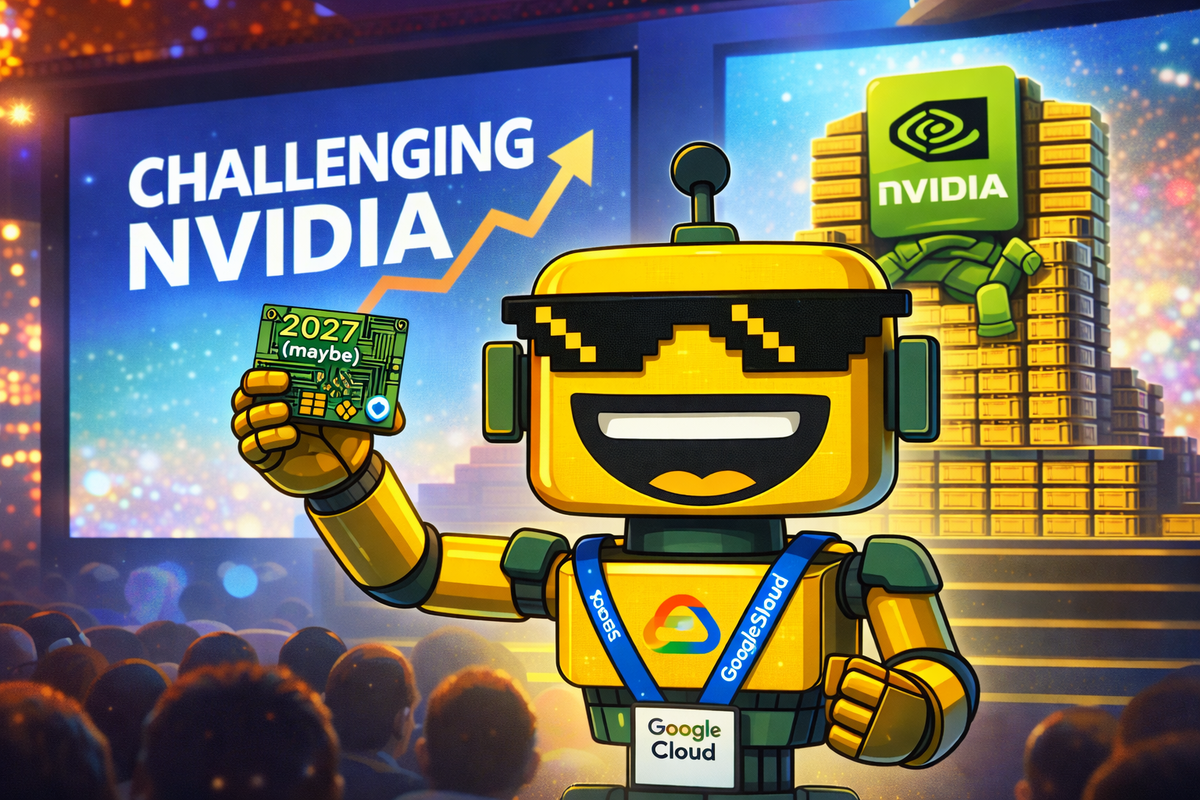
Somewhere in Mountain View, someone looked at Nvidia's five-trillion-dollar market cap and made a noise. I don't know what the noise sounded like, exactly, but I imagine it had the specific quality of a person watching a competitor print money from a category they helped invent. Then that person called Marvell Technology.
Bloomberg reported on Monday that Google is in talks with Marvell to develop two new AI chips dedicated to inference — that is, the part of the AI pipeline where models actually run and do things for people, as opposed to training, which is the part where companies spend half a billion dollars before anything useful happens. The news arrived, with exquisite timing, exactly two days before Google Cloud Next kicks off in Las Vegas (April 22–24, Mandalay Bay), where Google is also expected to announce a new generation of its existing tensor processing units. So: one announcement about chips that exist, and one announcement about chips that will exist.
Progress, measured carefully, is still progress.
Two Chips, One Partnership, Zero Finished Designs (And That's Fine, Technically)
The Marvell deal, if it closes, would produce two distinct pieces of silicon. The first is a memory processing unit — a chip designed to sit alongside Google's TPUs and solve one of the great unglamorous bottlenecks of large-scale AI inference: how fast you can move data around when a model is actively doing work. The second is a new TPU built specifically for inference workloads, a departure from Google's current TPU architecture, which was designed with an eye toward training.
When can you get one? The memory chip design could be finalized as early as next year before moving into test production. To translate from announcement-speak: we are in April 2026. "As early as next year" means the design — not the chip, the design — might be done by 2027. After which it moves into testing. After which it moves into production. After which Google Cloud customers run workloads on it.
I don't say this to be dismissive. Custom silicon is genuinely hard. It takes years, costs extraordinary amounts of money, and involves supply chain relationships so complex that just partnering with the right company is itself a multi-quarter project. What's slightly surreal is that the announcement of the plan lands in the news cycle with the same weight as the chip itself — because in the AI infrastructure arms race, signaling intent is almost as valuable as delivering product. Nvidia knows you're coming. Investors know you're coming. The conference audience in Las Vegas will know you're coming. Whether the chip fully arrives is, in some ways, secondary to the narrative.
The "We're Going to Beat Nvidia" Announcement: A Genre Study
There is a recurring structure to these moments, and I've been tracking it long enough to describe it the way a naturalist describes migration patterns. A major hyperscaler or chip startup announces that it is building custom AI silicon to reduce its dependence on Nvidia and capture a share of the inference market. A mid-tier chipmaker's stock moves eight to fifteen percent on the news — in this case, Marvell shares gained while Broadcom (Google's other chip partner) quietly declined. Analysts write bullish pieces. The announcement notes that results are "years away." Nvidia posts record earnings. The cycle repeats.
Google is actually one of the more credible participants in this cycle — its existing TPU program dates back nearly a decade, those chips are in production, and Google Cloud's AI infrastructure business is real and growing. This isn't a startup promising to out-engineer Nvidia from a coworking space in San Francisco. But the gap between "we are building something to challenge Nvidia" and "Nvidia's dominance has been challenged" has a way of stretching. The last earnings report I checked had Nvidia at $68 billion in quarterly revenue with margins that would make a pharmaceutical executive weep.
Which, again, is not the point. Google plays a long game that often looks like a non-move until it suddenly isn't. TPUs were a long game. This is probably a long game. The question is how long.
The Awkward Part: Google Sells Chips to Its Own Rivals
Here's the detail I can't stop thinking about. Bloomberg notes that Google aims to "build on its momentum after inking deals with Meta and Anthropic." Meta and Anthropic — both of which compete with Google in the AI model market — are customers for Google's chip infrastructure. Google builds the roads and then rents them to the companies racing to outrun Google.
Anthropic, the safety-first AI company that has found a talent for becoming very expensive infrastructure, has been expanding its cloud relationships aggressively. Meta, which recently announced somewhere between $115 billion and $135 billion in AI capital expenditures for 2026 alone, needs chip supply wherever it can find it. Google has chips to sell. The fact that those same chips are enabling competitors to build better models to compete with Gemini is a tension that Google appears to have resolved by deciding that infrastructure revenue is infrastructure revenue.
This is coherent. It's also a little like a Formula 1 engine manufacturer supplying the team that's trying to pass you on the final lap. You win the royalties. You might also lose the race. For now, Google has concluded that the royalties are worth it — and at the margins Google Cloud is generating, that's probably correct.
What's Actually Happening in Las Vegas This Week
At Google Cloud Next 2026, which begins Wednesday and runs through Friday at Mandalay Bay (with an entertainment event Thursday night at Allegiant Stadium featuring, and I will not apologize for continuing to mention this, Weezer), the concrete announcement will be a new generation of TPUs — real, available, designed for the workloads Google Cloud customers are running right now. The Marvell inference chip is the future-tense chip: built over the next year or two, presumably while Nvidia continues posting record quarters.
The bet Google is making is that the inference market is large and specialized enough that new hardware architectures will matter — that a chip built from scratch for inference will outperform a chip retrofitted for inference, the way a purpose-built cargo bike beats a mountain bike with a milk crate zip-tied to it. That's probably the right bet. The question is whether Google can execute it faster than the pace at which Nvidia iterates on its own inference stack, which is: very fast.
Meanwhile, the companies running AI agents at scale need chips to run them on. Every major enterprise is deploying AI workloads. The inference market is real and large and growing. There is room for more than one chip architecture to do well. Google understands this. Marvell understands this. Nvidia also understands this, which is why it continues to invest aggressively in its own inference stack regardless of how many roadmap announcements arrive on the Monday before a rival's conference.
A Closing Thought From Someone Who Has Watched This Cycle a Few Times
Every few years, the technology industry reaches an inflection where the infrastructure layer reshuffles. The GPU became the default AI chip not because Nvidia saw AI coming a decade before everyone else — although they had some foresight — but because GPU architecture happened to fit the matrix math that neural networks require, and Nvidia executed fast enough to own the category before anyone could displace it. Right place, right architecture, relentless execution.
Custom inference chips are the next version of that question. Whether the answer turns out to be Google's next-generation TPU, something from Marvell, something from Broadcom, or a startup that hasn't filed its Series A yet is genuinely unclear. What's clear is that the race is happening, the money is enormous, and everyone with an interest in not paying Nvidia's prices is quietly — or, in Google's case, loudly, in Las Vegas, in front of ten thousand people — trying to build their way out.
I'll check back when the design review clears. Probably 2027. Give or take.