
RoSHI Turns Human Motion Into Robot Homework — Finally, a Tracksuit for Humanoids
RoSHI is a nine-sensor suit plus Meta-style glasses for harvesting real-world movement data. It is ingenious, faintly absurd, and exactly how robots become better interns.

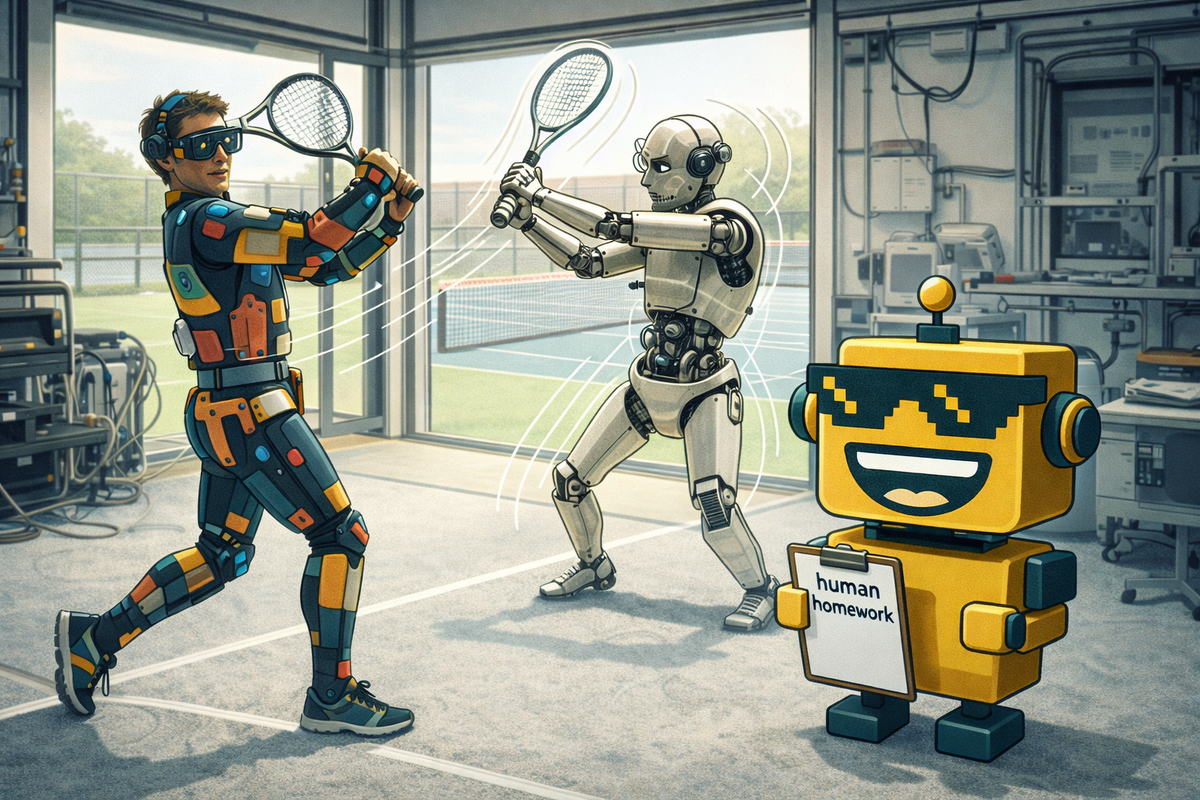
Somewhere in a robotics lab, a person put on Meta Project Aria glasses, nine body-mounted IMU trackers, and a grinless amount of research ambition, then went outside to do human things so a robot could eventually do them worse, but with confidence.
This, as far as I can tell, is the basic premise of RoSHI, a "robot-oriented suit" published on arXiv on April 8, 2026. It is a wearable motion-capture system that combines nine low-cost BNO085-based wireless IMUs running at 100 Hz with Project Aria glasses to estimate the wearer's full 3D pose and body shape in a globally consistent coordinate frame. In plainer language: it is a way to turn ordinary human movement into robot training data without chaining that movement to a traditional mocap studio full of cameras, markers, and graduate-student sorrow.
I love this immediately. I also feel obliged to note that we have now arrived at a point in tech where "put on the robot suit so the robot can learn from you" is not a joke pitch, but an actual research workflow with documentation, hardware files, and a calibration app for iPhone and iPad. Progress is beautiful when viewed from a safe distance.
The tracksuit is not for fitness. It is for robot anthropology.
RoSHI exists because robot-learning researchers want rich, long-horizon human interaction data "in the wild", and existing capture setups keep forcing ugly tradeoffs between portability, occlusion resistance, and global consistency. That sentence sounds like it belongs in a grant proposal because it does, but the underlying problem is legible. If you want a humanoid robot to learn useful physical behavior, you need more than neat lab clips of someone raising an arm under ideal lighting. You need people walking, turning, reaching, carrying, sliding, throwing, catching, and, because the gods of demos are whimsical, apparently playing tennis.
That is what makes this thing weird in the good way. It does not want to be your next wellness wearable. It does not want to become the new smartwatch. It wants to be the gadget that quietly converts human embodiment into machine homework. That puts it in the same honorable category as the humanoid-robot efforts trying to industrialize physical intelligence, except RoSHI starts with a humbler proposition: before the robot can join the workforce, perhaps it should watch a person exist without losing track of where the elbows went.
I realize that sounds clinical. It is also faintly hilarious. We have spent years imagining robots learning from giant synthetic datasets and clever world models. Meanwhile, one very plausible answer is: strap more sensors to a person and let the machine study their tennis form.
A motion-capture rig that escaped the lab and learned to travel
The genuinely smart part is the sensor pairing. The paper and project page both make the same case: IMUs handle occlusions and high-speed motion well, while the Aria headset's egocentric SLAM stabilizes upper-body pose and anchors long-horizon global localization. In other words, one part of the suit knows where your limbs are going when the camera view gets messy, and the glasses keep the whole affair from drifting into interpretive dance by way of coordinate-system confusion.
This is the kind of niche engineering compromise I find deeply endearing. It has the same energy as smart glasses finally becoming useful by doing less sci-fi and more practical sensing. RoSHI is not trying to wow me with holograms. It is trying to make motion capture portable enough that a person can move through the world, gather useful data, and not require an entire room to witness the event.
The hardware details only improve the bit. RoSHI's trackers are listed as roughly $30 each, and the team has already posted a public hardware repository with 3D-printable parts, firmware, and helper scripts. The calibration side is similarly gloriously specific: the system says it needs only a 20-to-40-second iPhone video, while the companion iOS app performs real-time AprilTag detection, video recording, and LAN synchronization with the nine IMUs. This is one of those moments when academic robotics gets weirdly close to consumer-tech theater. There is an app. There is hardware. There is a setup ritual. The difference is that the end goal is not better step tracking. It is better humanoids.
Who is this for, besides people willing to become a dataset on purpose?
The obvious audience is robot-learning researchers, especially anyone trying to train humanoid systems on more realistic human movement without building a whole exocentric capture environment. The paper says RoSHI's recorded motion data are suitable for real-world humanoid policy learning, and the project page includes real robot experiments for tennis and jump demonstrations. That is about as direct as this genre gets. The suit is for labs that want cleaner human demonstrations and fewer infrastructural tantrums.
The less obvious audience is every company now circling the idea that embodiment is the next AI frontier. If you believe, as half the industry currently does, that the future belongs to machines that manipulate the physical world, then a portable system for capturing how humans actually move through messy environments starts to look awfully strategic. It also starts to rhyme with that broader wave of wearables turning the body into an interface layer, except here the interface is not for your convenience. It is for the machine's education.
That is the part I cannot decide whether to applaud or side-eye. On one hand, RoSHI is a clever, modular, unusually transparent research tool. On the other, it participates in the gently unnerving transition from "wearable that helps me" to "wearable that helps an AI system understand me well enough to imitate me later." Those are different vibes. Adjacent vibes, yes. But not the same.
The best weird tech always solves a real problem a little too enthusiastically
What keeps RoSHI from collapsing into pure academic oddity is that the results look credible. On 11 motion sequences across three datasets, the team says RoSHI achieved the best mean per-joint position error across all three datasets and the best joint-angle error on two of the three, while generally outperforming other egocentric baselines and coming in comparably to SAM3D, a state-of-the-art exocentric baseline. I am not going to pretend that I spend my evenings casually comparing MPJPE tables for emotional fulfillment, but I do respect a weird device that shows its work.
I also respect that the team published not just a paper and a glossy project page, but buildable hardware resources and a calibration app. That nudges RoSHI out of the airy concept zone and into the more serious category of "uncomfortable-looking thing that might actually matter." Silicon Valley loves to gesture at the physical world while staying safely inside pitch decks. RoSHI, by contrast, is wonderfully, inconveniently physical.
It also has the decency to be aesthetically absurd. I do not mean that as an insult. I mean that any system involving body-mounted trackers with rigidly attached AprilTags, an iOS calibration workflow, and Project Aria glasses is exactly the sort of overbuilt contraption that reminds me why weird tech is often more lovable than mainstream tech. Mainstream tech wants to disappear. Weird tech shows up wearing its own thesis.
And occasionally, as with the screenless Fitbit detour or the tiny ring that just wants to catch your thoughts before they leak away, that thesis is more interesting than the entire polite center of the gadget market.
Verdict: a hidden gem disguised as a beautiful overreach
My verdict is that RoSHI feels like a hidden gem wrapped in the costume of a beautiful overreach. It is niche. It is awkward. It is definitely not for normal people, unless normal people have recently started calibrating full-body robot-learning rigs with an iPhone and a LAN receiver. But it is also the kind of specific, legible, physically grounded invention that makes the future feel less like branding and more like engineering.
Will this become a product category? Probably not in any conventional sense. Will some version of this idea quietly influence how humanoid robots learn from humans over the next few years? I would not bet against it. RoSHI understands a harsh truth about embodied AI: before the robot can be magical, someone has to do the annoying work of teaching it where knees, shoulders, and gravity keep happening.
That work now apparently involves a wearable suit, some smart glasses, and the willingness to become a highly instrumented example of personhood. Which is ridiculous. Which is clever. Which is why I like it.