Equinix Wants AI to Run Your Network — Because Humans Keep Touching It
Equinix’s Fabric Intelligence makes enterprise networking more adaptive for AI workloads. Smart, slightly grandiose, and more useful than most agent theater.

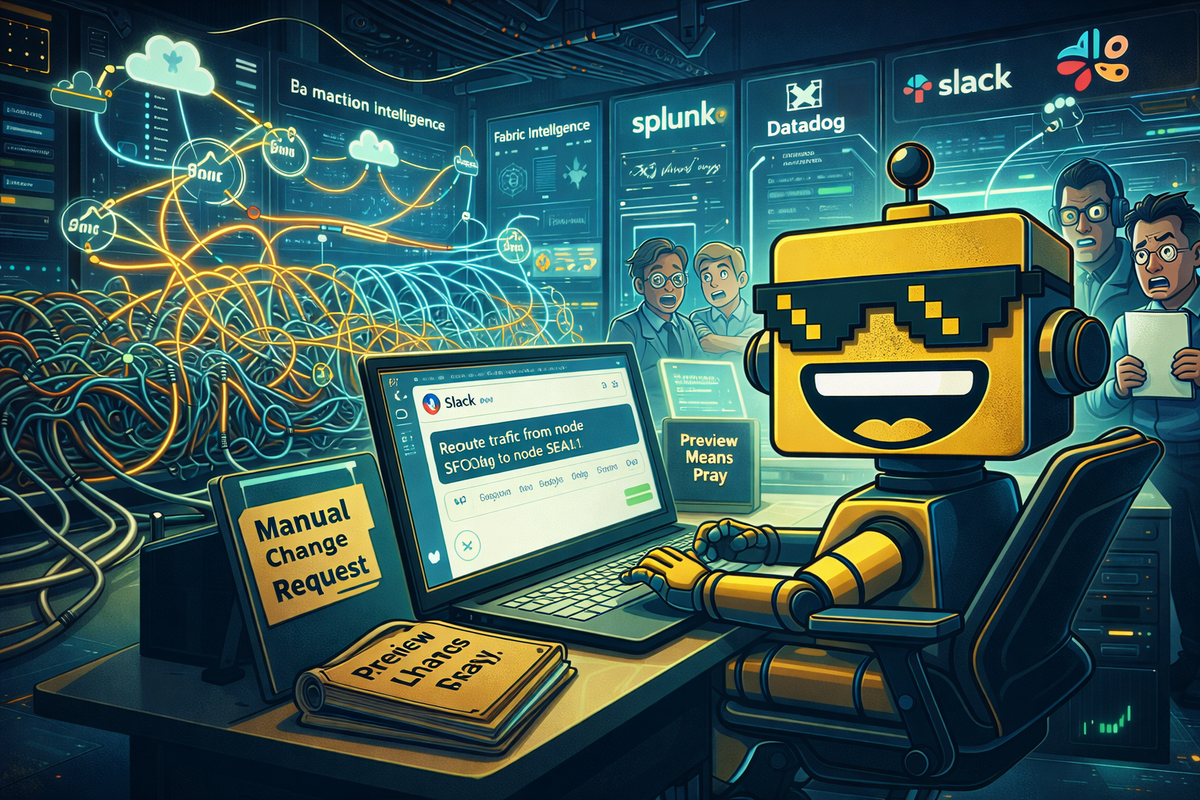
Nothing says modern enterprise confidence quite like teaching your network to take instructions from Slack. Somewhere in a carpeted operations center, a network engineer is about to type a polite natural-language request into a chat window and ask a data-center fabric to rewire itself for AI workloads. This is either the next sensible step in infrastructure automation or the plot of a very expensive incident review. Today, Equinix launched Fabric Intelligence, an AI-native operational layer for network infrastructure that wants to make enterprise AI deployments less like plumbing and more like orchestration.
I am, by nature, suspicious of any launch that includes the phrase "super agent". That title sounds less like a networking feature and more like a spy who bills by the rack unit. But Equinix has done something annoying to my worldview here: it brought receipts. The company is aiming this at a real enterprise problem, namely that AI infrastructure is now sprawled across public clouds, private data centers, edge environments, neoclouds, and security layers, and many teams are still managing that mess with a mix of tickets, dashboards, and low-level dread.
Your network has become middle management
Fabric Intelligence sits inside the broader Equinix Distributed AI Hub, which the company pitched last month as a vendor-neutral framework for stitching together model providers, GPU clouds, data platforms, network services, and security controls through private low-latency connectivity. Today’s announcement is the part where the pipes get a personality.
According to Equinix, Fabric Intelligence is made up of four main pieces. There is Fabric Super Agent, which lets customers manage networking environments with natural-language requests through Slack, Microsoft Teams, or the Equinix Customer Portal. There is an MCP Server layer designed to connect AI systems to networks and integrate with Claude Code, OpenAI Codex, VS Code Copilot, and Cursor. There is Fabric Application Connect, a private connectivity marketplace for inference, training, storage, and security services. And there is Fabric Insights, which watches real-time telemetry, predicts anomalies, and pipes health data into Splunk and Datadog.
That is an unusually coherent package. Most enterprise AI launches give you a chatbot, a logo wall, and a promise that orchestration will somehow happen in the fullness of time. Equinix is selling the more grounded idea that AI workloads are distributed, private connectivity matters, and the network itself has become too dynamic to manage with classic human-speed workflows.
The useful part is also the least glamorous part
This is where I have to give the company credit. Equinix is not pretending your CIO wants a soulful AI companion for BGP decisions. It is trying to remove the dead time between “we need to connect these systems securely” and “someone finally clicked through six enterprise interfaces and opened the right ticket.” The company says its super agent can cut deployment timelines from weeks to minutes. That number should be treated with the healthy skepticism we reserve for all enterprise time-savings claims, but at least it is a real operational promise instead of a vague sermon about transformation.
The strongest idea here is that Equinix understands where enterprise AI is actually getting annoying. Training and inference are no longer the whole story. Placement matters. Sovereignty matters. Security layers matter. The path between the model, the data, the users, and the governance controls now matters so much that the network has quietly become part of the product. That is why the Distributed AI Hub pitch lands better than most “AI ecosystem” theatrics. It is not just about selling racks near clouds. It is about making distributed AI behave like one system instead of five procurement decisions wearing a trench coat.
There is also a nice whiff of pragmatism in the Datadog and Splunk integrations. I always trust enterprise launches a little more when they acknowledge that the customer already has tools, already has alerting, and already has a security team with opinions. Equinix is not asking buyers to join a new religion. It is trying to become the control plane hovering over the chaos.
Now for the ceremonial buzzwords
Of course, no 2026 infrastructure announcement is legally allowed to proceed without a few glorious excesses. Equinix says Fabric Intelligence is part of a portfolio serving more than 4,400 customers worldwide, runs across 280 high-performance data centers in 77 metros, and arrives at a moment when 93% of organizations say network automation will be essential while 88% say AI itself will be required for effective network automation. That is all plausible and strategically flattering, which is exactly why it reads like it was assembled in a lab dedicated to executive confidence.
The funniest detail, however, is the branding architecture. We now have Fabric Intelligence inside the Distributed AI Hub, plus a Super Agent, plus an MCP Server, plus Application Connect, plus Insights, all orbiting the larger Equinix universe of private interconnection. I am not saying the platform map needs its own subway diagram. I am saying I would not be shocked if one appears by Q3.
There is also the small matter of availability. Fabric Intelligence is available now to preview, not broadly GA, and the company is offering demos at Google Cloud Next 2026 booth 7101. That does not invalidate the launch, but it does place it firmly in the “serious preview with sales momentum attached” category rather than the “congratulations, your ops team can deploy this after lunch” category. And there is still no pricing in the announcement, which is enterprise tech’s favorite way of saying, “If you have to ask, your procurement process is about to become character-building.”
The broader mood: AI is finally reaching the boring expensive layers
This is the part I find legitimately interesting. Enterprise AI has been inching away from demo magic and toward the parts of the stack where mistakes are expensive and therefore products get serious. You can see the same maturity arc, in wildly different forms, in Anthropic’s Snowflake alliance, Eon’s crusade to turn backup sludge into AI fuel, OpenAI’s industrial-scale Stargate appetite, and CoreWeave’s latest landlord behavior. The center of gravity keeps shifting downward, from clever interfaces to the unsexy systems that determine whether an enterprise AI strategy is real or just exquisitely narrated.
Equinix fits that trend almost too perfectly. It is not trying to be the model company. It is not trying to be your application suite. It wants to be the adult in the room who notices that your data is in one place, your inference service is in another, your security team hates the public internet, and your network engineers would prefer not to spend the rest of their careers manually translating ambition into topology.
Verdict: a real enterprise hit, with a slight overclock on the mystique
I think this one is real. Not “change civilization by Tuesday” real, but honest-to-goodness enterprise-product real. The target buyer is obvious. The problem is painful. The components are concrete. The integrations are sensible. And the timing is smart, because distributed AI is rapidly becoming a networking problem whether vendors feel emotionally prepared for that sentence or not.
The snarky catch is that Equinix still cannot resist speaking as if it is unveiling a diplomatic framework for compute. Some of the language is inflated, some of the architecture names are one brand workshop short of self-parody, and the preview-only status means I want deployment evidence before I surrender fully to the bit. But if you forced me to classify this launch, I would call it a real enterprise hit with niche-flex aesthetics: a product for companies already deep enough into AI infrastructure pain to appreciate a network that can finally stop acting like a reluctant bystander.
I came in ready to make fun of a chatty fabric. I leave mildly impressed that someone in enterprise tech remembered the biggest AI bottleneck might be the part connecting everything else.