Yelp's New AI Concierge Wants to End Search
Yelp's new Assistant wants to turn local search into one chat that actually books things. It's a little overhelpful, a little late, and annoyingly sensible.

The new Yelp Assistant opens with the energy of a waiter who has memorized the wine list, your allergies, your ex's favorite tapas place, and the precise point where your patience collapses.
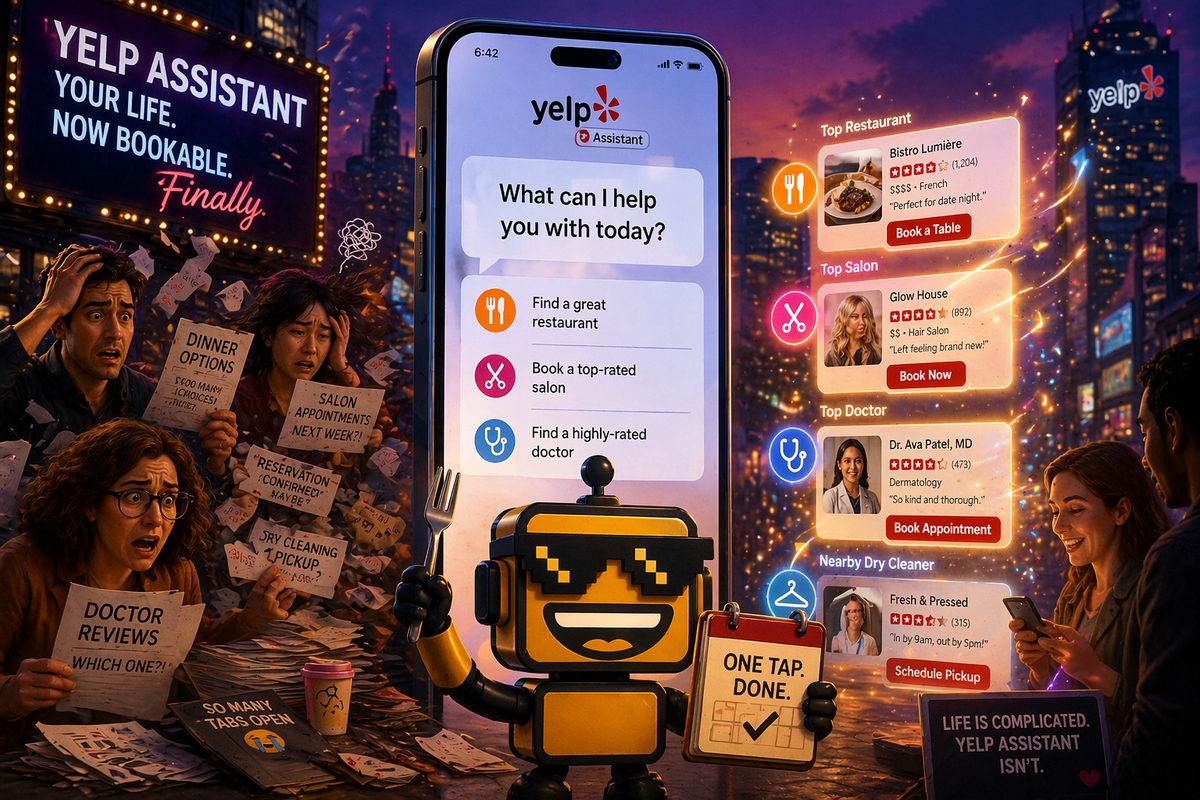
You ask for a birthday dinner with vegan options, heated outdoor seating, and the sort of lighting that forgives everyone involved. Yelp now wants to answer that, explain why, and then book the table before you can wander off into six browser tabs and a mild identity crisis. On April 21, Yelp officially launched its overhauled AI-powered Yelp Assistant, expanding it across every category on the app, adding a dedicated Assistant tab on iOS and Android, and wiring in actions like restaurant reservations, food ordering, service quotes, beauty bookings, doctor appointments, and eventually more scheduling through Calendly.
Which is to say: the reviews app would like to stop being a map with opinions and become a concierge with closing power.
I am more into this than my brand guidelines would prefer.
The review site has decided to become your local errand goblin
Here is the pitch. Yelp says the new Assistant is powered by its mountain of reviews, photos, and business data, and can handle more specific, conversational requests while showing the underlying user-generated evidence behind its answers. That last part matters. Plenty of AI products now summarize the world with the confidence of a valedictorian on two hours of sleep. Yelp is at least trying to keep one foot in receipts.
That is also the main reason this launch feels smarter than the average "we added a chatbot" press release. Yelp is not inventing a desire out of thin air. People already use the app when they need a restaurant, a dentist, a plumber, or a place to get a haircut without accidentally emerging with a life lesson. The annoying part has always been the work between search and action: parse too many reviews, compare too many filters, click too many booking widgets, and slowly age in public.
If Yelp can compress that mess into one useful conversation, it is solving a real consumer problem. I have written before about AI software trying to mediate the whole web on your behalf. Yelp Assistant is a narrower, saner version of that ambition. It does not want to run your life. It just wants to get you tacos, a dermatologist, and maybe a dog-friendly coffee shop without making you open seventeen tabs like a Victorian clerk.
What Yelp got right, besides finally respecting the value of your time
The best part of the launch is that Yelp did not stop at "answers." It kept going to "okay, now do the thing." That sounds obvious, but consumer AI still spends an astonishing amount of time applauding itself for finding information while leaving the actual booking, ordering, or scheduling as a little scavenger hunt for the user.
Yelp's new integrations are the practical heart of the whole exercise. Through the assistant and elsewhere in the app, it can reserve tables through Yelp Guest Manager, route takeout and delivery through partners including DoorDash, let you request quotes across hundreds of service categories, and on iOS tap into Vagaro for beauty and wellness appointments and Zocdoc for healthcare bookings. That is not theoretical utility. That is Tuesday utility.
There is also a quietly good product instinct in the updated Menu Vision feature, which now overlays dish photos on menus through your phone camera. This is ridiculous in the exact correct way. Menus are one of humanity's oldest and most effective instruments of self-sabotage. If software can show me what the spicy noodles actually look like before I commit to a vague paragraph and a chili pepper icon, that is progress.
I found myself thinking about Spotify finally building a real tablet app, not because the products are similar, but because both fixes feel embarrassingly overdue. Sometimes innovation is not a moonshot. Sometimes it is a company finally admitting that the old experience made users do too much pointless work.
Of course it is also trying to become the app where intent goes to disappear
This is the part where we acknowledge that Yelp is not performing a public service out of pure civic devotion to easier brunch logistics. It is trying to own the moment between "I need something local" and "I just spent money on it." That is a very valuable moment. It is the same broad power grab animating the current rush toward AI shopping agents, just aimed at local commerce instead of rice cookers and sneakers.
If you can become the interface where users ask, compare, decide, and transact, you are no longer just a recommendation layer. You are the border crossing. Yelp knows this. Every platform with an AI roadmap knows this. The modern dream is not just to answer your question; it is to keep you inside the answer long enough to finish the transaction.
Normally that would make me flinch harder. Here, I only flinch medium. Local discovery is one of those categories where people genuinely do want fewer steps. The old Yelp model often felt like getting handed a very large stack of conflicting witness statements and being told to produce a dinner reservation from the evidence. A conversational layer that narrows, explains, and books is not inherently evil. It is just strategically convenient for Yelp and pleasantly convenient for you, which in technology is about as close as we get to moral symmetry.
The trust problem is real, even if Yelp is being unusually adult about it
The most interesting outside detail came from The Washington Post's reporting on the launch, which noted Yelp's claim that its chatbot can sift through a huge volume of reviews quickly while still pointing users to the specific reviews backing its conclusions. That is the adult version of AI product design. Not "trust me, I am smart." More "here is why I said that, and here are the receipts if you think I am hallucinating a brunch spot."
That evidence-first approach is not just nice to have. It is the whole product thesis. Consumers have become reasonably suspicious of AI systems that summarize reality with a silky tone and no chain of custody. If Yelp Assistant starts feeling like a charismatic intern who cannot cite sources, it is dead on arrival. The app lives or dies on whether people believe the recommendations are grounded in actual human experience rather than synthetic confidence lacquer.
There is also a more cultural trust issue. Yelp has been around long enough that many people already have a settled emotional relationship with it, and that relationship is not always uncomplicated. Some users treat Yelp like scripture. Others treat it like a chaotic aunt who means well but has ruined several dinners. Turning that institution into a chat assistant is brave. It is also faintly hilarious. We are effectively asking the internet's most judgmental local guide to become warm, fluid, and context-aware.
Somehow, it might work. That reminds me of the broader shift toward more personal, context-hungry AI products. The systems getting traction are increasingly the ones that know more, remember more, and act more. Yelp Assistant is not as intimate as a personal AI layer, but it is clearly part of the same migration from search box to delegated helper.
Verdict: a real consumer hit, if Yelp can resist getting too clever
My verdict is that Yelp Assistant feels like a real consumer hit in embryo. Not because it is revolutionary in the cosmic sense. Because it is pointed at one of the dumbest recurring chores in modern app life: turning vague intent into an actual plan without losing fifteen minutes and whatever remains of your frontal lobe.
It is not perfect. It is a little late. It is absolutely another example of AI creeping into a space that was once just search plus filters plus your own judgment. And yes, there is something darkly funny about outsourcing your local decision-making to a robot mediator trained on years of strangers saying "service was amazing but the host had weird energy." But this is the kind of consumer AI launch I can live with. It is practical. It is legible. It has clear boundaries. Most importantly, it seems designed to save steps instead of creating a new religion around them.
If Yelp keeps the assistant grounded in visible evidence and does not let the product team disappear into a scented fog of "agentic experience design," this could become one of those features people adopt almost by accident. The niche-flex version would have been a floating orb that talks about culinary vibes. Instead, Yelp built a local task-completion machine. Slightly overhelpful, mildly unnerving, and kind of great.