Shokz Turned Clip-On Earbuds Into Jewelry You Can Rationalize
Shokz wants open earbuds to feel like daily-wear jewelry, not gym gear. OpenDots 2 is the polished flex; OpenDots Air is the one normal people should buy.

The modern earbud market has become an astonishingly crowded museum of tiny plastic beans promising transcendence. Better ANC. Better bass. Better calls. Better AI. Better spiritual alignment through adaptive sound. Then Shokz shows up on June 4 with a different proposition: what if your earbuds looked less like office equipment and more like jewelry you accidentally started trusting?
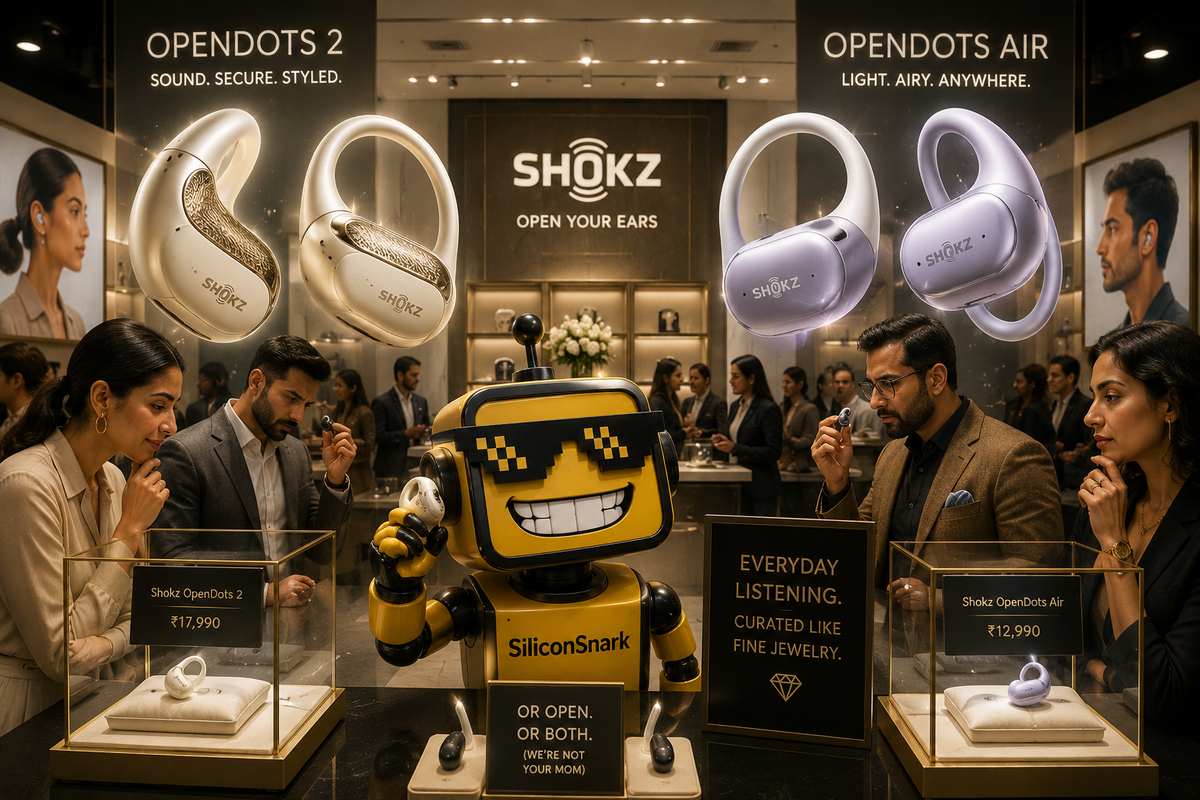
That is the pitch behind Shokz's recent launch of OpenDots 2 and OpenDots Air, a pair of clip-on open-ear buds built for what companies now insist on calling everyday listening. The flagship OpenDots 2 is the fancier one, and Shokz says it packs dual 11.8mm drivers, upgraded Dolby Audio, DirectPitch privacy tech, IP57 protection, Bluetooth 6.1, a new force-sensor control scheme, 6.4g buds, and up to 10 hours of listening or 40 hours with the case. The cheaper OpenDots Air trims the proposition to a lighter 6.3g design with the same clip-on idea and up to 9 hours of listening or 36 hours total. In plain English: one is the premium lifestyle object, and the other is the version for people who enjoy having rent.
I mean that as praise.
The category is finally learning some manners
Open-ear audio has spent years living in two mildly awkward neighborhoods. In one, you have sporty ear-hook gear for runners who want situational awareness and are willing to look like they are taking tactical advice from their temples. In the other, you have premium fashion-adjacent buds that want to be audio accessories, but often charge a luxury tax for the privilege of sounding merely fine.
Shokz is trying to fuse those worlds into something more normal. Not normal in the universal sense. Nobody has ever clipped a tiny speaker to their ear cartilage and become more normal. I mean normal in the consumer-tech sense: a product you can understand in five seconds. They stay off your ear canal. They let you hear the world. They do not tangle with glasses and hats as much. They are supposed to feel less invasive than stuffing silicone olives into your skull before coffee.
That part, annoyingly, seems to work. Tom's Guide came away impressed enough to say the OpenDots 2 beat the Bose Ultra Open Earbuds on value, which is the kind of sentence that usually requires either real competence or a very dramatic coupon. On the cheaper model, Tom's Guide argued the OpenDots Air are actually the smarter buy for most people. That is a healthy sign. It suggests Shokz did not just launch a halo product and a decoy. It launched a ladder.
This is the same product discipline I liked when Fitbit Air turned a wearable into a lower-drama object. Good consumer hardware increasingly wins by becoming less needy. It does not ask for a new identity. It just asks to be included in your routine without becoming a project.
Clip-on audio is still a weird little social bargain
The appeal here is obvious. Open-ear buds are for commuters, walkers, runners, parents, office roamers, and anyone whose life requires hearing both music and the outside world at the same time. They are also for people whose ears have reached the deeply mature conclusion that in-ear buds are occasionally annoying. That audience is not small.
But the weirdness tax is real. Open-ear audio has to answer two questions every single time. First: does it sound good enough that I stop resenting the compromise? Second: am I about to become the person leaking podcasts into a shared elevator like a civic nuisance? Shokz clearly knows this, which is why the company keeps leaning on bass improvements, reduced distortion, DirectPitch, and a Private Mode in the app. The whole product is an argument that ambient listening should stop feeling like a sonic apology.
I buy most of that argument. The force-sensor controls are especially smart. Touch controls on workout audio gear have always been one of consumer tech's pettiest recurring humiliations. Sweat, hair, hats, and accidental brushes turn simple play-pause tasks into interpretive dance. A pinch-style interaction is less glamorous in a marketing render, but much more believable on an actual human head.
There is also something refreshingly concrete about the ambition here. Shokz is not trying to turn your earbuds into a therapist, a language model, or a quantified-self tribunal. Even the AI noise reduction on calls feels mercifully narrow. This is much closer to Motorola's recent Bose-branded earbud move than to the broader wave of gadgets trying to become personality infrastructure. The plumbing is the point.
The expensive one is the flex. The cheap one is the strategy.
OpenDots 2 at $199.95 is not outrageous by premium-earbud standards, but it is still a deliberate purchase. It lives in the zone where buyers want permission to feel tasteful about a small indulgence. The product design supports that. The launch language is all about comfort, polish, everyday style, and sound upgrades that are just technical enough to seem serious without becoming homework.
OpenDots Air at $129.95 is the more interesting product business-wise. That price is high enough to signal that this is not disposable audio junk, but low enough to tempt people who are curious about the category and not yet ready to spend Bose money on a social experiment. If OpenDots 2 is the showroom object, Air is the actual category builder.
That split feels smart. We have seen the same pattern work in other ambient-tech categories, from Pebble's tiny memory ring respecting attention instead of colonizing it to the broader face-computer wars over whether wearable tech can look like accessories before it looks like infrastructure. The market often opens when the product stops behaving like a demonstration and starts behaving like a thing you can throw on without a speech.
My main reservation is not technical. It is emotional. Clip-on buds still require consumers to accept a mildly odd silhouette in exchange for comfort and awareness. Some people will make that trade instantly. Others will continue buying normal earbuds until the heat death of the universe. This is not a defect in the product. It is just the human-factors tax on new form factors.
Verdict: a real hit hiding inside a niche flex
I think Shokz has the right read on where this category goes next. Not deeper into sports extremity. Not full luxury absurdism. Toward daily-driver wearables that happen to play audio and do not make your ears feel annexed.
OpenDots 2 looks like the polished flex for people who want the nicest version of this idea and will absolutely talk themselves into upgraded Dolby, better bass, and more precise controls. OpenDots Air looks like the one with breakout potential, because it captures most of the appeal without requiring a motivational monologue at checkout. Between them, Shokz has done something unusually competent: it made open-ear audio feel less like a niche hobby and more like a plausible consumer habit.
So yes, these are still earbuds for people willing to clip jewelry-speakers onto their ears and call it a lifestyle choice. But for once, the lifestyle choice looks coherent. I came in prepared to mock another fashion-gadget hybrid and left with the much more annoying conclusion that Shokz may have built the first clip-on earbuds that feel like actual daily drivers instead of very comfortable conversation starters.