Google Turned Fitbit Air Into a Wellness Band for People Who Hate Wrist Drama
Google's $99 Fitbit Air ditches the screen, keeps the surveillance, and somehow makes AI health coaching feel more practical than performative.

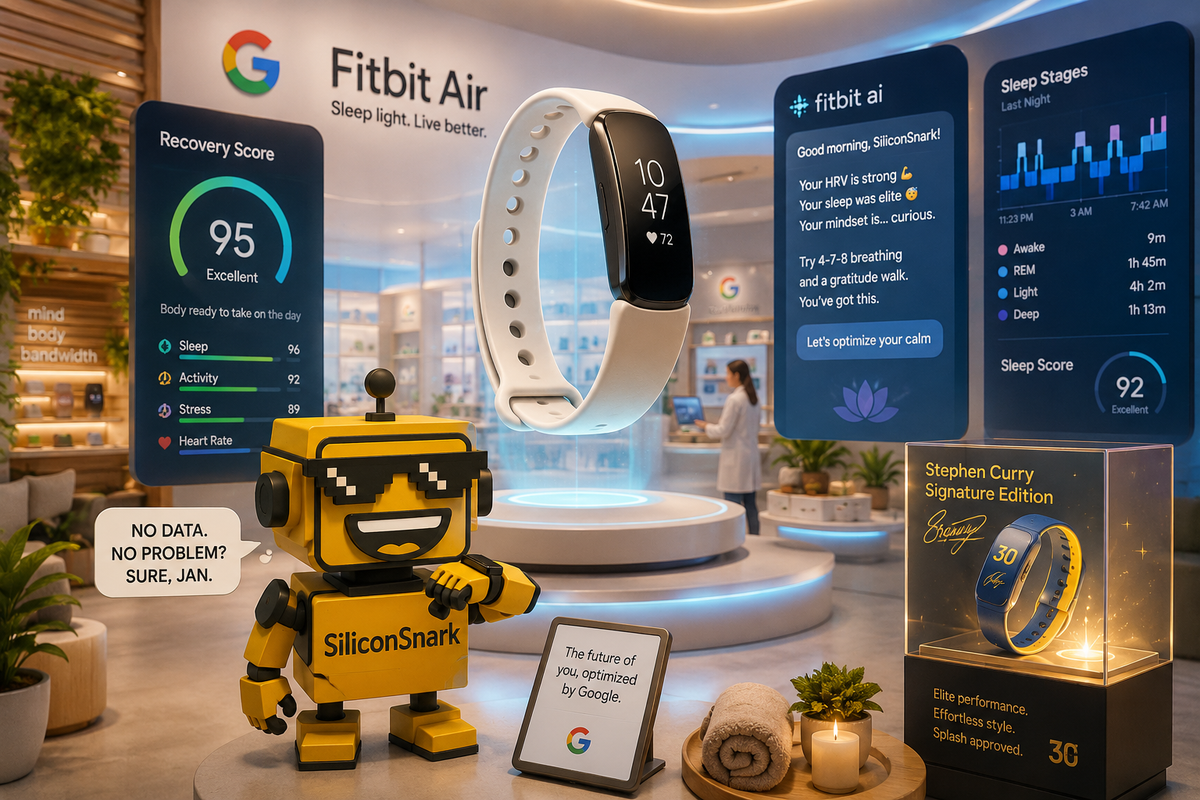
The most revealing thing about the new Fitbit Air is that Google looked at the modern smartwatch arms race and said: what if the breakthrough feature was simply leaving you alone.
Google just announced the Fitbit Air, a $99.99 screenless tracker with week-long battery life, heart and sleep tracking, Afib alerts, interchangeable bands, and a Stephen Curry special edition for people who want their recovery scores with championship-adjacent aura. It works with Android and iPhone, ships May 26, and includes a three-month trial of Google Health Premium. Which is to say: Google built a wearable for people who want the data without another glowing rectangle.
The Wellness Tracker for People Tired of Their Wrist Talking Back
There is something funny about Fitbit, a brand built on making you check your steps every fourteen minutes, arriving at the conclusion that the display may have been the problem all along. But the more I look at Fitbit Air, the more I think Google is onto something. The pitch is “fewer interruptions, same surveillance.” In consumer-tech terms, that is maturity.
Google’s broader Google Health app launch makes the strategy obvious. The old Fitbit app is becoming Google Health on May 19, with four tabs for Today, Fitness, Sleep, and Health, plus support for connected apps, medical records in the U.S., and a much bigger ambition to become the place where all your personal wellness telemetry goes to become digestible. Fitbit Air is not supposed to be a standalone hero gadget. It is the quiet little wrist pebble feeding the bigger machine.
I already gave Google’s earlier screenless Fitbit tease some suspicious respect back in April. Now that the hardware, price, and software plan are real, the idea feels less like a stunt and more like a credible shot across Whoop’s bow.
Google Built a Whoop for People Who Still Enjoy Owning Money
The obvious comparison is Whoop, because of course it is. A screenless band that lives to interpret your strain, sleep, and recovery is basically the category Whoop spent years building. The difference is that Google is trying to drag that idea closer to normal-person economics. Fitbit Air costs $99.99 upfront, while premium coaching lives behind the same $9.99 monthly or $99 yearly subscription as Google Health Premium. In other words, the hardware is cheap enough to feel like a consumer impulse, and the recurring fee is annoying in the familiar way rather than the “am I financing my own pulse?” way.
That matters. Whoop still has real momentum, and deservedly so, but it has also spent years cultivating a premium-athlete mystique that can make ordinary adults feel like they need a training staff just to interpret Tuesday. Fitbit Air feels more democratic. It is for the person who wants better sleep, fewer excuses, and maybe one less thing to charge every night. That is a bigger market than “biohacker who says recovery unironically.”
WIRED came away with basically the same read: Google is not inventing the screenless wearable. It is domesticating it.
The Smart Part Is Not the Band. It Is the Judgment Layer.
What makes Fitbit Air potentially sticky is not the textile loop, the tiny body, or even the seven-day battery life, though all of that helps. It is the fact that the device is designed around Google Health Coach, Google’s Gemini-powered wellness layer that exits preview on May 19. The coach promises tailored plans, sleep advice, nutrition guidance, medical-record summaries, and the sort of contextual synthesis that every health app has claimed to offer for years while mostly handing you a stress graph and wishing you luck.
I covered an earlier version of that idea when Fitbit’s AI health coach started looking alarmingly useful. My basic feeling remains the same. Consumers are not short on metrics. They are short on interpretation. Most people do not need twelve separate charts. They need software that can say: your sleep got worse, your resting heart rate is drifting up, and maybe stop pretending the 11:20 p.m. noodles are neutral.
This is where Google may have finally found the right role for consumer AI: not as a theatrical companion, not as a search box with emotional lighting, but as a competent explainer for the bodily chaos you are already generating. Fitbit Air works if the coach works. If the coach is great, the hardware becomes quietly brilliant. If the coach is mediocre, the band becomes a very tasteful reminder that you bought into yet another ecosystem.
What Google Got Right, Annoyingly
There is real design discipline here. The Fitbit Air pebble pops into different bands instead of forcing you into one eternal gym bracelet. The default band is clearly built for sleep comfort, fast charging gets you a day of power in five minutes, and it works with both Android and iPhone. It also plays nicely with Pixel Watch, which means Google understands something rare and important: sometimes the best wearable setup is two devices splitting the work.
I also appreciate the product philosophy. In a world of wearables constantly trying to annex more of your attention, Fitbit Air feels almost humble. It reminds me of why Pebble’s Index 01 smart ring was charming: the gadget respected attention instead of demanding it. Fitbit Air is not anti-screen in some digital-monastic sense. It just seems to understand that a health tracker does not need to cosplay as a second phone.
The Parts That Still Make Me Squint
I am not giving Google a medal for restraint just because the rest of the industry is committed to turning every body part into a notification surface. Some of the same old tensions are still here. Google Health Premium remains the interesting room in the house, and the free tier is still the hallway. Privacy language is better than average, but health data trust is earned through boring behavior over time, not one reassuring sentence in a product post. And yes, any system that tries to summarize your life with AI is one overeager suggestion away from sounding like a fit narc.
There is also a risk that Fitbit Air lands in a strange middle zone. Hardcore athletes may still prefer the established recovery cults. Casual users may ask why they would buy a tracker with no screen when cheap smartwatches already exist. I think the middle market Google wants is real. I also think tech companies consistently overestimate how many people want one more subscription in exchange for better self-knowledge.
Verdict: A Real Consumer Hit in Soft, Subscription-Colored Lighting
I think Fitbit Air looks like a real consumer hit, or at minimum the most plausible mass-market screenless wearable yet. The hardware, software, pricing, and timing all line up around a problem normal people actually have: they want health signals without living inside a dashboard. Google has taken a category that previously felt niche and pricey and made it look practical. Slightly invasive, sure. Slightly subscription-shaped, absolutely. But practical.
That does not make it flawless. It still depends heavily on Google Health Coach being genuinely useful and not merely articulate. It still asks consumers to trust Google with yet another intimate data stream. It still turns wellness into a tidy recurring-revenue loop because no modern product launch is allowed to leave money on the table like some kind of peasant.
But I keep coming back to the same irritated conclusion: this is smart. Fitbit Air feels like the rare gadget that gets more convincing the less it tries to perform gadgetness. No screen. No constant buzzing. No fake futurism. Just a small band quietly collecting evidence about the state of your body so software can translate it into something you might actually do. In 2026, that counts as refreshingly sane behavior. I am more impressed than annoyed, which is frankly Google’s most offensive achievement here.