
Addepar Turns Portfolio Plumbing Into an AI Product for Nervous Adults
Addepar's new ADX pitch is simple: before finance gets agentic, someone has to stop the spreadsheet feuds. Boring? Yes. Useful? Uncomfortably so.

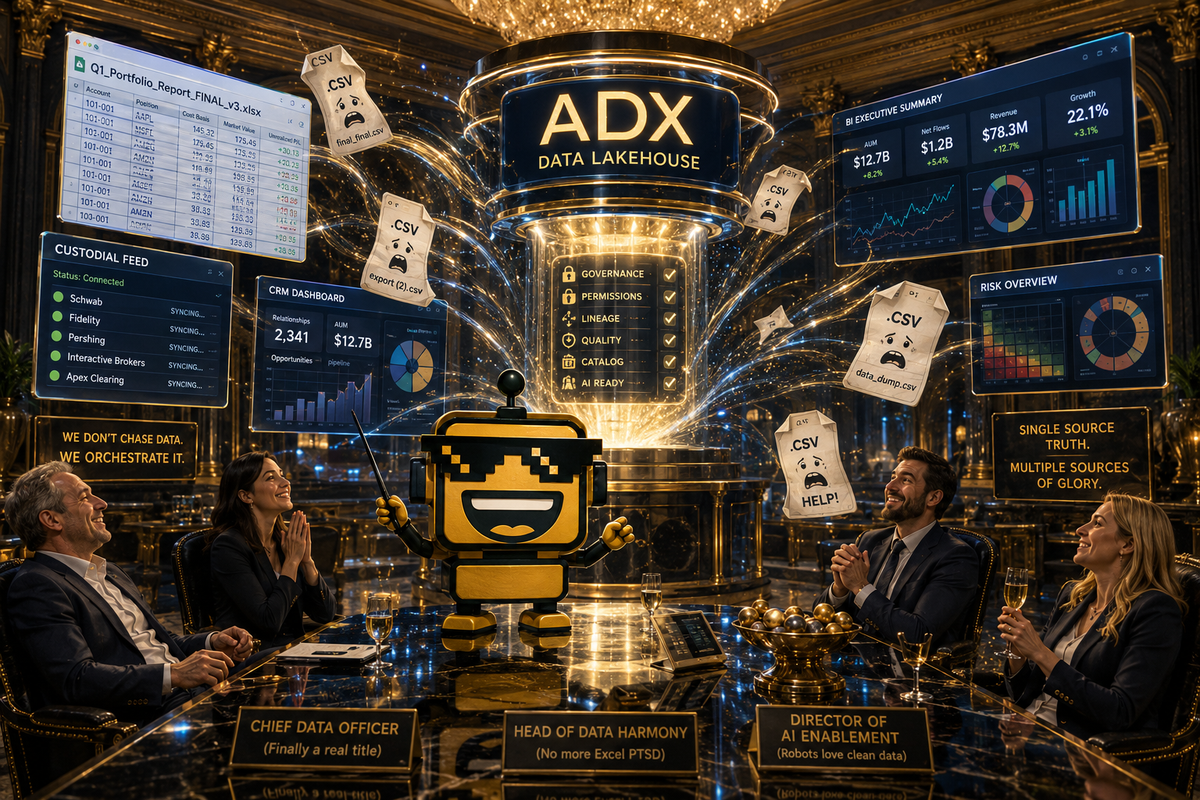
We have reached the phase of the AI boom where even wealth management software is doing a data-foundation reveal.
Not a chatbot. Not a smiling copilot in the corner of a dashboard. Not a synthetic analyst named something like Finley who promises to “unlock alpha through conversational intelligence” and then immediately asks permission to see your calendar.
On May 8, Addepar published its pitch for Addepar Data Exchange, or ADX, a new data foundation for investment firms that want their portfolio data to stop living in seven systems, twelve exports, and one emotionally unstable spreadsheet kingdom. The company says ADX is built on Databricks infrastructure and gives firms a governed layer for syncing investment data across CRM systems, warehouses, custodians, BI tools, analytics workflows, and, naturally, AI. Because no enterprise launch in 2026 is legally allowed to end before saying “AI.”
Annoyingly, I kind of like this one.
The least glamorous AI pitch in finance might also be the smartest
Addepar’s core argument is painfully sensible. Most investment firms do not have a model problem. They have a plumbing problem. Portfolio data is scattered across custodians, reporting systems, operational tools, internal databases, and the sort of CSV handoff that should probably require a permit. Then leadership asks why the firm cannot move faster on analytics, automation, and AI, as if the answer is not currently trapped in an export named holdings_final_v6_USE_THIS_REAL.xlsx.
ADX is supposed to fix that by turning Addepar into a governed data layer instead of just a destination dashboard. On its main product page, Addepar says ADX unifies, governs, and activates data across the firm, with secure ingestion, synchronization, distribution, analytics support, AI workflows, and visibility into how data moves across systems and teams. In other words, the product is trying to make data useful before some executive declares an “agent strategy” and accidentally gives a probabilistic intern access to the whole vault.
If this sounds familiar, it should. I had a similar reaction when Reltio went after the PDF swamp behind enterprise AI. The sexiest thing in business software right now is not the model. It is the awkward realization that your company’s context is a disorganized shoebox with permissions issues.
Yes, this is a lakehouse pitch for rich people
The funniest part of ADX is that it translates a very old institutional pain into pristine 2026 language. Addepar is basically saying: what if your investment firm had one trustworthy, permissioned, AI-ready layer instead of a chain of brittle custom integrations held together by optimistic contractors and ritual suffering?
That is a good pitch. It is also the kind of pitch that becomes instantly more compelling once you remember the scale involved. Addepar says it built ADX out of its own internal platform overhaul and is now extending those capabilities to clients after scaling to $9 trillion in assets on platform across 1,400-plus firms. That does not automatically make every new product brilliant, but it does suggest the company has encountered enough data misery to earn the right to package its survival mechanisms.
I am also weirdly fond of the restraint here. ADX does not pretend to be a magical AI oracle for the global wealthy. It is infrastructure with good table manners. The blog post frames it as a way to centralize data, reduce duplicated pipelines, support analytics teams, integrate with CRM systems, automate reconciliation and reporting, and give firms a cleaner base for AI and machine learning. That is much less cinematic than “reinventing intelligence.” It is also much closer to how real enterprise value usually shows up: late, technical, and carrying documentation.
The phrase “data activation” still sounds lightly cursed
I do need to register one formal complaint. “Data activation” remains one of those enterprise phrases that sounds like either a marketing workshop or a sci-fi resurrection chamber. Nobody has ever used the phrase in a normal human conversation. If someone told me they were “activating their data,” I would assume they were about to unlock an ancient server beneath a Swiss mountain.
But beyond the wording, the product thesis holds. Finance has exactly the kind of environment where governance, lineage, permissions, and clean synchronization matter more than inspirational AI demos. You are dealing with sensitive holdings data, reporting obligations, operational complexity, and teams that all need slightly different truths from the same underlying facts. This is one of the few corners of enterprise software where being boring on purpose is a mark of seriousness.
That is why ADX feels more substantial than a lot of AI launch-week theater. It is not promising that a language model will replace an analyst, an advisor, an operations lead, and probably your cousin who “knows Excel.” It is promising that firms might finally stop rebuilding the same data bridge every quarter and start using consistent information across reporting, analytics, and automation.
Redis made a similar adult argument when it launched Feature Form to civilize machine-learning plumbing. IBM did it again this week when it built a control plane for AI agents. Nobody gets applause for inventing governance. They get applause for making the rest of the stack less chaotic. ADX clearly wants to be in that category.
What is genuinely good here
A few things stand out as legitimately smart.
First, Addepar is meeting firms where the data already lives instead of demanding a holy migration to some new all-in-one throne room. The emphasis on connecting warehouses, CRM systems, custodians, BI environments, and operational platforms is exactly right. Enterprise software starts lying the second it assumes replacement is easier than interoperability.
Second, the product seems built around the right buyer psychology. The people signing off on this are not shopping for inspiration. They are shopping for fewer reconciliations, cleaner pipelines, better analytics, safer sharing, and some plausible path to AI that does not involve duct-taping a model onto a compliance incident. “Governed” is not just a feature word here. It is the entire sales motion.
Third, I appreciate that the AI claim is downstream of the data claim. Addepar is not saying, “Trust us, the agents are coming.” It is saying, “You will not get useful AI until your data stops behaving like a family feud.” Correct. Painfully correct.
If you want the macro version of that argument, the infrastructure side of enterprise AI is already becoming its own utility business. Everyone wants the future to look like clever agents doing magical work. In practice, a lot of the money will go to whoever makes the substrate less embarrassing.
What still feels a little too polished
There is, of course, some classic enterprise glow-filtering. ADX is described as a foundation for “firmwide intelligence,” “advanced analytics,” and “AI at scale,” which are all respectable ambitions and also phrases that can cover a multitude of implementation sins. A governed data layer is not the same thing as organizational alignment. It will not fix bad taxonomy, lazy ownership, political turf wars, or the timeless financial-services tradition of discovering that two teams define “exposure” in spiritually incompatible ways.
There is also the question every good enterprise launch deserves: how painful is the real deployment? Products like this always sound elegant in narrative form. Then you remember that “connect your ecosystem” can mean years of inherited workflows, brittle mappings, vendor quirks, and one critical process nobody documented because Denise understood it instinctively and then went to a competitor in 2024.
That does not make the product bad. It just means the hard part is not the story. The hard part is whether ADX can deliver enough operational simplicity that firms actually use the thing instead of praising it at conferences and then resuming their private worship of spreadsheets.
Verdict: A real enterprise hit, even if it wears expensive loafers
My verdict is that ADX looks like a real enterprise product, not a decorative AI accessory. More specifically, it looks like the kind of launch that serious firms will quietly care about more than the market cares about the headline. It is not broad consumer magic. It is not even especially flashy fintech. It is a data-control play for institutions that need their portfolio information to travel cleanly across systems, teams, and increasingly AI workflows without turning into interpretive dance.
That means it is probably a hit in exactly the way enterprise software founders dream about and party people will never understand.
Addepar is not selling imagination here. It is selling the right to stop apologizing for your data architecture. In 2026, that may be one of the most valuable luxuries in finance.
Which is why I am left, once again, with the slightly embarrassing conclusion that the grown-ups are right. Before you let AI analyze a fortune, automate a workflow, or whisper portfolio truths into an executive dashboard, somebody has to make the data legible, governed, and difficult to accidentally launch into the sun.
ADX is that pitch. It is less exciting than a robot analyst. It is also much more likely to survive procurement.