
Reltio Wants to Feed PDFs to Enterprise AI — Finally, a Data Janitor With Ambition
Reltio’s April 24 release turns PDFs, transcripts, and data sprawl into governed context for AI agents. It is glorified enterprise plumbing, which is why I kind of like it.

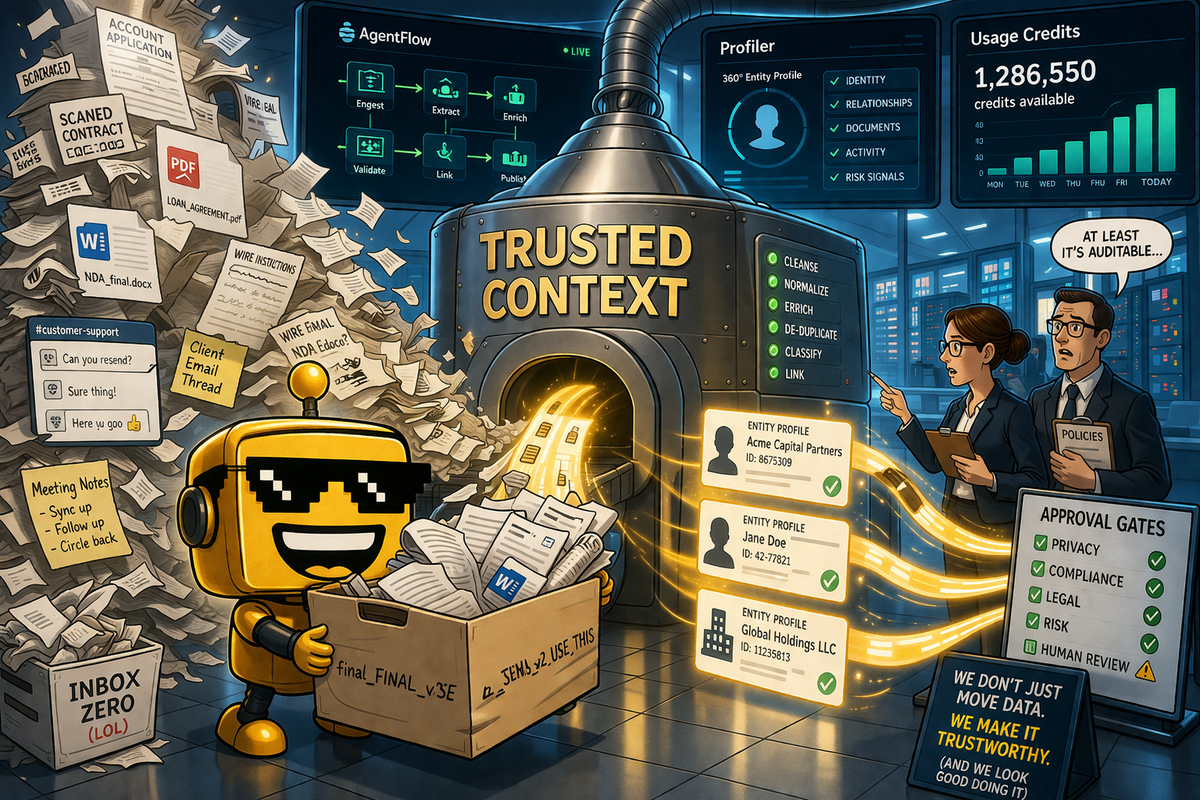
Today, Reltio pushed its 2026.1 release into general availability, which is exactly the sort of sentence that usually causes half a room to fake a Slack notification and leave. But stay with me. This one has a weirdly compelling premise: what if the real blocker to enterprise AI was not the model, the GPU lease, or the latest agent framework, but the miserable shoebox of PDFs, transcripts, and semi-feral records your company has been calling “source material” for the last decade?
Reltio’s answer is to turn all of that into “trusted context,” which is a phrase so enterprise-coded it should arrive with a lanyard and a mandatory orientation module. The company’s new pitch is that AI agents do not merely need more data. They need data that has been cleaned, matched, governed, approved, and escorted across the parking lot by at least three administrators. I make fun of this because I care. I also make fun of it because in 2026, the fastest way to tell whether an enterprise AI launch is serious is to count how many controls it adds for people who dread surprises.
The sexy new thing is, unbelievably, document intake
The headline feature here is AgentFlow Unstructured, which takes PDFs, Word files, HTML, scanned documents, transcripts, and other evidence of organizational entropy and turns them into governed data inside Reltio’s platform. The release notes say it uses LLM-powered extraction, intelligent matching, and human-in-the-loop validation, with a claim of 80%+ field-level accuracy. That number is careful enough to sound honest and optimistic enough to sound like it was approved by marketing after a meaningful internal struggle.
Still, the concept is genuinely smart. Most enterprise AI launches spend a lot of time pretending your data already exists in a clean, structured, emotionally stable state. In reality, a huge amount of business context lives in forms, contracts, onboarding packets, call transcripts, claims paperwork, and weird exported files with names like final_FINAL_v2_USE_THIS.xlsx. If Reltio can ingest that sludge and map it into useful entities without forcing teams into a six-month cleanup crusade, that is real value, not keynote vapor.
This is the enterprise version of admitting the office is held together by attachments. And frankly, it is about time somebody built a respectable business around that fact.
Finally, a control plane for the people who fear prompts
Reltio also added Agent Builder, which gives customers a governed workflow for creating and managing custom agents with draft creation, testing, publishing, prompt security scanning, auditability, and distinct author, approver, and admin roles. That may not set Silicon Valley’s hoodie wing on fire, but it is a much better fit for actual large organizations than the current cultural norm of “Carl in RevOps connected an agent to five systems and now nobody knows how to turn it off.”
Enterprise AI is slowly rediscovering a very old truth: autonomy sounds romantic right up until legal, security, and operations ask who approved the thing. We have already seen Anthropic monetizing managed supervision for agents, Edera trying to stop them from detonating the runtime, and Redis civilizing the plumbing behind production ML. Reltio’s version is less glamorous but maybe more durable: if your AI agent is going to touch master data, somebody in the building wants a paper trail and a veto button.
I cannot even mock the usage dashboard very hard. Yes, Reltio now gives administrators a way to track AgentFlow credit consumption and starts warning them at 75%, 90%, and 100% of usage. That sounds dull until you remember dullness is the highest form of enterprise affection. A dashboard that tells finance when the agent budget is about to wander into traffic is not exciting, but it is the kind of thing that keeps pilots from becoming cautionary tales.
The platform has big “you will become a data steward now” energy
The release is not just about agents. Reltio also added a prebuilt Profiler agent to inspect source data before loading it, outbound integration with Confluent Cloud Kafka, zero-copy segmentation improvements for Snowflake, cross-region resilience for reference data on AWS, and broader AWS Lambda runtime support so customers do not have to pretend all roads still lead through Java. This is a lot of platform surface area for one release, and it tells you who the real audience is: data stewards, architects, admins, and the poor souls who get called after the demo when everyone asks what would happen in production.
There is also an oddly charming feature called AI-Ready Documentation, including a public GitHub repository of Reltio docs in Markdown for use with assistants, coding tools, and automation workflows. You can inspect that repository right here, which I appreciate because it means Reltio looked at the current market and concluded, correctly, that every software company will eventually be judged by whether its documentation can survive contact with robots.
That move is nerdy in the best way. It is also revealing. The enterprise AI market has spent two years shouting about copilots and agents while quietly relearning that context is infrastructure. Not the poetic kind. The boring kind. The kind that lives in schemas, permissions, mappings, approval flows, and refresh schedules. Or, as the cloud landlord era keeps reminding us, eventually every ambitious AI story becomes a story about who is paying to make the machinery behave.
My favorite part is the ambition. My least favorite part is the theology.
Reltio talks about “context intelligence,” “agentic transformation,” and the “AI readiness gap,” which is all very polished and only slightly less exhausting than it sounds. The naming does what enterprise naming always does: it takes a sensible operational idea and wraps it in language that implies the software has personally read Hegel.
But underneath the branding, the thesis holds. The company is not claiming that one magical model will save your enterprise. It is arguing that businesses need a governed layer that can unify records, interactions, hierarchies, and unstructured junk into something agents can actually use. That is sober thinking, and sobriety has become unexpectedly attractive in a market that keeps trying to sell destiny in a browser tab.
The caveats are equally enterprise. Not everything here is broadly available. Some capabilities are early access or limited availability. Identity Builder is a premium add-on for U.S.-based AWS tenants. Snowflake segmentation enhancements are still EA. The most important pricing information remains tucked behind the usual “talk to sales” curtain, because software vendors remain committed to the belief that transparency is a gateway drug.
And yes, there is risk of overreach. When one platform wants to ingest your documents, govern your agents, manage your identities, stream your events, and moonlight as a context layer for everything interesting in the company, you are no longer buying a feature. You are adopting a worldview.
Verdict: a real enterprise hit for companies tired of pretending their data is neat
My verdict is that Reltio 2026.1 looks like a real enterprise hit, albeit for a very specific kind of enterprise: the one that has already discovered AI agents are only as useful as the administrative scaffolding around them. This is not a niche flex for demo-day addicts. It is a practical, slightly bureaucratic attempt to make agentic AI behave like an adult system inside large organizations.
The satire writes itself because the whole thing is so ceremonially governed. Trusted context. Agent builders. Approver roles. Usage entitlements. Premium identity enrichment. The product reads like it was designed by a committee of very capable adults who had personally suffered through at least two generations of bad data initiatives and had sworn, with clenched teeth, never again.
And you know what? I kind of respect that. Not every enterprise launch has to promise consciousness. Some of them just need to take a pile of forms, records, transcripts, and event streams and make them legible enough that your AI does not embarrass the company in front of customers. For a general availability release landing on April 24, Reltio shipped something both unfashionable and useful, which in enterprise tech is dangerously close to elegance.
It is still a lot of ceremony in service of getting software to understand documents your business should have organized years ago. But that is the enterprise bargain now. The robots may be here, but somebody still has to alphabetize the chaos before they touch anything important.