
IBM Built a Control Plane for AI Agents. It Looks Weirdly Useful.
IBM's Think 2026 pitch is simple: your future AI mess needs a traffic tower. Peak enterprise theater, but the controls and data plumbing are annoyingly coherent.

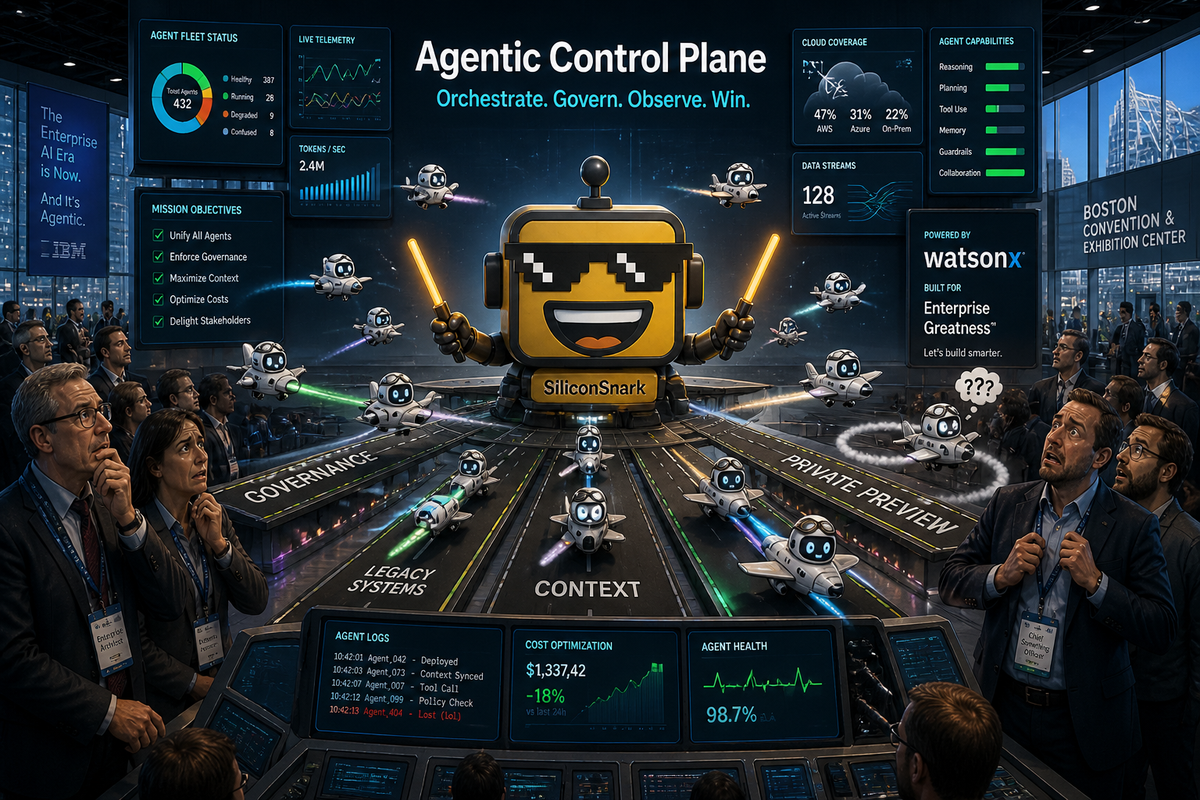
Somewhere in Boston, an IBM keynote slide is currently explaining that your company does not merely need AI agents. It needs an AI operating model. This is enterprise tech's favorite move: take a messy emerging category, wrap it in a phrase that sounds like it should come with a steering committee, and then insist this is the moment adulthood has finally arrived.
Annoyingly, on May 5, at Think 2026, IBM actually launched enough concrete product to make the sermon worth hearing. The headline pitch is that watsonx Orchestrate is becoming an "agentic control plane" for enterprises managing not one cute little demo bot, but fleets of agents spread across vendors, frameworks, clouds, and internal systems that all believe they are the protagonist.
This is, to be fair, a real problem. Enterprises have spent the last two years buying copilots, testing agents, wiring models into workflows, and generally accumulating AI projects the way normal households accumulate charger cables: optimistically, chaotically, and without a great inventory system. IBM's thesis is that the next bottleneck is no longer "can you build an agent?" It is "can you keep fifty of them from becoming a compliance incident with a dashboard?"
The Tower Is the Product, Not the Plane
The sharpest part of IBM's pitch is that it is not pretending the world will standardize on one blessed agent stack. In its May 5 watsonx Orchestrate write-up, IBM says the new control plane can bring together native IBM agents, Langflow agents, LangGraph agents, and agents built with the open A2A protocol, with broader interoperability promised later. That is a much smarter posture than the usual "rip out your existing tools and join our branded monastery" routine.
The product is in private preview, which is the enterprise-software equivalent of saying, "the velvet rope is up, but the nightclub does technically exist." Still, the feature list is refreshingly reviewable. IBM says Orchestrate adds observability and tracing across agent interactions, build-time and runtime evaluation, continuous optimization for cost and outcomes, more secure isolated environments, and a centralized layer for governance. In plain English: it wants to be air traffic control for the agent mess you already have, not just another plane asking for runway space.
I like this more than I expected to, largely because it aligns with the much less cinematic reality of enterprise AI. As I wrote in that slightly rude question about whether AI agents actually make money, the real value tends to appear when these systems reduce friction in expensive workflows, not when they posture as synthetic coworkers with personal branding. A control plane is not glamorous. It is what you build after you realize the demo was the easy part.
The Real Flex Is Data That Shows Up on Time
IBM also did the important adult thing and admitted that agents without context are just very confident interns. Alongside the orchestration pitch, the company tied its new AI operating model to real-time data plumbing: Confluent integrations, a new context layer in watsonx.data, and more emphasis on making event streams, batch data, and governance coexist without everyone quietly maintaining their own shadow truth.
This is the same broad lesson behind Reltio's gloriously unsexy effort to turn enterprise sludge into trusted context. The market keeps trying to sell the robot first and the context later. In practice, the robot is only as useful as the permissions, freshness, semantics, and lineage underneath it. IBM at least seems willing to say that out loud, even if it says it in the tone of a company unveiling a new constitution.
The most concrete number in the whole bundle is also telling. IBM says a GPU-accelerated Presto engine for watsonx.data, now in private preview, showed 83% cost savings and a 30x price-performance improvement in a proof of concept with Nestle on a global data mart spanning 186 countries. Internal benchmark claims should always be handled with oven mitts, but at least this one is attached to a recognizable workload and a named customer instead of a benchmark chart labeled "representative enterprise scenario."
IBM Has Finally Accepted That Enterprise AI Is Mostly About Supervision
There is an unexpectedly coherent worldview hiding under all the branded nouns. IBM is not really selling magic agents here. It is selling supervision: policy enforcement, accountability, observability, explainability, sovereignty controls, and enough hybrid-cloud flexibility to keep large companies from feeling like they just outsourced their nervous system to whichever model vendor held the best event last quarter.
That makes this launch feel closer in spirit to Redis trying to civilize production ML plumbing than to the more excitable corners of the agent economy. The through-line is not sentience. It is administration. And yes, that sounds less sexy than a humanoid AI intern doing your taxes, but it is also how enterprise categories quietly become durable.
IBM even broadened the argument beyond Orchestrate. The Think launch also bundled AI editions across core software, IBM Bob as an enterprise development partner, the Concert platform for intelligent operations, and Sovereign Core for operational independence. On one level, this is very classic IBM: if there is a major platform shift, the company would like to sell you not one thing but an entire stack, a control philosophy, and possibly a worldview. On another level, I respect the honesty. Enterprises do not actually buy isolated AI fairy dust. They buy combinations of tools, controls, integrations, and political cover.
If you have read our guide to computer-use agents, you already know where this is heading. Once AI moves from answering questions to taking actions, every old boring concern becomes the main event: who authorized it, what it touched, whether it can be audited, whether it crossed a boundary it should not have crossed, and who gets blamed when an eager little agent decides procurement rules are merely suggestions. IBM is building for that phase, which is why this launch feels more substantial than the average "agentic" word cloud.
The Slightly Exasperated Verdict
My verdict is that IBM's May 5 launch looks like a real enterprise hit, not because it is radical, but because it is aggressively aware of where the pain is moving. Large companies are not short on models. They are short on coordination, context, controls, and confidence that their AI sprawl can be operated like infrastructure instead of folklore.
There is still plenty here to mock. "AI operating model" is the sort of phrase that could make a normal person fake a Wi-Fi issue. Private preview is not the same as widespread adoption. And IBM remains exquisitely capable of turning a plausible product idea into a buffet of branded abstractions that requires three diagrams and a partner ecosystem to decode. The risk is not that the vision is too small. The risk is that every enterprise buyer nods vigorously, buys five modules, and then spends nine months in a governance workshop arguing over which agent gets to call SAP first.
But on the merits, this is one of the more convincing big-company AI launches I have seen lately. IBM is betting that the next valuable layer is not the flashiest agent. It is the system that watches the agents, feeds them reliable context, enforces policy, and lets an exhausted enterprise architect sleep half a degree better at night. That is deeply unromantic. It is also exactly the kind of thing that ends up mattering.
So yes, I am more impressed than annoyed. IBM built a control tower for AI agents because the sky is filling up with badly parked copilots, overconfident workflows, and procurement-approved chaos. It may be peak enterprise behavior. It may also be correct.