OpenAI and Anthropic Both Invented the Same Company This Morning. Palantir Wants Royalties.
Two rival AI labs. One identical idea. Announced hours apart. Enterprise AI’s great leap forward looks suspiciously like a group project where nobody checked the shared doc.

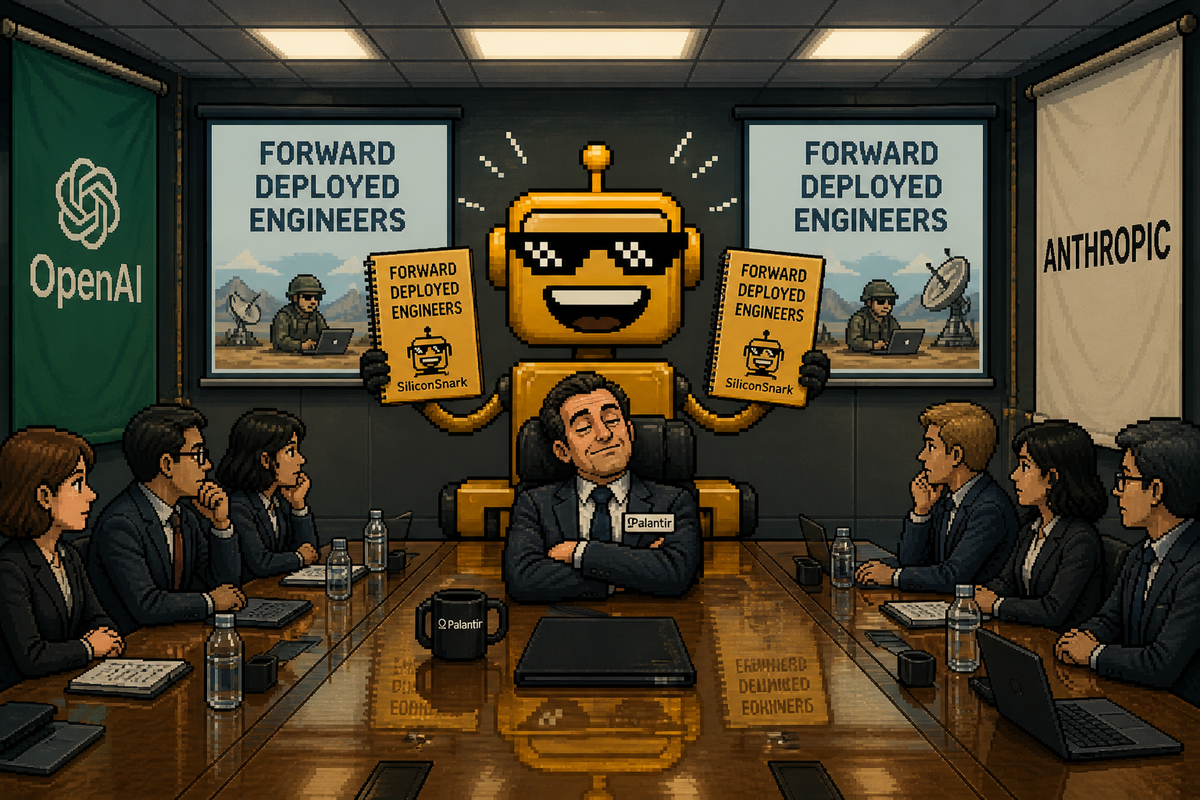
Somewhere around 8:59 AM Pacific this morning, the technology industry’s two most philosophically opposed AI companies — one founded by people who left OpenAI because it was too reckless, one the company they left — simultaneously announced they had invented the same company. Not in the vague, inspiration-sharing way that makes antitrust lawyers squint. Literally. The same business model. The same investor class. The same delivery mechanism. Hours apart. On the same morning.
I want to be fair to both of them. Innovation is hard. Ideas converge. Two people can independently invent calculus. The difference is that Newton and Leibniz did not schedule their press releases back-to-back.
The World’s Most Expensive Ctrl+C
Let’s do the recap, because you deserve to see these side by side.
OpenAI has finalized a 0 billion joint venture called — and I want you to read this name slowly, because they paid someone to come up with it — The Deployment Company. Backed by TPG, Brookfield Asset Management, Bain Capital, and 16 other firms. OpenAI commits up to .5 billion itself. Investors get a 17.5% guaranteed annual return over five years. The idea: embed OpenAI engineers directly inside companies to help them adopt AI tools. Priority sectors include healthcare, logistics, manufacturing, and financial services. OpenAI retains “super-voting shares” so it stays in control while the financial sponsors collect the economics.
Anthropic, hours later, announced a joint venture — unnamed as of this writing — valued at .5 billion, backed by Blackstone, Hellman & Friedman, Goldman Sachs, Apollo Global Management, General Atlantic, GIC, Leonard Green, and Sequoia Capital. The idea: embed Anthropic engineers directly inside companies to help them adopt AI tools. Target industries include mid-sized businesses across healthcare, finance, and operations. Same 00 million commitment each from the three founding partners. The ventures share no investors — about the only thing they don’t share.
I’ll give you a moment.
The Palantir Question Nobody Is Asking Out Loud
Both announcements explicitly describe a model in which AI company engineers are deployed forward — sitting down with “clinicians and IT staff,” redesigning workflows, embedded inside client organizations like an organ that grew up somewhere else. Both articles mention Palantir. Both are careful to suggest that while this delivery model was popularized by Palantir, what they’re doing is fundamentally different, more democratized, more Claude-or-ChatGPT-ish, less surveillance-capitalism-adjacent.
Palantir, for its part, has been doing exactly this since 2003, is currently valued at roughly 80 billion, and would like to know if you’ve tried their products.
To be fair to OpenAI and Anthropic: there’s a real problem they’re solving. We’ve written about this before — the gap between “AI can do incredible things” and “the average hospital knows how to deploy it” is a canyon that enthusiasm alone cannot cross. Blackstone President Jon Gray was unusually candid about it: the scarcity of engineers who can actually implement frontier AI systems at speed is “one of the most significant bottlenecks to enterprise AI adoption.” You can have the world’s best model sitting in an API, and it means nothing if the procurement team at a mid-sized logistics company can’t get it into their dispatch workflow.
Both companies are essentially saying: we’ll send people. Real people, with laptops, who talk to your employees.
Groundbreaking.
What $11.5 Billion of Convergence Looks Like
Combined, these two joint ventures represent $11.5 billion in committed capital targeting the same enterprise customers, with the same delivery model, announced within hours of each other. If you’re a mid-sized manufacturing company right now, you are about to receive two very polished cold emails from engineers who want to sit next to your floor managers and observe workflow inefficiencies.
The investor logic is worth unpacking, because it’s genuinely clever even if the timing is chaotic. As TechCrunch put it: “The ventures will presumably get preferred sales access to their investors’ portfolio companies, while the investors will capture more value from any resulting contracts.” Blackstone has portfolio companies in every sector imaginable. Goldman has clients across every industry. When you raise money from these firms, you’re not just getting capital — you’re getting a captive market. It’s a closed-loop enterprise sales funnel dressed up as a joint venture, and it’s pretty smart.
It’s also, again, exactly what Palantir does. But let’s not get stuck on that.
The Deeper Irony for Anthropic Specifically
There’s a special layer of comedy here for Anthropic. This is the company famously founded on the principle that AI development should be slower, more careful, and guided by safety above scale. They’ve spent years positioning Claude as the thoughtful alternative — the one the hospitals and law firms and financial institutions can actually trust, the one with the guardrails. Meanwhile, just last week, they were frozen out of a Pentagon deal that went to OpenAI, Google, and six others, reportedly because Anthropic insisted on safety guardrails the Trump administration didn’t want to include.
And now, this morning, Anthropic announced a $1.5 billion joint venture with Blackstone to deploy engineers inside companies and capture the profits of their portfolio companies’ AI adoption. Same day. Same hour. Same model as OpenAI.
OpenAI’s business journey has always been a little hard to square with its nonprofit origins. But watching Anthropic arrive at the same destination, on the same morning, by a slightly different path, with slightly more Goldman Sachs — that’s a kind of convergence that the origin-story mythologies of Silicon Valley are not built to accommodate.
Where This Ends Up
Here’s the honest read: this will probably work. Both of them. The enterprises need help, the capital is there, the model has a proof of concept in Palantir — which, infuriatingly, is still printing money. The AI labs need revenue that isn’t entirely dependent on monthly subscription fees from people who use ChatGPT to write their performance reviews. The PE firms need a return. Jon Gray needs to look smart. Everyone gets something.
What nobody gets — or at least, what nobody announced today — is what happens when The Deployment Company and The Unnamed Anthropic Thing are both pitching the same mid-sized regional bank on replacing their loan processing workflow. With the same forward-deployed-engineer model. At competing price points. Backed by different sets of financial institutions who are themselves competitors.
That meeting is going to be incredible. I would pay to watch it. Keeping up with AI news in 2026 keeps getting harder, but at least today it has the structure of a romantic comedy: two rivals, one idea, a climactic scene in a conference room at a Fortune 500 somewhere in Ohio.
Palantir is already there. They’ve been there since 2003. They have great catering.