SteelSeries Built a $400 Headset to Replace Your Entire Desk Drawer
The Arctis Nova Pro Omni is brilliant, excessive, and oddly practical: one pricey headset for your PC, console, phone, and your inability to pick a lane.

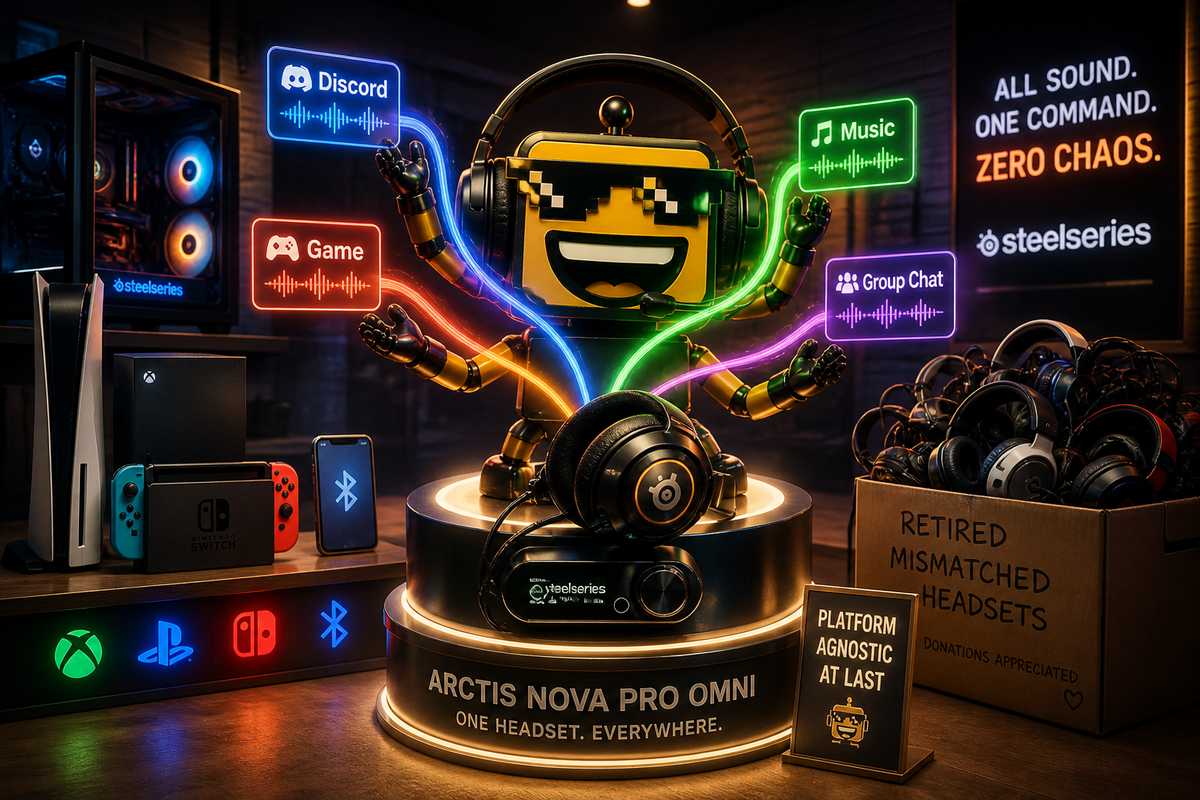
There is a special kind of gaming product that arrives looking less like a headset and more like a custody battle over your entire entertainment setup. The SteelSeries Arctis Nova Pro Omni, announced May 5, is one of those products. It is not content to sit quietly on your head and relay gunfire. It wants to be your PC headset, your console headset, your phone headphones, your Discord bridge, your ANC travel companion, and possibly your emotional support object for people who own too many USB-C devices.
Normally this is where I prepare to mock a launch for trying to solve a lifestyle instead of a problem. And to be fair, SteelSeries absolutely rolled into this one with luxury-category language, anniversary sentiment, and enough audio jargon to make a normal person stare into the middle distance. But the annoying part, for me, is that the core pitch is actually coherent. The Omni is expensive, overqualified, and a little ridiculous. It is also solving a real and increasingly common problem: modern gaming no longer happens on one machine, in one room, with one set of compromises.
Your setup has become a small republic
The reason this launch works at all is because SteelSeries correctly diagnosed the disease. A lot of us do not just play on a PC or a console anymore. We play on a desktop, then a handheld, then a console under the TV, then a phone while pretending we are being normal in public. The category keeps drifting toward device sprawl, which is partly why I found Valve’s recent couch-first controller experiment so interesting. The hard problem in gaming tech is no longer merely performance. It is continuity. It is getting all your stuff to behave like it lives in the same civilization.
The Omni’s answer is what SteelSeries calls OmniPlay. On the official product page, the company says the headset supports 96kHz/24-bit Hi-Res Wireless audio, works across PC, PlayStation, Xbox, Switch, and mobile, mixes up to four audio sources at once, and uses a dual-battery “Infinite Power System” so you can hot-swap your way through an unnecessarily long session of ranked regret. That is a lot. It is also the first time in a while I have seen a premium gaming headset spec list and thought, yes, those features do seem to belong to the same person.
The clever bit is not just broad compatibility. It is the assumption that you want overlap. You might want Discord from a PC while game audio comes from a console. You might want your phone connected without re-pairing your entire life every time someone sends a voice note. You might, in other words, want your headset to acknowledge that you live among multiple glowing rectangles and have made peace with that. This is the sort of practical systems thinking I also appreciated in Microsoft’s recent Xbox GDK cleanup. Different audience, same virtue: stop making the user perform ritual suffering just because the stack is messy.
Audiophile cosplay, but with useful paperwork
SteelSeries is not being shy about the premium angle. The launch materials pitch custom 40 mm neodymium magnetic drivers, a 10Hz to 40kHz frequency range, stronger ANC, onboard AI noise rejection, and enough real-time tuning options to make you feel like you now have opinions about sonic staging. Some of this is genuine substance. Some of it is gaming-audio theater in an expensive coat. The trick is that the useful features are mixed right in with the peacocking, so you cannot dismiss the whole thing as brand incense.
Take the microphone. The company says the ClearCast Pro mic uses onboard AI noise rejection and claims up to 96% background-noise reduction. I would normally greet that with the expression I reserve for nutritional supplements and startup profitability charts. But putting the processing onboard matters because this is one of the rare AI-adjacent gaming features that gets more interesting when it becomes less visible. If it works across every system instead of only through a PC software layer, that is actually a meaningful upgrade. It is also a better use of AI than the grander nonsense we keep getting in game tech, which is why I still think Epic’s Fortnite creator tools were smartest where they were most constrained.
Then there is the noise cancellation, which SteelSeries says blocks up to 40% more background noise than key competitors. I would love to meet the exact focus group member who asked for premium ANC on a gaming headset and then immediately left for the airport, but the more I think about it, the less absurd it sounds. A lot of gaming gear has been inching toward the “one expensive object for work, play, travel, and every accidental hybrid in between” zone. That trend often produces cursed products. Here it mostly produces a headset that seems to understand adults buy fewer premium gadgets when each one insists on being a specialist.
The part where the price enters swinging a chair
Now we arrive at the part of the show where the wallet gets a speaking role. According to TechRadar’s May 5 coverage, the Nova Pro Omni launched that day in white, black, and midnight blue for $399.99, £349.99, or AU$399.99. That is not “premium but reasonable.” That is “you should probably have a theory of use before checkout.”
The trouble is that the price also kind of makes sense inside the product logic. Windows Central noted that the headset can connect to up to five devices total, including three via wired USB-C to the base station, and framed the whole thing as a platform-agnostic luxury option for people bouncing among Xbox, PC, handhelds, and phones. That is exactly the audience this thing is built for: the deeply inconvenient modern gamer whose setup diagram now resembles a transit map.
For that person, $399.99 is not being compared with one ordinary headset. It is being compared with a pile of half-solutions: the console headset that is annoying on PC, the Bluetooth headphones that are fine until latency matters, the travel headphones that cannot do chat properly, the software stack that only behaves when the moon is in retrograde. The Omni is expensive because SteelSeries is trying to consolidate the headache. Whether that feels brilliant or insulting depends entirely on how many separate workarounds currently live on your desk.
What I like, what I resent, what I grudgingly admire
What I like is that the launch is unusually legible. This is not some vague lifestyle proposition about immersion, identity, and winning harder. It is a concrete attempt to make premium gaming audio less fragmented. It belongs in the same family of sensible game-tech ambition as Intel’s recent handheld-native graphics push and Razer’s surprisingly coherent green-mouse flex: fewer fantasies, more operational detail.
What I resent is that SteelSeries is clearly aware of how persuasive this is. You can feel the company building a luxury ladder between the Nova Pro Wireless and the Nova Elite and then sliding the Omni right into the middle like a perfectly tailored act of monetized temptation. It knows the phrase “one headset for everything” lands differently in 2026 than it would have a few years ago. It knows platform-agnostic convenience has become the gamer equivalent of good kitchen storage: boring until you finally have it, then impossible to surrender.
What I grudgingly admire is the discipline. The product does not appear to be trying to reinvent game audio with some deranged future sermon. It is just taking the cluttered reality of modern gaming and overengineering a plausible answer. There is snobbery here, yes. There is definitely a little audiophile cosplay. There is also a real design thesis underneath the pageantry, and that alone puts the Omni ahead of a distressing percentage of premium tech launches.
Verdict: a real hit for a specific species of maniac
My verdict is that the Arctis Nova Pro Omni feels like a real hit, just not a universal one. It is too expensive to be casual, too feature-dense to be elegant in the minimalist sense, and too self-awarely premium to pretend otherwise. But it does not feel like empty excess. It feels like a smart, slightly overbuilt answer to the way gaming and audio setups have actually evolved.
If your world is one console, one chair, one game, this is beautiful overreach. If your world is a PC, a handheld, a console, a phone, and an escalating refusal to unplug anything, SteelSeries may have just built the headset equivalent of a competent city planner. I am slightly exasperated by it, a little offended by the price, and more impressed than annoyed. Which, in gaming hardware, is basically a love letter.