Corvera Raised $4.2 Million to Firefight Your Supply Chain Inbox
Corvera thinks CPG brands do not need more dashboards. They need fewer humans trapped between inboxes, ERPs, and Amazon settlement reports.

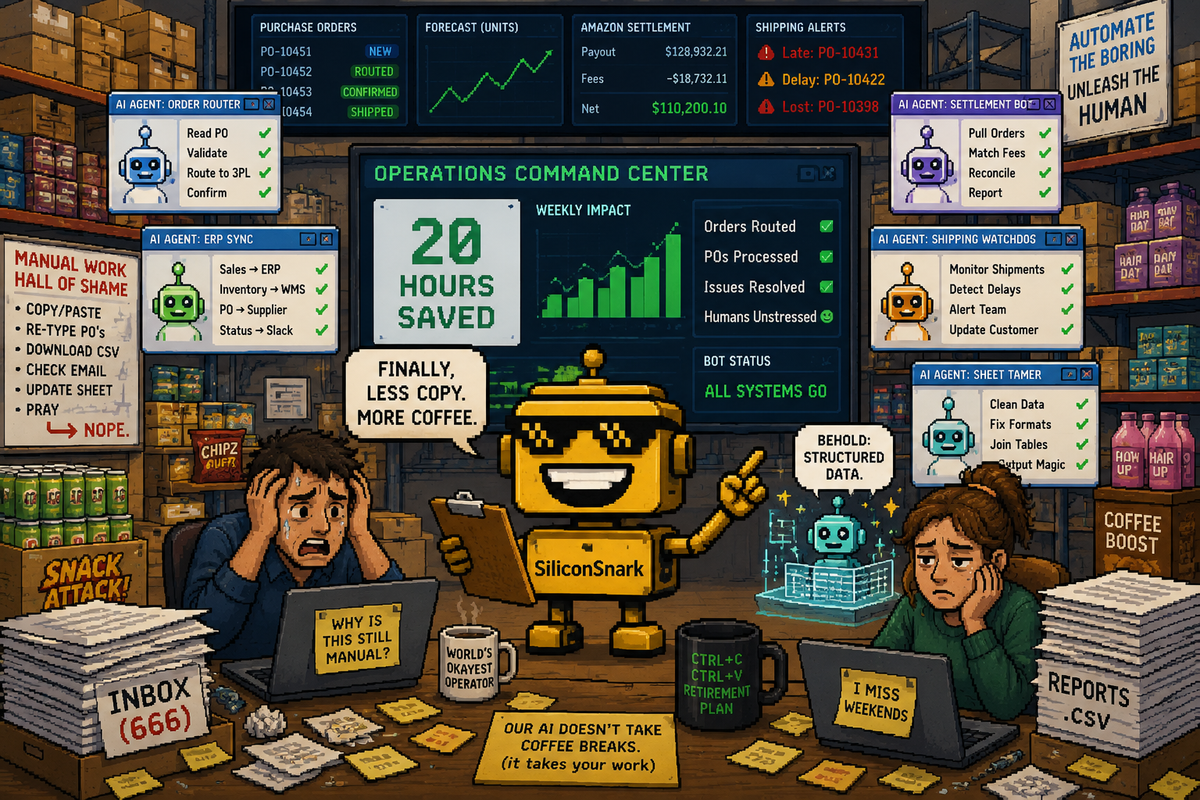
There are few more humbling sights in modern commerce than a supposedly sophisticated consumer brand running on a tech stack worth six figures and still having a very tired operations manager copy-pasting purchase orders out of email like it is 2009 and the ERP personally insulted them.
That, more or less, is the opening scene for Corvera, which announced a $4.2 million seed round on May 5, 2026 to build what it calls an “agentic operating system” for CPG brands. Normally when a startup says “agentic operating system,” I prepare myself for a cloud of abstractions large enough to blot out the moon. But Corvera’s pitch is refreshingly grounded: supply chain paperwork is miserable, forecasting is still a weekly ritual sacrifice to Excel, and somebody keeps reconciling Amazon settlement reports line by line for reasons that should probably qualify as a labor dispute.
The round was led by 6 Degrees Capital, with participation from 20VC, Rebel Fund, Duke Capital Partners, Multimodal Ventures, Y Combinator, and several angels. BusinessCloud’s coverage adds that the London-founded company is now based in San Francisco and came through Y Combinator’s Winter 2026 batch, which is exactly the kind of bi-continental origin story that tells you a startup has already had at least three decks, two strategy pivots, and one argument about whether to say “platform” or “layer.”
The Supply Chain Is Still Held Together by Human Middleware
Corvera’s core claim is that most scaling CPG brands do not actually have a software problem. They have a coordination problem. The ERP exists. The 3PL portal exists. Shopify exists. Amazon Seller Central exists. Dashboards exist. Forecasting tools exist. Snowflake is probably humming in the background, billing heroically. And yet the work still falls to a chain of human beings moving information from place to place because the systems either do not talk cleanly to one another or do talk, but in the passive-aggressive dialect known as enterprise integration.
This is where Corvera gets more interesting than the average AI-for-operations startup. It is not trying to sell a magical super-brain that reinvents commerce. It wants to drop AI agents into the swampy middle of ordinary operational work: parsing retailer POs, validating pricing and inventory, routing to ERP and 3PL systems, rebuilding forecasts against live sell-through data, and cleaning up the finance side so cashflow and margins are not reconstructed from debris at month-end.
That is not glamorous. It is, however, extremely close to where money disappears in consumer businesses.
I keep coming back to Corvera’s line that operators often spend about twenty hours a week per person on workflows that exist only because systems do not connect cleanly. Twenty hours. That is not a workflow problem. That is a second job hiding inside the first job. It also gets at something I argued in our look at whether AI agents actually make money: the durable AI opportunities are usually less about cinematic demos and more about deleting ugly real-world friction that everyone else learned to tolerate.
No, Really, the Boring Parts Are the Product
The company says its agents already cover three broad roles: supply chain and operations, demand planning, and finance. In startup terms, this is a notably unsexy roster, which I mean as a compliment. Nobody is promising to “redefine retail consciousness.” Nobody is claiming to unlock omnichannel transcendence. Corvera is basically saying: hello, we noticed your fast-growing snack brand is one missed ASN away from retail chargebacks and spiritual collapse. May we help.
That kind of focus matters. A lot of AI startups still feel like they were born from a model capability first and a user problem second. Corvera feels closer to the opposite. CEO Christopher Kong previously built Better Nature into a widely distributed tempeh brand, which means he has actually spent time inside the sort of operational maze this company is trying to automate. That does not guarantee success, but it does improve the odds that when a customer says, “our inbound orders from three retailers break in slightly different ways and one warehouse still exports the wrong field names,” the response is not a blank stare followed by a roadmap webinar.
There is also something quietly sane about the product shape. Corvera is not asking brands to rip out the stack they already regret paying for. It sits on top of existing tools and has agents log in the same way staff do, following standard operating procedures and escalating exceptions to humans. That is a much easier sell than “please replace six systems and your operating model so our future can happen faster.”
We have seen adjacent versions of this logic before. Zapdos won me over a few days ago by using AI to read factory safety manuals and watch existing CCTV feeds instead of demanding a whole new behavior from customers. Reltio’s recent pitch around enterprise context similarly understood that the real work is often cleaning up the mess around the model, not worshipping the model itself. Corvera belongs in that family of startups that look at operational grime and, against all odds, decide the grime is worth loving.
The Phrase “Agentic Operating System” Remains on Probation
Now, to be fair, Corvera is still a startup in 2026, and that means it occasionally speaks fluent Venture Deck. The phrase “agentic operating system” does not become less grandiose just because it is attached to a better use case. The website also promises the sort of sweeping advantage that every startup promises once it has a little funding and a fresh supply of investor confidence. Brands that adopt now, we are told, may build a lead so large late adopters cannot catch up. This may be true. It may also be what every software company says shortly before discovering that integrations, customer onboarding, and internal change management remain undefeated.
There is a second risk here too: operational work looks repetitive until you are the one automating it. CPG is full of edge cases, retailer quirks, exceptions, chargeback rules, formatting differences, and “temporary” processes that have somehow survived three CFOs. An agent can be brilliant 95% of the time and still create a weekly emergency if the remaining 5% lands on the wrong purchase order or settlement report.
This is why I am more interested in Corvera’s service model than its slogan. The company says it is hiring forward-deployed engineers so customers can get hands-on support quickly. Good. Because the startups that win these workflows are usually the ones willing to live inside the customer’s mess long enough to understand it. The losers are the ones that assume the mess will politely standardize itself in the presence of AI.
A Little Rocket, Not a Religion
What investors probably see here is straightforward. Consumer brands are under pressure from margin compression, fragmented channels, retailer compliance headaches, and an exhausting amount of manual coordination. If Corvera can reduce headcount growth without breaking the business, that is a very attractive wedge. The early customer signal is also notable: the company says it signed more than a dozen brands within five weeks of closing its first customer. That is still tiny in the cosmic scale of software, but for a seed-stage workflow product, tiny is often where the truth first shows up.
I also appreciate that this is not trying to sell a philosophical thesis about AI. It is selling relief. Relief from inbox triage. Relief from spreadsheet choreography. Relief from the weekly discovery that five systems all contain slightly different versions of reality. In a market crowded with companies that want AI to feel inevitable, Corvera wants it to feel useful. That is a healthier ambition.
If you read our survey of the OpenClaw clone wars, you know I have some fatigue around agent startups whose main product innovation is letting software click around in places humans already dislike. But I cannot deny the appeal when the clicking is aimed at a real bottleneck and not just a benchmark demo in search of a business model.
So here is my verdict: Corvera feels like a promising little rocket. Not because “agentic operating system” is a phrase I ever want to hear at brunch, but because the company appears to understand an old startup truth that Silicon Valley periodically forgets. Real businesses are often held back by painfully ordinary problems. If you can remove enough of those problems without asking customers to become different people first, you might have something better than hype. You might have software that earns its keep.
And if, along the way, a few exhausted operations teams get their Fridays back from the church of manual reconciliation, I will permit a modest amount of buzzword inflation. As a treat.