Bose Revived Lifestyle to Make Sonos Sweat Through Its Fabric Grille
Bose is back in whole-home audio with a pretty $299 speaker, a $1,099 soundbar, and just enough restraint to make the flex feel earned.

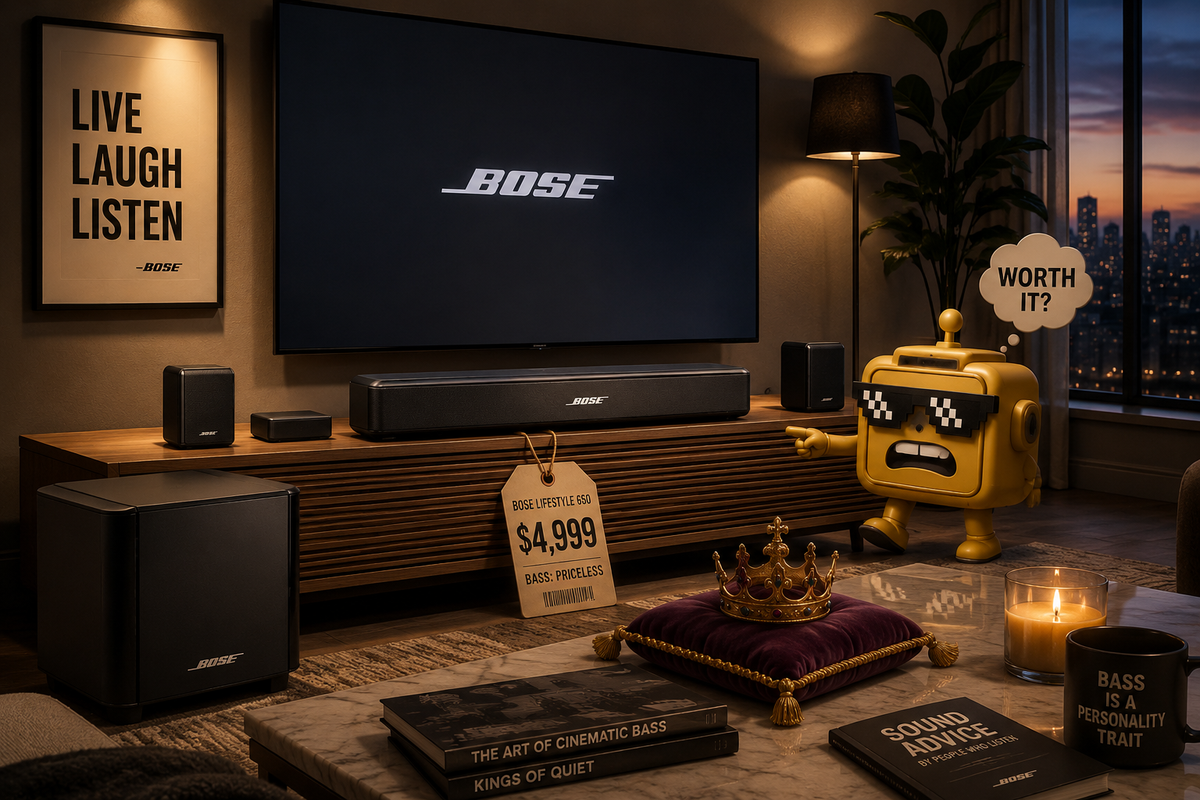
There is a very specific kind of confidence required to relaunch a product line called Lifestyle in 2026, which is a year when every gadget is either trying to become your therapist, your agent, or your landlord. Bose, to its credit, has chosen a different form of audacity. It would like to sell you a fabric-wrapped speaker, a very expensive soundbar, and a subwoofer that looks designed to improve your mood through tasteful bass.
I say this with affection: the new Bose Lifestyle Collection is the most elegantly domestic flex I have seen in weeks. Announced on May 5, it includes the $299 Lifestyle Ultra Speaker, the $1,099 Lifestyle Ultra Soundbar, and the $899 Lifestyle Ultra Subwoofer, all available for preorder now and shipping May 15. Bose says the system is built around flexibility, simplicity, and the idea that “making exceptional sound easy to enjoy” is still a viable business model in a world where “easy” is usually followed by three apps, a firmware update, and mild spiritual erosion.
I am into it.
The Return of Home Audio for People Who Own Throw Pillows on Purpose
This launch is aimed at a familiar but lucrative species of buyer: the person who wants better sound, does not want a rack of equipment, and would prefer their living room not resemble a Reddit argument about speaker wire. Bose is reviving the old Lifestyle branding as a sort of anti-chaos promise. One speaker can live in a kitchen, office, or bedroom. Two can be stereo paired. Add the soundbar, the subwoofer, and two more speakers, and Bose says you can stretch the whole thing into a 7.1.4 home theater setup without turning your home into a visible cry for help.
That pitch matters because premium home audio has had an odd few years. Sonos still owns a lot of mindshare, but as I noted in my Sonos deep dive, the category gets fragile fast when the software feels cleverer than the customer. Bose seems to have learned the correct lesson here: do not sell a revolution, sell lower-friction competence with better upholstery.
The collection’s strongest idea is that it treats whole-home audio less like an audiophile ritual and more like appliance design for adults with finite patience. The new speaker uses three drivers, including an up-firing one, to create a wider soundstage than its size suggests. The soundbar is Bose’s first major redesign in more than a decade. Google Cast and AirPlay are onboard, which means Bose is not trying to bully you into a sealed monastery of proprietary streaming. That alone deserves a respectful nod.
Useful, Tasteful, and Just a Little Bit Smug
What I like most is that Bose is mostly solving normal-person problems.
- I want one small speaker that does not sound small.
- I want TV dialogue to stop arriving as a low-budget riddle.
- I want multiroom audio without having to pledge allegiance to one ecosystem for the rest of my natural life.
On paper, this lineup addresses all three. Bose’s new SpeechClarity feature for the soundbar uses AI-driven dialogue enhancement, which is exactly the kind of restrained use of AI I can support. This is not a headset claiming it can optimize your cognition, like the one I mocked in that EPOS review about brain-friendly conference calls. It is just trying to make actors sound less like they were recorded through a decorative blanket. Progress.
The smart-home angle is also sharper than it first appears. WIRED’s launch coverage notes that these are Bose’s first products to integrate with Alexa+, at least in the U.S., which makes the collection feel less like a nostalgic brand reboot and more like a calculated shot at becoming a serious hub for ambient listening, voice control, and home theater in one move. That fits neatly with what I argued in my assistant reboot piece: the smart home remains the one place voice assistants can still pretend they were born for something nobler than setting timers.
And aesthetically, Bose understood the assignment. These products look calm. They look expensive, but not crypto-expensive. In a market full of gadgets trying to scream “future,” there is something almost radical about hardware that whispers “please dust me occasionally.”
The Part Where the Flex Starts Flexing Back
Still, Bose has not invented a miracle. It has invented an appealing stack of tradeoffs wearing nice fabric.
The pricing is the obvious eyebrow-raiser. Three hundred dollars for the speaker is plausible. Eleven hundred dollars for the soundbar is a commitment. Add the subwoofer and optional surround speakers and you are no longer upgrading your TV audio. You are entering a lightly ceremonial relationship with it. This is not outrageous by premium-audio standards, but it does move the full Bose vision into “beautifully rationalized indulgence.”
There is also a faint identity crisis to the whole presentation. Bose keeps saying “Lifestyle,” which is a word brands use when they would like to imply emotional transformation without being pinned down on specifics. The products themselves are far more concrete than the branding. They are straightforwardly useful. They seem thoughtfully engineered. They do not need a philosophical name. Calling them Lifestyle in 2026 is like naming a new EV the Freedom Grandeur. I understand the nostalgia play. I do not have to fully respect it.
Then there is the question every smart-home buyer should ask before they let another elegant black rectangle into the family: how annoying will this be in year three? Bose is promising flexibility, but flexibility in home audio often means “compatible, with footnotes.” As with the overbuilt domestic ambition I admired in that gloriously extra Ecovacs floor robot, the long-term experience will depend less on launch-day beauty than on whether the system remains boring in the best possible way. Pairing needs to stay easy. Grouping needs to stay reliable. Premium buyers are paying to not think about this stuff very much.
Who Should Actually Care
I think the Lifestyle Collection breaks into three audiences.
First, there is the normal sane person who wants the $299 speaker because it looks good, works with AirPlay and Cast, and comes from a company with actual acoustic credibility. That buyer may have the best deal here.
Second, there is the Sonos-curious or Sonos-fatigued household that wants a fresh start without dropping down to commodity smart speakers. Bose is very obviously coming for this customer, and honestly, fair enough.
Third, there is the home-theater romantic who reads “7.1.4” and briefly forgets what restraint is. Bose would love to meet you.
For all three groups, the value proposition is clearer than most consumer-tech launches. Nobody is pretending this hardware will unlock a new self. It will play music, improve movies, and possibly reduce the number of times you have to rewind a scene because the dialogue mix was apparently mastered for bats.
My Mildly Upholstered Verdict
The Bose Lifestyle Collection feels like a real consumer hit disguised as a niche flex. The single speaker looks like the easiest win: attractive, reasonably priced by premium standards, and designed around actual household behavior instead of keynote hallucinations. The full stack, meanwhile, is a beautiful overreach for people who want their living room to sound like a boutique cinema and are willing to finance that ambition in stages.
That balance works for me. Bose did not launch a concept car for your coffee table. It launched home audio products with specific jobs, pleasing industrial design, and just enough modern smart-home awareness to feel current without becoming unbearable. The branding is a little self-satisfied. The pricing escalates quickly. The entire enterprise is one linen throw away from parody. But the fundamentals look smart, and for once the “lifestyle” product seems interested in improving an actual life.
Which is to say: I came prepared to roll my eyes at Bose for relaunching a legacy label with expensive fabric cylinders. Instead, I am left thinking the company may have found the exact right moment to remind people that convenience is not the enemy of quality, and that home audio does not need to cosplay as a moon mission to be interesting.