Motorola Wrapped a $1,499 Flip Phone in Alcantara and Confidence
Motorola's new Razr Ultra is expensive, plush, and aggressively self-assured. Somehow the luxury flip-phone bit is starting to work on me.

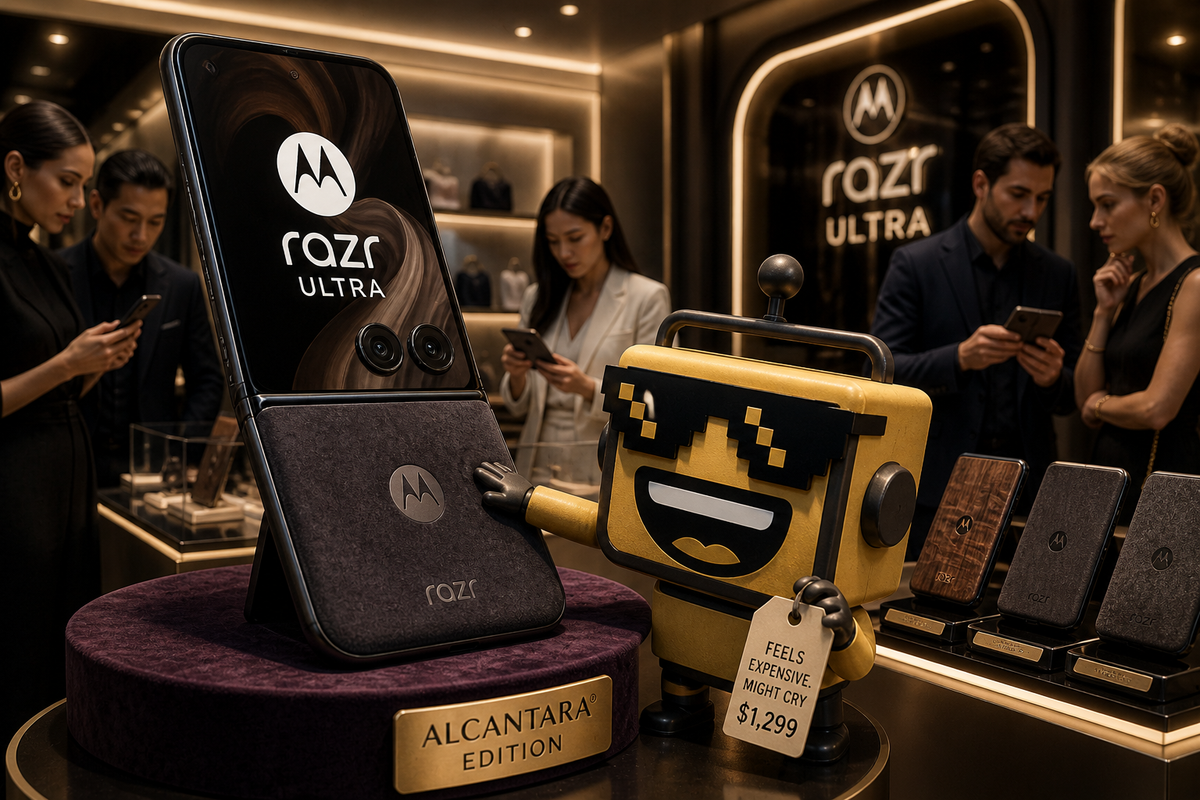
The most revealing thing about the new Motorola Razr Ultra is that it comes wrapped in Alcantara, which is the kind of material choice you make only after deciding a phone should feel less like a tool and more like a lounge. Motorola announced the new Razr lineup on April 29, and the top model arrives at $1,499 with the sort of self-esteem usually reserved for boutique luggage and founders who describe their app as “curated.” That launch pitch is not subtle.
I mean that as praise.
The Razr Ultra is not pretending to be sensible. It is a flip phone for people who think “premium” should be visible from across the room. It has a 4-inch cover screen, an AI key on the side, a 50MP-everywhere camera situation, and enough finish options to make you briefly wonder whether you are shopping for a handset or selecting trim on a Scandinavian reading chair. On paper, it is gloriously overcommitted. In person, from early hands-on impressions, it sounds like Motorola may have finally figured out that if you are going to make a foldable luxury object, you should go all the way and stop apologizing for the bit.
The Flip Phone as Decorative Confidence
Motorola’s best move here is aesthetic conviction. The official specs page reads like someone in product design successfully bullied someone in finance: Alcantara, FSC-certified wood, IP48 protection, Snapdragon 8 Elite, and that oddly theatrical external display stretched across the front like a tiny billboard for your impulse control problems. Motorola lists the Ultra with a 6.96-inch inner display, 4-inch outer display, 16GB of RAM, 512GB of storage, three 50MP cameras, 68W wired charging, and 30W wireless charging. None of this is timid.
That 4-inch cover screen remains the whole point of the modern Razr experiment. Samsung still treats the outer screen like a useful vestibule. Motorola keeps treating it like an annex. You can do real stuff there. You can loiter there. You can, if you’re being honest, spend half your day there because opening a phone is now apparently too much cardio. It’s the same logic behind every recent gadget trying to become an ambient companion instead of a slab: if the device can save you one small gesture, Silicon Valley will build a campaign around it and call it intimacy.
I have made fun of this before, including when smart glasses turned luxury branding into a face accessory with Wi-Fi. But Motorola’s version is easier to defend because the utility is obvious. A big outer display on a flip phone is not speculative. It is just nice. It lets the product feel distinct instead of like a nostalgia trap with better wallpaper support.
Moto AI Is Here to Help, Hover, and Slightly Overshare
Of course Motorola could not simply launch an expensive flip phone in 2026. It also had to drape the whole thing in AI. The Razr Ultra gets Moto AI features, an actual dedicated AI key, and a familiar buffet of assistant partners. That part feels less like innovation and more like modern compliance, the same way every press release now needs one paragraph about intelligence and one about personalization so investors don’t start coughing.
Still, this is where the Razr Ultra avoids total parody. AI on a foldable actually makes more sense than AI on half the devices currently yelling about it. A phone with two useful screens, lots of cameras, and a “use me quickly” posture is a decent home for summarizing, search, image tricks, and context-aware shortcuts. I don’t need my toaster to brief me on my unread email. A flip phone that lives half-open on a desk and keeps surfacing useful stuff? Fine. I can work with that.
TechRadar’s hands-on take is basically that Motorola leaned harder into the premium look and made competing flip phones feel a little drab by comparison, which is exactly the sort of petty consumer-electronics drama I support. That early impression matters because Motorola is not selling raw specs alone. It is selling permission to enjoy the object. That sounds frivolous until you remember that half the premium market is just industrial design plus emotional justification.
The Part Where Luxury Meets Battery Chemistry
The funny thing is that under all the fashion energy, Motorola did real engineering homework. Rival coverage points to a 5,000mAh silicon-carbon battery, which is both an actual upgrade and a reminder that sometimes the most useful innovation is the boring one hidden beneath the suede-adjacent shell. Tom’s Guide called the Ultra a “silicon-carbon battery beast” after seeing the lineup, and that phrase is ridiculous enough that I’m obligated to respect it.
This matters because foldables live or die by whether they feel fragile, needy, or compromised. If Motorola can make a flip phone that lasts, charges fast, takes decent photos, and doesn’t feel like a social experiment by month three, then the luxury flourishes stop being garnish and start becoming differentiation.
That, to me, is the Razr Ultra’s real trick. It doesn’t ask you to forgive the fold. It asks you to want it. There’s a difference. Too many foldables still feel like demos in search of a lifestyle. Motorola, like the companies trying to turn every hinge into a personality trait, understands that shape alone is not enough anymore. You need a reason. The Ultra’s reason is delight, convenience, and a whiff of extravagance. That is not a noble mission, but it is at least an honest one.
What Still Feels a Little Absurd
Let’s not act like this is normal behavior. Fifteen hundred dollars is laptop money. It is vacation money. It is “I should probably wait two months for a carrier promotion” money. The Razr Ultra is entering a category where admiration and immediate discount-hunting can coexist in the same human soul, often within the same browser tab.
There is also the persistent issue that foldables remain more aspirational than necessary. For many people, the smartest phone purchase is still a boring rectangle with better long-term support. If your heart beats faster for minimalism, the whole premium-flip-phone genre may feel like the exact opposite of what you want, which is why the Light Phone crowd keeps trying to escape this entire circus.
And yes, the AI layer could still become decorative frosting. A dedicated AI button is either a shortcut to genuinely useful stuff or the fastest route to accidental summaries of text threads you were already ignoring successfully. The industry has not exactly earned trust here. We are still in the stage where every company insists its assistant is practical while you quietly wonder whether it can do one thing reliably without first giving itself a branded name.
My Annoyed, Slightly Impressed Verdict
I think the Razr Ultra feels like a real consumer hit for a specific kind of buyer: not the optimization goblin comparing benchmark charts at midnight, but the person who wants their phone to be capable, distinctive, and just a little bit smug. That market is real. It overlaps heavily with people who buy nice luggage, wear interesting sneakers, and enjoy telling themselves they are paying for craftsmanship while absolutely paying for vibes.
But unlike some consumer-tech launches that are all aura and no follow-through, the Razr Ultra appears to have enough substance to justify the pose. The hardware is strong. The cover screen remains genuinely useful. The battery and charging story sound better than decorative. The design choices are indulgent in a way that at least feels intentional. It reminds me of the broader gadget trend where the product only works if the company commits to the premise, whether that’s making familiar tech feel newly luxe or turning old form factors into fresh identity signals.
So no, I don’t think Motorola has built the phone for everyone. Thank God. Phones for everyone are how we got a decade of elegant black rectangles and annual speeches about computational photography. The Razr Ultra is prettier, sillier, pricier, and more fun than that. It is a beautiful overreach with strong odds of becoming someone’s favorite bad financial decision, which in consumer tech is often the closest thing we get to love.