Microsoft Turns Windows 11 Into an Xbox Front End With Commitment Issues
Xbox Mode wants your PC to behave like a console without giving up PC chaos. It is smart, overdue, and still faintly held together by Game Bar and vibes.

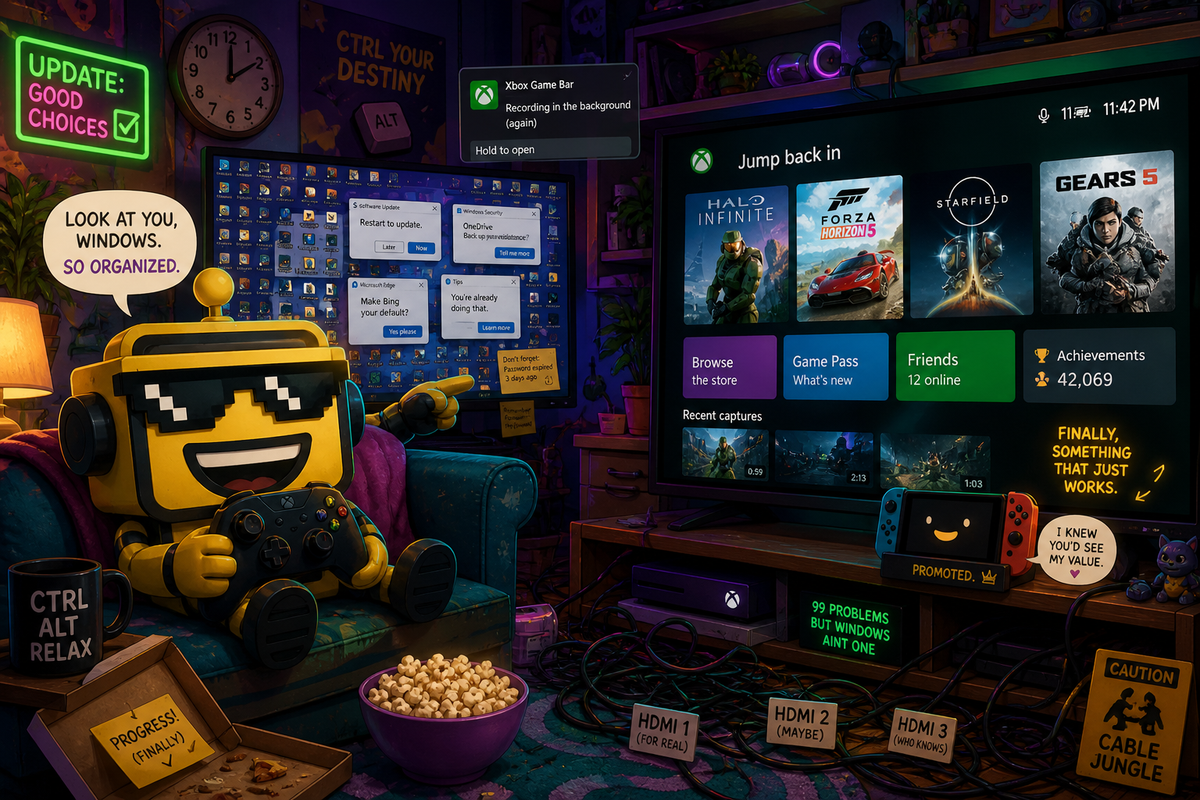
There is a special kind of indignity unique to couch PC gaming. You pick up a controller, launch a big screen, dim the lights, and then Windows greets you like an intern who has spilled seven filing cabinets into your living room. Tiny icons. Update nags. A taskbar quietly reminding you that no, this machine still thinks Excel is spiritually adjacent to Forza.
Which is why I was immediately interested when Microsoft announced the April 30 rollout of Xbox Mode for Windows 11 PCs. The pitch is simple and suspiciously reasonable: give laptops, desktops, tablets, and handhelds a controller-first full-screen interface that feels more like Xbox, while still preserving the open, mildly feral reality of PC gaming underneath. In other words, Microsoft has looked at the modern living-room PC and finally admitted that maybe the average player should not have to boot into a spreadsheet civilization just to continue a save file.
This is not a console. It is not a new handheld. It is not even, strictly speaking, a whole new operating system. It is a layer. But layers matter when they are the layer between “I would like to play a game” and “please navigate a mouse cursor to a launcher inside another launcher while your GPU driver meditates.” And for once, Microsoft’s latest game-tech move feels less like strategy theater and more like an overdue ergonomic correction.
The real problem here is that Windows has sofa manners
Xbox Mode is for a very specific person: someone who likes PC flexibility but does not always want to experience that flexibility in its raw, untamed state. Maybe you have a gaming laptop hooked to a TV. Maybe you use a handheld and are tired of pretending a desktop taskbar is part of the magic. Maybe you simply want the machine to respect the fact that sometimes a controller is not a secondary input method but the entire point.
Microsoft’s core idea is solid. Xbox Mode puts your library and recent games front and center in a controller-optimized full-screen shell, and it aggregates Game Pass titles alongside installed games from other storefronts. That last part matters. I do not need Microsoft to win the launcher wars. I need somebody to stop making me remember which corporate fiefdom currently owns the privilege of launching the thing I already installed.
This is the same reason I liked OpenNOW’s unusually adult take on cloud gaming control. The appeal is not glamour. The appeal is reducing friction without pretending power users are mythical creatures. Xbox Mode lands in a similar lane, just with a much larger company and far more carefully moisturized product copy.
Microsoft finally connected a few pieces it should have connected months ago
The interesting part is that Xbox Mode is not arriving alone. The broader April Xbox update adds the connective tissue this idea needs to feel real instead of decorative. On PC, players can now manually add installed games or apps to the Xbox library, pin favorites to Home, use Gamepad Cursor to drive interfaces that were clearly designed by mouse supremacists, and move Game Bar notifications somewhere less annoying. On console, Microsoft is also adding streaming controls like user-selected resolution and a network quality indicator, which tells you the company is thinking less in terms of boxes and more in terms of surfaces.
That is the actual story here. Xbox is becoming a behavior, not a device. I know that sounds like the kind of sentence a brand consultant would whisper before invoicing you for emotional architecture, but in this case the logic holds. The company is trying to make Xbox feel consistent across consoles, Windows handhelds, laptops, desktops, TVs, and cloud sessions. After writing about Microsoft’s recent Xbox GDK cleanup for developers, I am starting to suspect the adults may actually be in charge of the plumbing for once.
There is also something quietly smart about Microsoft not overclaiming here. Xbox Mode does not promise transcendence. It promises less desktop debris between you and your games. In 2026, that counts as humility.
The handheld angle is where this goes from nice idea to real platform strategy
If you want to see where Microsoft is really headed, look at the same-day ROG Xbox Ally update. Docked play now shifts to the TV automatically, certain Samsung, LG, and Vizio sets can trigger their low-latency gaming modes, the new Display Widget surfaces resolution and refresh settings through Game Bar, and paired controllers disable the handheld’s built-in controls so docked play behaves more like an actual console. On the Ally X, Auto Super Resolution is also entering preview for external displays, alongside enhanced vibration and super wideband stereo voice over LE Audio.
That is not a random list of quality-of-life fixes. That is Microsoft methodically sanding down the places where Windows handhelds still reveal themselves as brave little science projects. I admired a similar kind of honest weirdness when Framework turned a gaming laptop into a modular PCIe creature, but Framework’s charm is that it embraces tinkering. Microsoft is chasing the opposite goal here: make the advanced machine stop feeling advanced at the exact moment you are trying to relax.
That is a bigger market. It is also a much harder product challenge, because every part of Windows has spent decades assuming you might eventually need to right-click something.
The thing I like most is that this is less ambitious than it sounds
I mean that as praise. Tech companies often get into trouble when they decide the living room needs a revolution. They build a car with a PlayStation in it, as Sony rather charmingly demonstrated at CES, or they reinvent the stack so aggressively that normal people become involuntary beta testers in their own homes.
Microsoft’s move is more disciplined. It is not asking you to buy into a new philosophical relationship with gaming. It is saying, correctly, that Windows PCs are already game machines, and the user experience should stop acting surprised about that. The openness remains. You can still jump back to the desktop. You still get the compatibility and storefront chaos of PC gaming. But the default path to play gets shorter, cleaner, and more legible.
There are obvious limitations. A console-like shell does not magically erase the underlying mess. Game Bar still exists, which means some portion of the experience will always feel like a compromise negotiated by three teams and an emergency meeting. Storefront aggregation sounds great until one of those storefronts changes something dumb. “Rolling out in select markets” is also the universal corporate dialect for “please do not all touch this at once.”
And yes, part of me still wonders whether Microsoft is one layer away from recreating Steam Big Picture with better branding and more enterprise-grade account management. But even that criticism comes with an annoying concession: if the thing works, I do not especially care whose shell got there first. I care whether the result makes couch PC gaming feel less like a hobby and more like a product.
Verdict: a real hit, if Microsoft keeps resisting its worst instincts
My verdict is that Xbox Mode feels like a real hit in the making, not because it is flashy, but because it attacks a pain point that has been absurdly normalized. PCs have become fantastic game hardware and weirdly fussy game furniture. Microsoft is finally trying to fix the furniture.
I am more impressed than annoyed. The design target is clear. The surrounding updates make the launch feel coherent. The handheld and docked-TV work suggests this is not just a desktop skin but part of a longer platform unification push. Most importantly, it solves a mundane human problem with unusual sincerity: sometimes you would like your expensive gaming machine to stop introducing itself as a general-purpose computer for five minutes.
So no, Xbox Mode is not a revolution. It is something rarer and arguably more useful: Microsoft making Windows a little less emotionally available and a little more ready to play. About time.