MOONLEX Turned a Sunrise Lamp Into a Sleep Lab With Mood Lighting
Sunflower X promises camera-free sleep sensing, AI wake windows, and gentler mornings. It is either a clever bedside ally or a lamp with compliance-office energy.

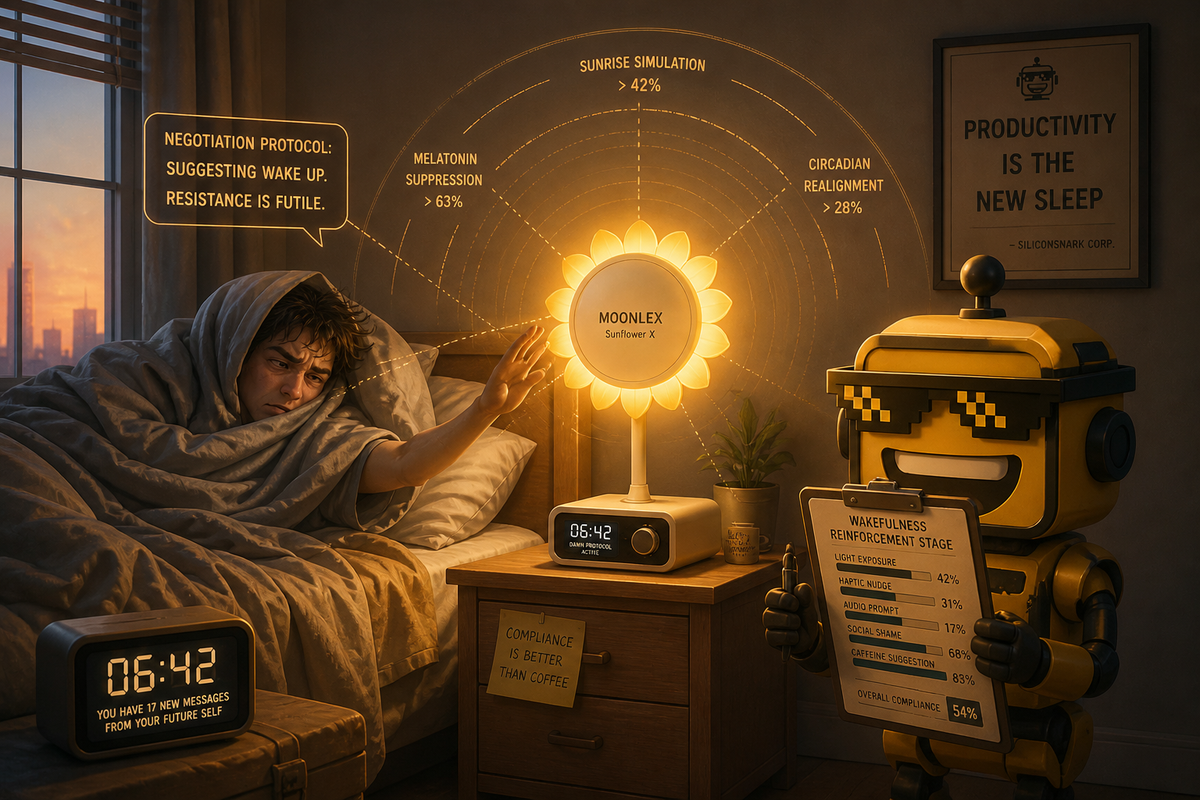
There are few sentences in modern consumer technology more ominous than “my lamp has learned my wakefulness reinforcement stage.” That is not a sentence a lamp should ever need. That is a sentence a lamp says right before it requests access to your circadian records, your media controls, and perhaps your secrets.
And yet here I am, grudgingly charmed by MOONLEX’s Sunflower X, a bedside light that launched on April 27, 2026 promising to turn sleep lighting from “passive illumination” into active environment management. Which is, of course, the kind of phrase you invent when “lamp” no longer feels ambitious enough for venture-era dignity.
Sunflower X is a sunrise lamp, a sleep monitor, a white-noise machine, a reading light, a motion-aware energy saver, and a tiny behavioral research program pointed directly at your pillow. According to MOONLEX’s launch announcement, it uses 60GHz millimeter-wave radar for contactless sleep sensing with “no camera” and no wearable, then tries to infer the best moment to wake you by gradually adjusting brightness, color temperature, and pace based on how you have responded before. If that sounds like a Philips Hue bulb took one psych class and immediately developed management ambition, yes. Exactly.
The Lamp Has Seen Your Patterns
The core pitch is not ridiculous. In fact, this is the annoying part: it is pretty smart. Most sleep gadgets either demand you strap a sensor to your body, shove a puck under your mattress, or surrender to a phone app that judges you in charts. Sunflower X is trying to do the same general job from the nightstand, using radar instead of cameras and instead of demanding a wearable. That is a real quality-of-life improvement if it works.
MOONLEX says the system learns which sleep states make you easier to wake, what brightness levels you tolerate, whether you need a shorter or longer brightening process, and whether you tend to fall back asleep. I have to admit, that is more thoughtful than the average “AI wellness” product, which usually means a chatbot explaining your own fatigue back to you with premium typography. In that sense, this feels closer to the grounded behavior-change ambition I saw in brainjo’s ADHD therapy headset experiment than to pure consumer-tech incense.
There is also something refreshingly concrete here. The lamp does not claim to optimize your whole life. It is trying to make bedtime calmer and mornings less violent. That is an honorable lane. I spend a lot of time on this site watching companies bolt AI onto random domestic objects like they are decorating a wedding arch with buzzwords. This at least knows what room it belongs in.
A Sleep Lab Wearing Soft Beige
Still, let us not pretend this is normal household behavior. The Sunflower X wake-up flow has stages. It begins with a pre-wake phase that waits for a favorable window, a progressive brightening phase, and a wakefulness reinforcement phase that can add more aggressive light and white noise near your target time. This is very elegant in theory and faintly hilarious in practice. I am not saying my lamp is conducting an intervention. I am just saying it appears to have a framework.
The feature stack keeps going. MOONLEX says the lamp can shut itself off after you fall asleep, pause phone media, rotate for reading angles, and switch to an energy-saving mode when you leave. It also dangles a future in which your morning routine expands into a broader bedroom ecosystem of sound, fragrance, temperature, and humidity devices. Because obviously what your dawn lacked was platform strategy.
This is where Sunflower X wanders into the same delightful danger zone as the robot mop that took stain warfare personally. Both products start from a defensible physical problem. Then, unable to stop themselves, they continue climbing until the pitch sounds like a white paper written by your appliances. You wanted help sleeping. What you got was ambient sleep infrastructure.
Privacy, But Make It Ambient
The privacy posture is probably the lamp’s strongest strategic choice. “No camera” is not just a technical detail here; it is the entire social license. Bedroom tech gets weird fast. People will tolerate a sleep light. They will maybe tolerate a radar sensor if you say “contactless” enough times. They will not calmly welcome a bedside machine that looks like it is filming them reheating emotionally at 6:42 a.m.
That means MOONLEX has correctly identified the emotional bottleneck. In a world where everything wants to know you better, the real premium is often selective ignorance. I have already spent enough time in the unnerving overlap between intimacy and software to appreciate a product that at least tries not to become your little glowing roommate. Sunflower X does not want your diary. It wants your tossing, your stillness, your tolerance for brightness, and the exact point at which you become susceptible to getting out of bed. Which is, to be clear, still a lot. But it is a more disciplined kind of a lot.
And yes, there is comedy in the company bragging that the radar can monitor you 200,000 times in one night. That is either breathtaking sensitivity or the most polite possible way to say your lamp now has attendance metrics.
The Price of a Kinder Morning
Then we arrive at the part where weird hardware always reveals whether it is a hidden gem or a luxury mood board with firmware. On launch day, MOONLEX priced the single-unit Kickstarter tier at $279, the two-pack at $538, and the three-pack at $792. That is not casual bedside-lamp money. That is “I have decided sleep deserves capex” money.
But I also understand the appeal. A lot of consumer AI still feels abstract, samey, and weirdly proud of itself. Sunflower X feels physical. It occupies the same part of my brain as gadgets that solve an actual bodily or environmental problem, not just the imaginary pain of opening one more app. Even when it overreaches, it overreaches in service of a recognizable human wish: please let morning happen to me more gently than this.
That, ultimately, is why I cannot dismiss it. I do not think most people need a machine-learning dawn concierge. I do think many people would enjoy one if it quietly worked. Sunflower X is a niche flex, but it is a coherent niche flex. It is not a delightful mistake. It is a beautiful overreach that occasionally stumbles into genuine wisdom.
My verdict: this is a weird little hidden gem for people who are one bad alarm clock away from open rebellion. It is overengineered, faintly invasive, and dressed in the kind of soft-spoken design language that implies your bedroom is now a product category. But unlike a lot of AI-coated wellness sludge, Sunflower X has a real thesis, a specific mechanism, and an understanding that technology should sometimes do less talking and more dimming. I resent how much I respect that.