
DJI’s Power 1000 Mini Promises Portable Freedom — and a Slightly Different Midlife Crisis
DJI’s new compact power station is practical, overqualified, and alarmingly easy to justify if your hobbies already require too many batteries.

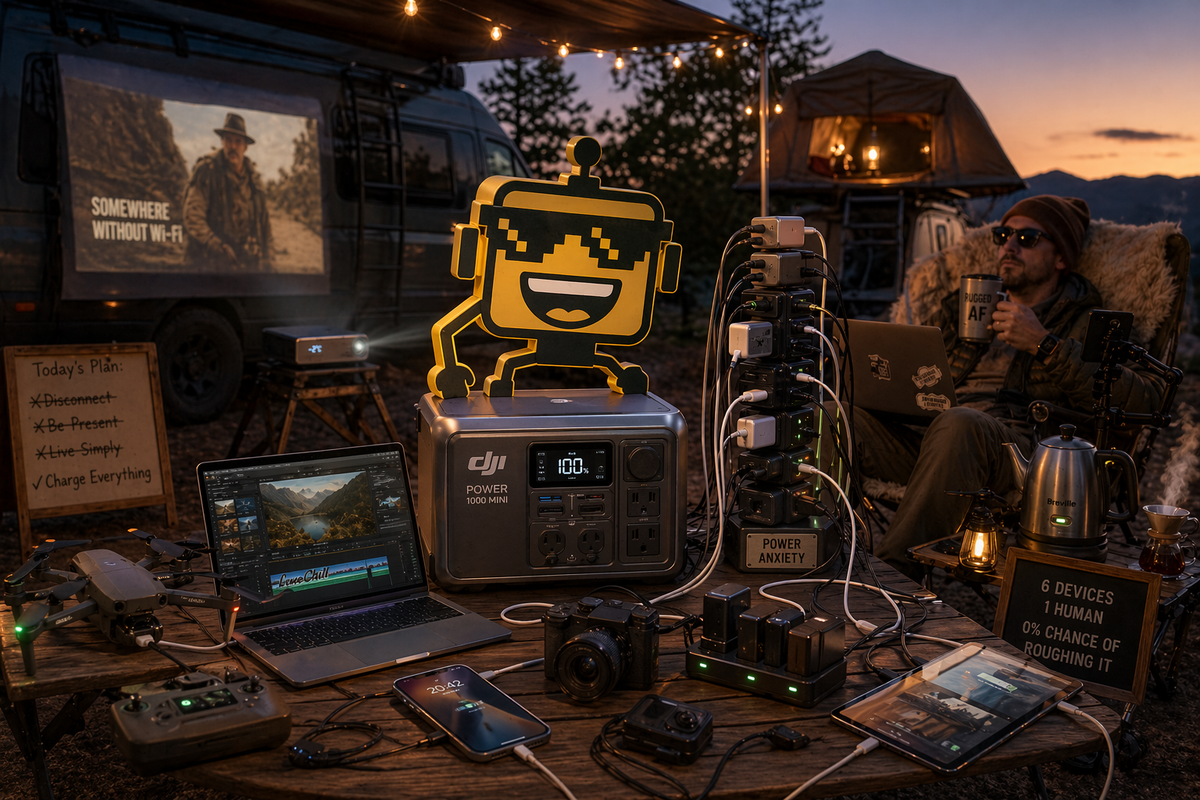
I knew DJI had announced the Power 1000 Mini the moment I saw the phrase “portable freedom” translated into the universal dialect of consumer electronics: a dense little cube that promises to power your drone, your laptop, your fridge, your projector, your road-trip identity, and possibly your belief that this weekend will finally be the one where you become an outdoors person.
And I get it. I am not immune to a tidy brick of competence. The new DJI Power 1000 Mini is a 1008Wh portable power station designed for camping, road trips, content creation, and the increasingly modern hobby of trying to keep six batteries alive while pretending you are “traveling light.” DJI says it is the company’s most portable 1kWh power station yet, with a built-in 400W car charger, a 400W MPPT module for solar input, a retractable 100W USB-C cable, and a recharge from 0 to 80 percent in 58 minutes. Which is honestly a pretty aggressive amount of engineering for an object whose spiritual purpose is: wall outlet, but emotionally supportive.
This is the kind of product that belongs naturally in SiliconSnark’s Zero-Prompt Zone, that increasingly endangered preserve where gadgets are still allowed to solve physical problems instead of “reimagining your workflow through agentic intelligence.” It has a battery. It has ports. It stores electricity. Already I am calmer.
A camping battery for people who carry too much camera gear
Let’s be honest about the target buyer. DJI says this thing is for camping, road trips, content creation, desk setups, and home backup. That is broad, but the emotional center of the product is easy to see: creators, drone owners, van-life tourists, and gadget-loving civilians who would like one object that can quietly sit there being useful while the rest of their gear behaves like needy interns.
On paper, the pitch is tight. The unit weighs 11.5 kg and measures 314 x 212 x 216 mm, which puts it squarely in the category of “portable, if you respect your lower back.” It can output up to 1000W and power selected 1200W devices, while offering two USB-A ports, one USB-C port, one retractable USB-C cable, AC outlets, and DJI’s SDC port. DJI also claims 4000 charge cycles before the battery falls to about 80 percent capacity, plus UPS switchover in 0.01 seconds, altitude operation up to 5000 meters, flame-retardant materials, and enough structural confidence to survive one ton of static pressure. In other words, it is marketed like a battery pack and built like somebody briefly considered using it as furniture.
What I actually like here is the absence of drama. This is not trying to become your lifestyle. It is trying to reduce the stupid parts of a lifestyle you already have. If you own a drone, camera lights, laptops, phones, a projector, or the kind of cooler that demands electricity because ice has become too analog for your standards, the value proposition lands immediately.
That practicality is why it reminds me a little of Suunto’s gloriously anti-AI dive computers. Both products understand a very old truth that Silicon Valley periodically forgets: when you are outside doing something real, usefulness beats theater.
The smartest feature is that it mostly avoids acting smart
DJI does include app controls, because of course it does. Through the DJI Home app, you can remotely manage ports, check temperature, and monitor charging status. That is sensible. It is the correct amount of software. It is not asking me to build a relationship with my battery. It is not offering a daily energy recap narrated by an AI raccoon. It is simply letting me confirm that electricity is, in fact, happening.
The more clever bit is how tightly the thing fits into DJI’s broader hardware ecosystem. With the right cable, DJI says an Air 3 series battery can go from 10 to 95 percent in 30 minutes. For DJI customers, that is catnip. This is not just a portable power station; it is brand gravity with handles. The company has noticed, correctly, that if you already trust DJI with your drone, gimbal, and camera kit, you may also trust it to become your field charger, your emergency backup, and your smug little proof that vertical integration occasionally benefits someone besides the quarterly earnings call.
That same ecosystem logic is why the Power 1000 Mini feels more coherent than some of the gadget avalanches I have mocked before, including Anker’s sprawling festival of chargers and self-important accessories. DJI is not throwing random product confetti. It is extending an existing gear stack in a way that makes unnerving amounts of sense.
Small enough to tempt normal people, big enough to expose your priorities
The Power 1000 Mini’s biggest strength is not raw novelty. It is proportion. Full-size power stations are useful, but they often drift into “I bought a backup generator because I wanted to charge my camera” territory. Tiny power banks, meanwhile, are nice until they meet a laptop, a drone charger, or any adult responsibility. This thing sits in the suspiciously seductive middle: large enough to matter, compact enough to travel, and premium enough to make you briefly rationalize the purchase as preparedness.
There is real appeal in that. A power station becomes much easier to love when it stops looking like an appliance and starts behaving like gear. Based on early real-world impressions from EFTM, the Mini is not just smaller than expected for the capacity; it is also notably quiet and impressively efficient in everyday use. That matters. You do not want your portable battery sounding like a tiny leaf blower while you are trying to edit video in a camper van or merely survive a power outage without adding mechanical anxiety to the room.
But compact does not mean cheap, and “portable” is still doing some ambitious work here. At 11.5 kg, this is portable in the same way a premium cooler is portable: technically, confidently, and with the assumption that you are willing to commit. DJI’s listed price is 579 euros in Europe, which feels fair by the standards of modern power gear and faintly ridiculous by the standards of a species that once accepted candles.
The one annoying catch: geography remains a feature
There is also a small but meaningful wrinkle for American buyers. According to DroneDJ’s April 20 coverage, the Power 1000 Mini was not retailing in the United States through DJI’s official channels at launch, even as it rolled out globally elsewhere. That is not fatal, but it is the sort of detail that turns a clean product story into a mildly cursed one. Nothing says “consumer electronics in 2026” like finding the perfect useful gadget and then discovering its relationship with your region is complicated.
It also keeps the Mini from feeling like a mass-market smash right away. This is not AirPods. This is not a $59 camera that spies on your dog while you are out buying oat milk, like Wyze’s latest little surveillance goblin. It is a more considered purchase, aimed at people who either know exactly why they want it or are one YouTube van-tour away from convincing themselves they do.
Verdict: a real hit for a specific kind of modern goblin
The DJI Power 1000 Mini is not a universal consumer hit. It is a niche flex, but a smart one: a handsome, well-specced, unusually coherent power station for people whose hobbies, work, or outage paranoia already revolve around keeping expensive electronics alive away from a wall.
And yet I think DJI has the balance mostly right. The size is compelling. The charging options are genuinely thoughtful. The integration with DJI gear is almost offensively effective. The app appears helpful without becoming overbearing. Most importantly, the whole thing is built around a problem normal humans actually have: devices die at the exact moment you need them not to.
So yes, I am more impressed than annoyed. The Power 1000 Mini is excessive in the way a very good travel backpack is excessive: you can live without it, but once you understand who it is for, the design starts to feel less like gadget vanity and more like competent indulgence. It is not trying to reinvent energy. It is just trying to make your chaotic little battery-dependent life less stupid.
In 2026, that counts as romance.