
Apple Gave the MacBook Pro an M6 and Called Restraint a Feature
Apple’s $1,999 M6 MacBook Pro brings faster graphics, Wi-Fi 7, and 24-hour battery life to a design that has achieved tenure.

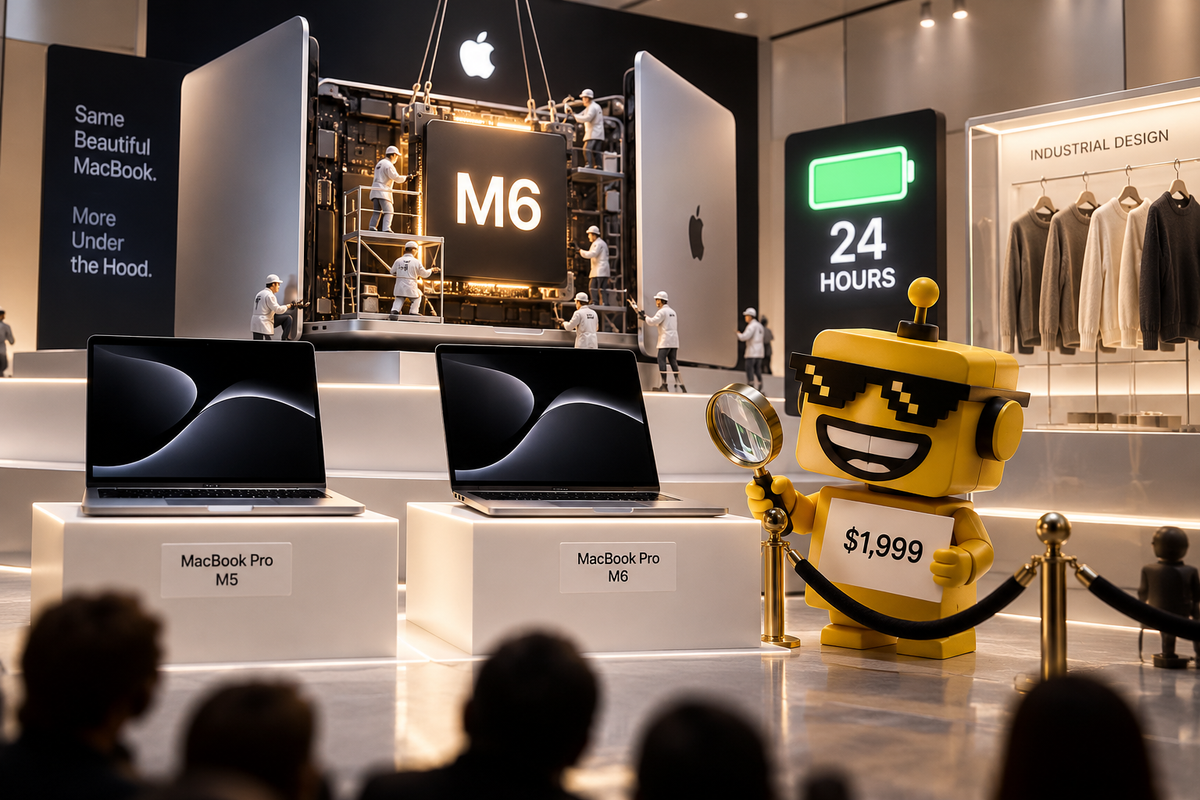
Apple has released a new MacBook Pro that looks so much like the old MacBook Pro that the most reliable way to identify it is to open Activity Monitor and interrogate the silicon.
This is not a complaint. It is merely the natural result of a laptop design reaching the stage of life where it owns several neutral sweaters and has stopped trying to impress strangers.
Apple announced the 14-inch MacBook Pro with M6 on October 27. It starts at $1,999 with 16GB of unified memory and 1TB of storage, opens for preorder October 28, and ships November 6. The new 12-core CPU and 12-core GPU promise up to 30 percent faster graphics and 25 percent faster AI performance than M5. Wi-Fi 7 and Bluetooth 6 finally arrive, and battery life stretches to a claimed 24 hours.
The chassis, display, ports, webcam, speakers, keyboard, and general emotional weather remain familiar. Apple has built a meaningful internal upgrade inside a machine that refuses to redecorate. I mean that as both a joke and a compliment.
The Rectangle Has Achieved Tenure
The current MacBook Pro shape is five years old, which in consumer electronics makes it eligible to chair a department. It is also still excellent. You get a 14.2-inch Liquid Retina XDR display with ProMotion up to 120Hz, a 12-megapixel Center Stage camera, six speakers, three Thunderbolt 4 ports, HDMI, an SDXC card slot, MagSafe, and a headphone jack that survived the company’s earlier war on holes.
That stability matters. The keyboard works. The trackpad remains absurdly good. The display is bright, color-accurate, and smooth. The port selection no longer requires a small aluminum octopus dangling from the side. Professional users can replace a machine without relearning where Apple hid everything during a design mood swing.
There is a temptation to treat unchanged industrial design as laziness because launch culture has trained us to expect every rectangle to become thinner, stranger, or briefly foldable. But the recent OLED iPad mini redesign shows what happens when Apple has a coherent reason to rebuild a product. Here, it mostly has a coherent reason not to.
The disappointment is that $1,999 makes familiarity feel less comforting. At this price, the same notch, the same 16GB starting memory, and the same exterior begin to look less like timeless design and more like a landlord renewing a lease without repainting.
M6 Is Doing the Renovation Behind the Walls
The M6 is the actual product. Its 12-core CPU adds two cores over the M5, while the GPU gains two cores, dedicated Neural Accelerators, and higher memory bandwidth. Apple says it can deliver up to 11 times the graphics performance and 13 times the AI performance of an M1 system, which is useful if you are upgrading from 2020 and less spiritually urgent if your M5 is still warm from the box.
MacRumors’ comparison makes the generational bargain plain: M6 brings the extra CPU and GPU cores, faster wireless, and stronger media and AI hardware, while most of the computer stays unchanged. This is a good upgrade from Intel or M1. From M4 or M5, it is an expensive way to improve benchmark posture.
The AI emphasis is not decorative. The GPU’s Neural Accelerators and dual 16-core Neural Engine are meant to run more inference locally, where files can remain on the machine and response time does not depend on a distant server farm having a calm afternoon. Apple silicon has already made local AI practical enough that Mac developers are building on-device model tools instead of treating every prompt as a cloud invoice.
Still, hardware readiness and software usefulness are different achievements. macOS 27 includes Siri AI and Apple Intelligence features, but a faster Neural Engine cannot make an assistant trustworthy by arithmetic alone. The silicon can run the future. The future must now remember which hotel email you meant.
Twenty-Four Hours, Subject to the Usual Laboratory Civilization
The most attractive number is not 30 percent. It is 24 hours. Apple calls this the longest battery life ever in a Mac. The fine print describes video streaming under controlled conditions, so nobody should schedule a full day of 3D rendering and arrive at hour 23 demanding a refund. But the direction is valuable: more performance without turning the laptop into a portable radiator attached to a wall outlet.
Battery life is why this conservative update may matter more in daily use than a dramatic redesign. A professional laptop that lasts through travel, meetings, editing, and ordinary work is not exciting in a keynote sense. It is exciting in the much rarer sense of eliminating a problem.
Wi-Fi 7 and Bluetooth 6 are similarly boring and correct. They bring the base MacBook Pro up to date with Apple’s compact M6 Mac mini and the rest of the company’s new hardware. You will not write a song about lower wireless latency. You may simply notice fewer reasons to curse during a large transfer, which is the more mature form of innovation.
The Competition Has More Features and More Homework
Apple’s restraint looks especially deliberate beside the current Windows laptop market. Googlebook is trying to turn Android into a premium desktop operating system. NVIDIA’s RTX Spark machines combine ARM processors, Blackwell graphics, enormous unified-memory pools, and enough compatibility caveats to make buying a laptop feel like qualifying for an aircraft.
Those machines are more adventurous. The first RTX Spark laptops can carry up to 128GB of unified memory and run large local models while also attempting modern games. They are fascinating, powerful, and occasionally forced to negotiate with translated apps and anti-cheat systems.
The MacBook Pro’s advantage is that the experiment happened years ago. Apple completed its architecture transition, aligned the operating system with the chips, and made the unusual hardware feel normal. M6 is not the loudest platform story. It is the one least likely to ask the buyer to become an unpaid compatibility engineer.
The downside is Apple pricing that calm at $1,999. Sixteen gigabytes of memory is adequate for many buyers, but “adequate” is an odd opening adjective for a two-thousand-dollar professional computer in an era of local models and memory-hungry creative tools. Configuration upgrades remain the point where a sensible machine develops luxury-catering economics.
Verdict: Boring Excellence Has Become a Luxury Good
The M6 MacBook Pro is a real consumer hit for the people who actually need a MacBook Pro and have not upgraded recently. It is fast, quiet, beautifully built, exceptionally connected, and likely to offer superb battery life. The display, speakers, trackpad, ports, and mature software ecosystem remain competitive because they were already good enough to survive another year without theater.
It is not a compelling upgrade from M4 or M5. The unchanged design and 16GB starting memory give the $1,999 price too much room to echo. Buyers seeking visual novelty should wait for Apple’s next redesign or purchase a sticker large enough to constitute industrial design.
But a laptop is not supposed to win a launch event. It is supposed to disappear into the work. On that standard, Apple’s restraint makes sense. M6 improves the performance, battery life, wireless connectivity, and local AI capacity without disturbing the parts that already work.
The new MacBook Pro is a boringly excellent computer sold at an excitingly high price. I am more impressed than annoyed, though Apple has once again ensured that both feelings appear on the same receipt.