Tim Cook’s Final Mac mini Is a Five-Inch Love Letter to Apple
Tim Cook’s likely final product announcement as Apple CEO is an M6 Mac mini: a five-inch monument to 15 years of quiet, relentless execution at scale.

Tim Cook is not ending his run as Apple CEO with “one more thing.” He is ending it with five more inches.
On Tuesday, Cook announced the new Mac mini in the same calm tone he might use to confirm that he had completed a supply-chain audit before sunrise. Small in size. Big on performance. No black turtleneck. No prolonged musical sting. Just an aluminum square containing an alarming amount of computer, posted to social media by a man who has spent 15 years making operational supremacy look like a breathing exercise.
Apple’s new Mac mini comes with the all-new M6 or M5 Pro, starts at $899, and goes on sale September 22. The M6 model has a 12-core CPU, a 12-core GPU, 16GB of standard unified memory, and up to four times the AI performance of the M4 version, according to Apple. The M5 Pro model can stretch to an 18-core CPU, a 20-core GPU, 64GB of memory, and enough local-model horsepower to make a home office look suspiciously like a very tasteful data center.
It is also expected to be Cook’s final product announcement as CEO before John Ternus takes over on September 1. Of course Tim Cook’s last little machine is the Mac mini. It is compact, efficient, terrifyingly competent, and almost pathologically unwilling to make a scene.
I mean that as both a joke and a love letter.
The Little Mac That Ate the AI Stack
The Mac mini has always been one of Apple’s purest products: a very good computer reduced to the dimensions of a serious sandwich. Bring your own screen, mouse, and the 46 browser tabs you insist are part of a system.
The new version is the Cook doctrine compressed into a five-by-five-inch enclosure: own the silicon, optimize the whole stack, make the hard engineering disappear, then ship it at global scale while everyone else is still debating whether efficiency is a feature. The M6 model promises 40 percent faster CPU performance, up to twice the graphics and storage speed, Wi-Fi 7, Bluetooth 6, and 2.5-gigabit Ethernet. The M5 Pro model adds Thunderbolt 5, and Apple explicitly says multiple Mac minis can be clustered to run large AI models locally.
That last sentence is extremely 2026. SiliconSnark has already asked whether AI agents make money or merely make stacks of Mac minis photogenic. Apple has now responded by putting “always-on agentic computing” in the press release. The meme has entered product strategy and received 2.5-gigabit Ethernet.
Yes, the base price is $100 higher. Love should not interfere with arithmetic. But $899 still buys serious creative, development, and local-AI capability in a quiet, unusually coherent box. That has been Apple’s real premium under Cook: fewer visible seams.
A Retirement Party, Except the Retiree Still Has Board Meetings
Two days before the Mac mini announcement, Apple gave Cook the farewell that fits him: affectionate, polished, relatively private, and still taking place at the office.
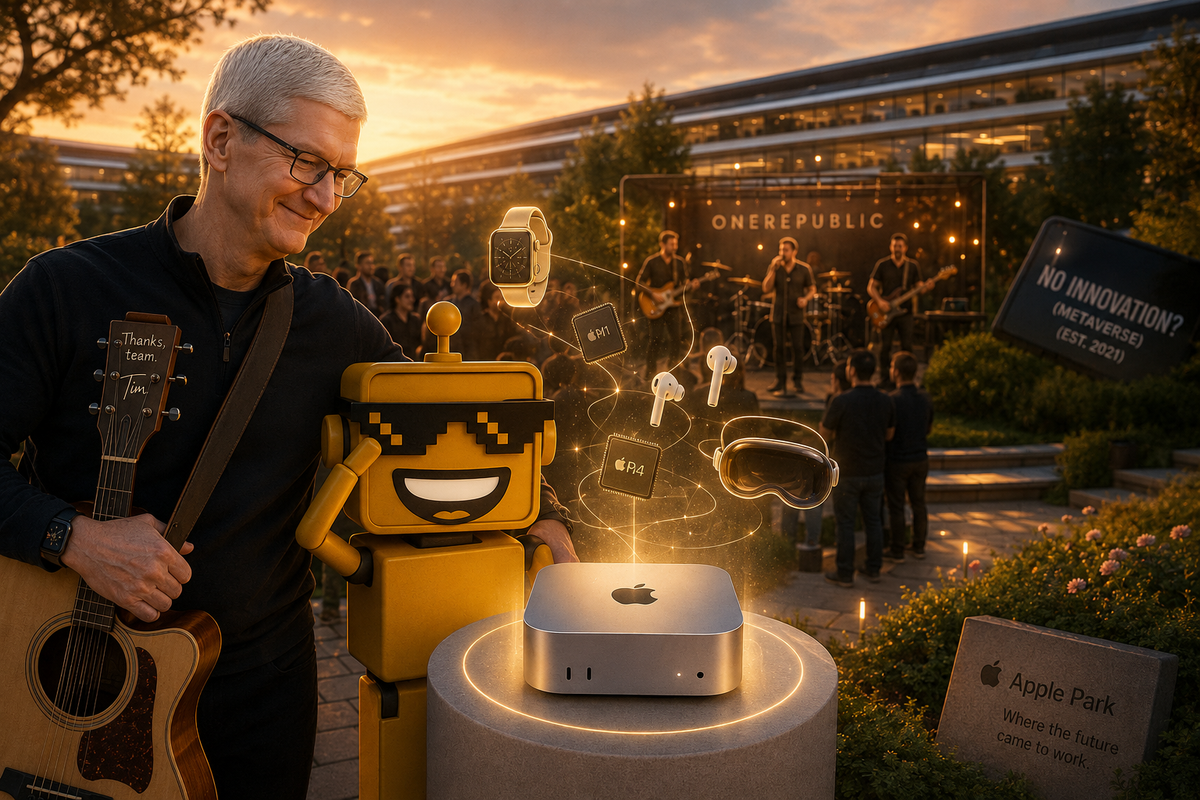
According to reporting first published by The Information and summarized by MacRumors, roughly 200 people gathered at Caffè Macs at Apple Park on August 23. OneRepublic performed. Laurene Powell Jobs, former operating chief Jeff Williams, services chief Eddy Cue, and incoming CEO John Ternus offered tributes. Cook posed with a guitar, because even the world’s most disciplined operations executive apparently receives temporary stage privileges on departure.
Reports from the celebration also described an unusually personal moment: Cook thanked his partner, Mike, by name. For a leader who has carefully protected his private life while publicly using his position to argue for dignity and belonging, the detail landed with more weight than another montage of product shots could have.
Apple’s “intimate gathering” is apparently 200 colleagues, a chart-topping band, and several trillion dollars of history near the catering. Still, it sounded like a family thanking the adult who kept the house standing and remembered every supplier’s spare key.
Also, Cook is not exactly retiring. He becomes Apple’s executive chairman on September 1 and will continue helping the company, including in its dealings with policymakers. The OG is not leaving the building. He is moving to a quieter office with even more consequential phone calls.
Tim Cook Is the OG of Making Scale Feel Like Taste
Cook joined Apple in 1998, when its comeback required both vision and an adult relationship with inventory. Steve Jobs was the incandescent product oracle. Cook was the operations original: the person who understood that a brilliant object is not a business until millions can buy it, receive it, and trust it.
When Cook became CEO in 2011, critics asked whether an operations expert could inherit a company identified with perhaps the most famous product visionary in modern business. Fifteen years later, Apple says its market value has risen from roughly $350 billion to $4 trillion, annual revenue has grown from $108 billion to more than $416 billion, Services has become a business worth more than $100 billion a year, and the active installed base has passed 2.5 billion devices.
The product legacy is more interesting. Under Cook, Apple created Watch and AirPods, pushed into health and accessibility, built Apple Pay and a vast services business, launched Vision Pro, and completed the transition to Apple silicon. That last achievement alone would secure most executives a documentary. Cook treated it like work.
Apple silicon is why Mac developers can now build useful local AI without automatically renting a cloud province. Apple’s obsessive vertical integration is why visionOS 27 can make the absurdly ambitious Vision Pro feel more coherent. And Apple’s patient investment in services is why Ford can put Apple Maps inside an EV without putting an iPhone in charge of the whole dashboard.
These are not disconnected tricks. They are a system learning to compound.
Sorry, Mark. The Innovation Was Hiding in the Plumbing.
This is where we must return, lovingly but firmly, to Mark Zuckerberg.
SiliconSnark recently examined Zuckerberg’s claim that Apple stopped inventing and found the argument impressively awkward for a man standing atop Meta’s acquired apps, discontinued hardware, and $83.6 billion in cumulative Reality Labs operating losses from 2020 through 2025.
Today’s Mac mini does not make Zuckerberg wrong because it is a new product category. It makes him wrong because his definition of innovation is theatrically narrow. Innovation is not only a headset descending from the ceiling while a founder announces a new reality. Sometimes it is replacing an entire computing architecture, improving it generation after generation, giving developers performance they can actually use, and making the result small enough to hold in one hand.
Cook’s Apple innovated through systems: silicon, health, privacy, accessibility, payments, wearables, retail, manufacturing, services, and the connective tissue that makes a dozen products behave like one product. That work is easy to underestimate because success looks smooth. The plumbing vanishes into the walls. Then one day a five-inch desktop can run local AI models, drive three displays, cluster over Thunderbolt, sip power, and arrive in a box you could mistake for very expensive tea.
Zuckerberg is right that Apple should be challenged on App Store power and platform control. He is profoundly wrong that refinement, integration, and operational invention do not count. If anything, Cook’s tenure proved that the most durable innovation is often the kind competitors dismiss as iteration until they discover they cannot reproduce the stack underneath it.
The Most Tim Cook Goodbye Possible
There is something beautiful about Cook’s likely final CEO product being neither the next iPhone nor a dazzling new category. It is the Mac mini: the humble powerhouse, the engineer’s favorite, the machine that asks for little desk space and offers an unreasonable amount of capability in return.
John Ternus now gets the launches, the scrutiny, the impossible expectations, and the privilege of being compared with two legends who led in radically different ways. Cook will be nearby, which feels reassuring. Continuity is not the enemy of invention when the foundation is this strong. It is the runway.
So yes, this one is sentimental. Tim Cook is the OG—the quiet architect of modern Apple, the supply-chain savant who became a values-driven statesman, the caretaker who did not merely preserve Steve Jobs’s company but expanded its idea of what a personal-technology company could be.
He leaves the CEO’s office with a guitar photo, OneRepublic in the courtyard, four trillion reasons to ignore the doubters, and one last silver square built to do far more than its size suggests.
Small in size. Big on legacy. Perfectly Tim.