Mark Zuckerberg Says Apple Stopped Innovating. The Metaverse Has Notes.
Mark Zuckerberg says Apple stopped innovating. Meta’s $83.6 billion Reality Labs loss total and 47.5% creator cut make the critique spectacularly awkward.

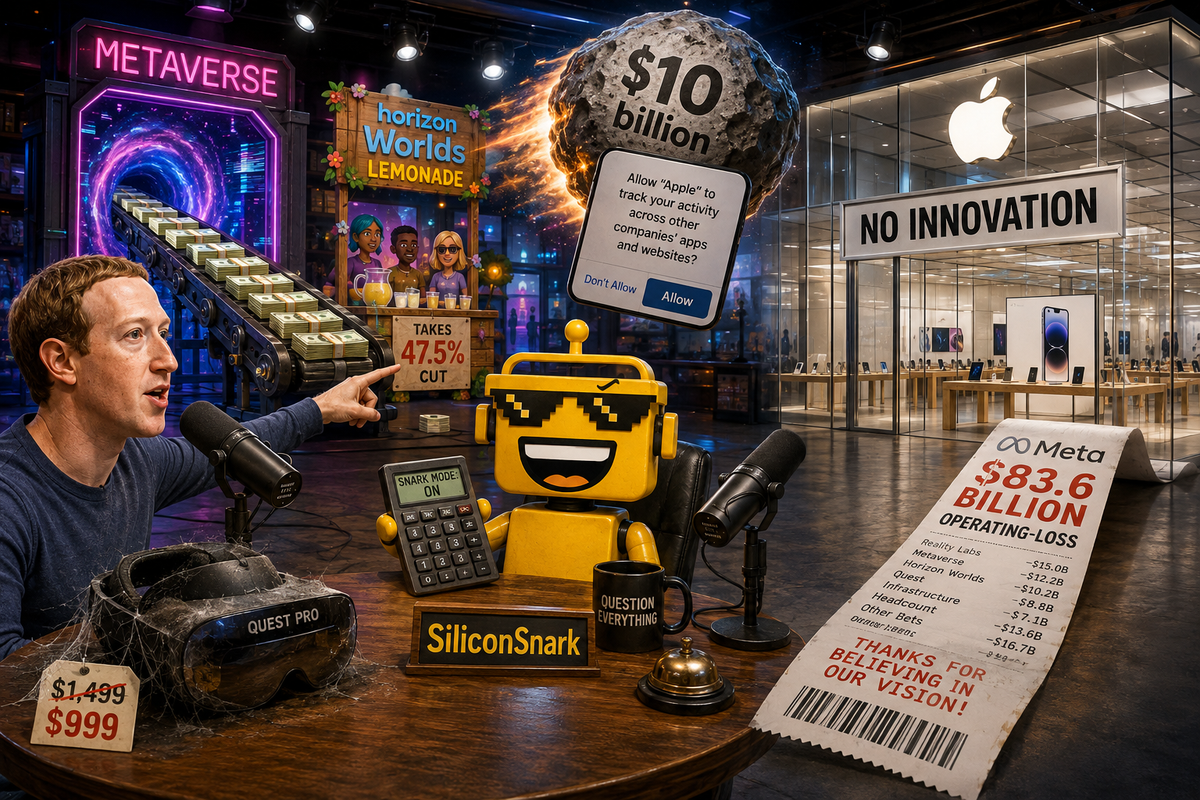
On January 10, 2025, Mark Zuckerberg sat across from Joe Rogan and informed the world that Apple had not “really invented anything great in a while.”
The clip from episode 2255 of The Joe Rogan Experience keeps recirculating, presumably because billionaire-on-billionaire criticism is the one renewable energy source Silicon Valley has actually perfected. Zuckerberg’s case was simple: Steve Jobs created the iPhone, Apple has been sitting on it, recent upgrades have not inspired enough people to buy new phones, and the company now makes more money by squeezing developers and privileging its own accessories.
In isolation, this is a respectable platform-economics argument. Coming from the chief executive of Meta, it is the Titanic’s iceberg publishing a stern Medium post about hull integrity.
The problem is not that Zuckerberg is entirely wrong. Apple’s rules can be restrictive, its ecosystem is designed to make departure feel like an international move, and its App Store power deserves scrutiny. The problem is that Meta’s own history keeps wandering into the shot carrying purchase receipts, regulatory orders, discontinued hardware, and an $83.6 billion Reality Labs operating-loss total.
Let us admire the glass house. Then let us count the headsets inside it.
The Annoying Part: Zuck Has a Point
Apple is not entitled to sainthood merely because its boxes have excellent typography. Its developer agreement has historically allowed commissions of up to 30%, with lower rates in cases including qualifying small developers and longer-running subscriptions. It controls distribution, payments, entitlements, hardware access, messaging conventions, and many of the connective tissues that determine whether a third-party product feels native or like it entered the building through a loading dock.
Regulators have noticed. In April 2025, the European Commission fined Apple €500 million for violating the Digital Markets Act’s anti-steering obligation. Developers being prevented from freely directing users to other purchase options is not innovation. It is a tollbooth wearing a privacy badge.
Zuckerberg was also directionally right about the iPhone plateau. Apple’s fiscal 2024 filing showed iPhone revenue of $201.2 billion, essentially flat from $200.6 billion the year before. This is stagnation in the same sense that Lake Superior is not getting noticeably wetter, but flat is flat.
Still, “Apple has not invented anything” requires a heroic refusal to notice Apple silicon. The M1 moved the Mac onto Apple’s own power-efficient chip architecture and changed the competitive expectations for laptop performance and battery life. AirPods became a category-defining business. The Watch turned a phone accessory into a serious health-and-fitness platform. Vision Pro was a huge, expensive, face-heavy swing. Zuckerberg himself admitted during the interview that it was one of Apple’s bigger attempts at something new.
Apple can be innovative and abusive. It can make excellent silicon and maddening rules before lunch. Our deep dive on Apple’s AI strategy makes the same distinction: caution can be strategic until the shipping gap becomes the product. Nuance is irritating like that.
A $10 Billion Privacy Prompt Enters the Chat
Zuckerberg presented his Apple objection as a defense of openness, competition, and the small developers crushed beneath Cupertino’s tasteful loafers. I am sure those concerns are sincere. I am equally sure it matters that Apple’s App Tracking Transparency prompt landed on Meta’s income statement like a piano.
On Meta’s first-quarter 2022 earnings call, finance chief David Wehner said the company still expected Apple’s tracking changes to create a roughly $10 billion headwind that year. The feature required apps to ask before tracking users across other companies’ apps and websites. For consumers, it was a choice. For Meta’s advertising machine, it was a small dialogue box with the fiscal personality of an asteroid.
That does not make every Apple restriction noble. It does explain why Zuckerberg’s philosophical awakening arrived with a calculator.
It also makes the privacy sermon awkward. In 2019, Facebook agreed to a record $5 billion FTC penalty over charges that it deceived users about control of their personal information. In the same April 2025 announcement that fined Apple, the European Commission fined Meta €200 million over its failure to give users a compliant choice involving a service that used less personal data.
This is not an acquittal for Apple. It is a two-car pileup in which both drivers have “privacy” printed on the door.
And the stakes keep growing. As our guide to personal AI and permanent memory explains, Meta and Apple are no longer merely fighting over an ad identifier. They are competing to become the layer that knows what you want before you say it. One company sells the walled garden. The other would like to know which flowers held your attention.
Welcome to Meta’s 47.5% Lemonade Stand
Then there is Zuckerberg’s disgust at Apple’s “30% tax.” Strong phrase. Easy to remember. Slight issue: Meta built a tollbooth with a larger number on it.
When Meta began testing sales of virtual goods inside Horizon Worlds in 2022, a company spokesperson confirmed that creators could face a combined cut of up to 47.5%: a 30% Quest hardware-platform fee plus an effective 17.5% Horizon platform charge. Meta could explain that these were separate layers. A creator watching nearly half the sale disappear might experience that distinction as an advanced lesson in corporate origami.
The principle appears to be that 30% is tyranny when Apple collects it and infrastructure when Meta does. Add another fee and apparently you have the metaverse.
To Meta’s credit, Quest permits more flexibility than iOS in some areas, and the company has moved toward a more open headset operating system. But Zuckerberg was not arguing for a careful comparison of platform access models. He was using Apple’s fee as evidence of creative decay while his own company had already demonstrated that owning the store can cause a sudden, mysterious appreciation for store economics.
Please Ignore the $83.6 Billion Headset Behind the Curtain
Now we reach the metaverse, a project so successful at generating perspective that Meta should expense it as executive coaching.
Reality Labs recorded operating losses of $6.6 billion in 2020 and $10.2 billion in 2021, according to Meta’s own segment results. The losses then reached $13.7 billion in 2022, $16.1 billion in 2023, and $17.7 billion in 2024, as shown in Meta’s 2024 annual report. In 2025, Reality Labs added another $19.2 billion operating loss on $2.2 billion of revenue.
Total operating losses from 2020 through 2025: approximately $83.6 billion.
In 2025 alone, Reality Labs lost about $8.70 for every dollar of revenue it produced. This is less a margin problem than a performance-art interpretation of subtraction.
Not all of that money was vaporized in a virtual conference room. Meta pushed down the cost of capable standalone VR, built impressive research, improved hand and eye tracking, and helped turn Ray-Ban Meta glasses into the first face computer many normal humans might voluntarily wear. Our guide to the smart-glasses wars gives Meta real credit for that.
But the ledger still exists. So does Quest Pro, which Meta launched in October 2022 for $1,499.99, cut to $999 barely four months later, and discontinued from production in 2024. Zuckerberg mocked the $3,500 Vision Pro as an unsuccessful first version, then briefly discovered self-awareness and said new products should be judged by their third generation. It was the fairest moment in the exchange. Unfortunately, this patience did not extend backward to the rest of his argument.
The Product Graveyard Has a Home Screen
The metaverse is not an isolated incident. Facebook Home arrived in April 2013 promising to rebuild Android around your friends; the HTC First that showcased it was widely panned and fell from $99 to 99 cents on contract. Libra arrived in 2019 promising a global currency, became Diem after regulators reached for the antacids, and sold its assets in January 2022. Portal video-calling hardware joined the discontinued pile later that year.
Products fail. That is part of innovation, and Apple has its own richly appointed cemetery. But a chief executive asking us to respect Meta’s experiments through version three cannot define innovation at Apple as “another iPhone-sized civilization change or it does not count.” That is not a standard. It is a trapdoor.
The Innovation Department Keeps Buying Innovation
Meta has produced important technology. Facebook itself was consequential. News Feed reshaped the internet, for better, worse, and several congressional hearings. The company operates astonishing infrastructure and world-class advertising systems. None of that changes the provenance of its modern empire.
Instagram was acquired. WhatsApp was acquired. Oculus was acquired for approximately $2 billion. Ray-Ban Meta is a partnership with EssilorLuxottica. Stories followed Snapchat’s defining format. Reels followed TikTok’s. Threads looked at Twitter’s identity crisis and arrived holding tracing paper.
The Federal Trade Commission went further in a still-contested antitrust complaint, alleging that Facebook responded to failed mobile innovation by buying or burying competitive threats including Instagram and WhatsApp. Whatever the ultimate legal outcome, the acquisitions themselves are not allegations. They are the tabs currently holding up Meta’s business.
There is nothing inherently shameful about acquisition, iteration, partnership, or copying a useful interface convention. Technology advances through all four. But that is exactly why Zuckerberg’s invention purity test collapses on contact. If Meta gets credit for integrating acquired products and steadily improving a platform, Apple gets to submit AirPods, Watch, Apple silicon, its health stack, and the global accessory economy attached to the iPhone.
If only inventions conceived wholly inside one corporate skull count, Meta should probably stop the audit before someone asks who founded Instagram.
The Verdict: Right Complaint, Hilarious Messenger
Apple deserves pressure over App Store commissions, anti-steering rules, privileged hardware integration, lock-in, and the peculiar Cupertino habit of describing commercial control as a warm embrace from security. Zuckerberg is right that dominant platforms can stop competing through products and start competing through permissions.
He also runs a dominant platform company that has charged developers comparable fees, restricted access to its own interfaces, absorbed competitors, paid record privacy penalties, and spent $83.6 billion in six years trying to make its next platform happen by force of capital expenditure. Meta has since carried that appetite into AI; SiliconSnark has already examined Zuckerberg’s latest enormous spending plan and its charmingly “technical” return question.
The most revealing line in the Rogan interview was not that Apple had stopped inventing. It was Zuckerberg’s estimate that Meta might make twice as much profit without Apple’s rules. There is the ideology, helpfully translated into dollars.
Apple wants to own the device, store, protocol, payment, accessory handshake, and customer relationship. Meta wants to own the social graph, ad auction, identity layer, headset, glasses, assistant, virtual world, and eventually the computer resting on your face. This is not a freedom fighter confronting an empire. It is one empire complaining that the other empire owns the bridge.
Perhaps Meta will win the next computing platform. Its glasses are good. Its research is real. Its willingness to look ridiculous for a decade may even become visionary in retrospect. But if Zuckerberg ever controls the dominant face-computer store, watch how quickly the “30% tax” becomes “sustainable ecosystem stewardship.”
Until then, he is free to criticize Apple’s glass house. He should just remove the Quest headset before throwing anything.