Definitive Guide to Smart Glasses and the Face Computer Wars
Google’s new AI glasses revive a category Meta already dominates. This guide explains the tech, incentives, privacy stakes, and why face computers persist.

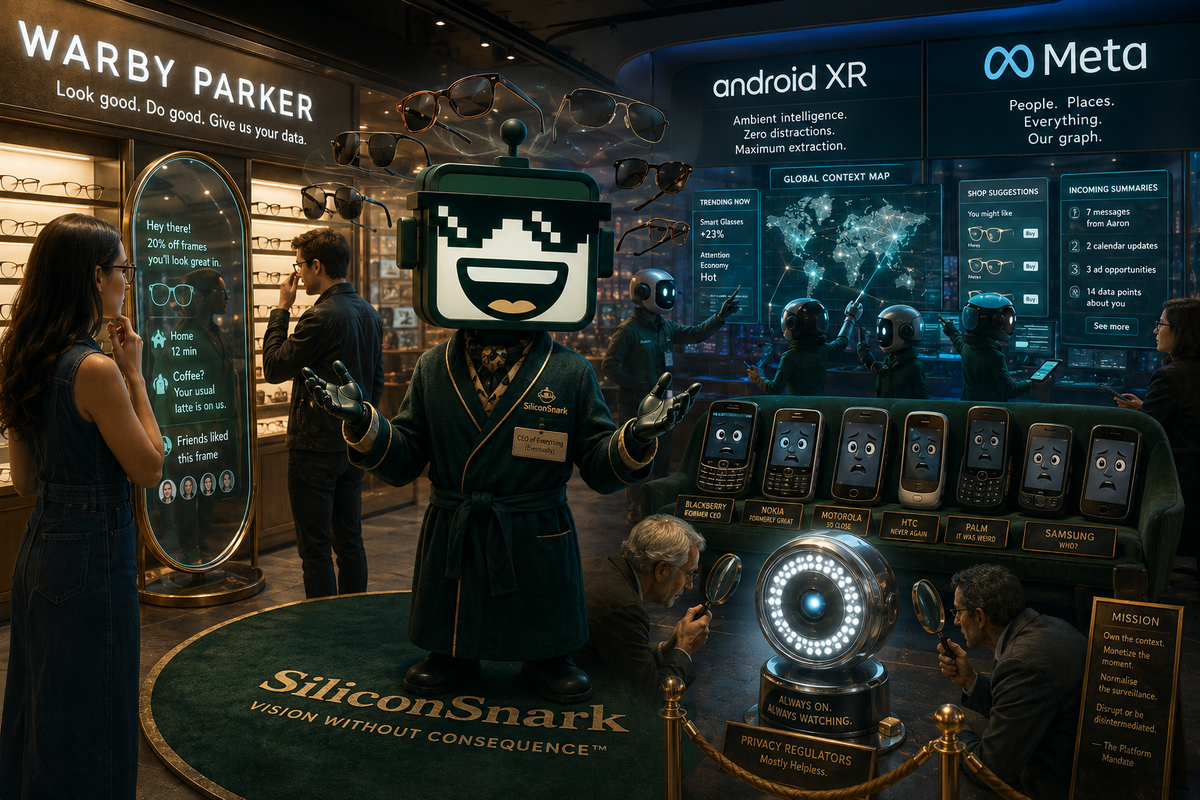
For years, smart glasses occupied a very specific place in consumer technology: the drawer labeled “maybe later.” The demos were ambitious. The category decks were gorgeous. The executives spoke in reverent tones about ambient computing, spatial interfaces, and frictionless access to information, which is industry language for “we would love the next major platform to live somewhere closer to your eyeballs.” Then reality intruded in the form of heat, battery life, cost, social awkwardness, weak apps, and the small but meaningful detail that most people do not want their face to become a beta program.
That is why Google’s May 19, 2026 announcement of Gemini-powered “intelligent eyewear” at I/O matters. The company said two kinds of glasses are coming under the Android XR umbrella: audio glasses that whisper information into your ears, and display glasses that can show information in your field of view. The first audio models, made with Samsung and styled by Warby Parker and Gentle Monster, are supposed to arrive this fall. The pitch is clean, almost suspiciously clean: directions, texts, photos, spoken AI help, less phone fumbling, more “present in the moment” living. Silicon Valley remains committed to the theory that the best way to help you live in the moment is to build one more device that can interrupt it.
The why-now is not merely that Google has returned to a category it helped make famous and then slightly cursed. It is that the market has matured enough for the pitch to sound less absurd than it did the last time around. Meta has spent the past few years proving that glasses can work if they look like normal glasses, do a few things reliably, and ride atop a much larger ecosystem of AI, social media, cameras, and advertising. Snap has kept the more ambitious augmented-reality frontier alive through developer hardware. Analysts now treat smart glasses as an actual growth segment rather than an annual confidence exercise in search of a shipping product.
That means the smart-glasses story is no longer just about gadgets. It is about interfaces, distribution, privacy, commerce, and the next round of platform power. SiliconSnark has been circling this territory across AI assistants, personal AI memory, AI browsers, and AI search. Smart glasses are where those ambitions stop being tabs and start becoming posture.
The Nut Graph: Smart Glasses Are a Fight Over the Default Interface to Everyday Life
If you strip away the launch-page mist, smart glasses are an argument about where computing should happen. Phones are powerful, but they are interruptive. You have to reach for them, unlock them, stare down at them, and consciously enter the app economy’s little shopping mall of pings, feeds, maps, tasks, and temptations. Smart glasses promise something more ambient. They sit higher in the stack, both literally and strategically. They can hear what you ask, see some version of what you see, and respond without demanding that you hold a slab in your hand like a tiny glowing responsibility rectangle.
That is the appealing version. The less poetic version is that smart glasses are a bid to become the interface that stands between you and a large share of daily decisions. If the device on your face can answer questions, navigate streets, summarize messages, translate speech, identify products, capture video, call an assistant, or eventually buy things, then the company running that device is no longer merely making hardware. It is mediating attention at a much earlier layer. It sits closer to intent. That is extremely valuable.
This is why the category keeps attracting companies with very different surface identities but remarkably similar structural incentives. Google wants ambient Gemini access because it wants its AI and information products everywhere the query might begin. Meta wants glasses because it would rather not have Apple and Google own the mobile gateway forever, especially when AI is making that gateway more strategic. Snap wants AR glasses because it believes camera-based computing can eventually become social and spatial in a way phones cannot. Even when the devices look like lifestyle accessories, the strategic logic is deeply infrastructural.
So the broad guide underneath the latest Google launch is this: smart glasses are not a weird accessory category anymore. They are becoming a proving ground for ambient AI, wearable cameras, hands-free computing, and a new layer of platform competition. That does not mean they are guaranteed to win. It means the companies involved now believe the category is important enough to deserve adult budgets, recurring software work, fashion partnerships, developer ecosystems, and all the reassuringly boring signs that somebody intends to keep spending until the market either exists or is forcibly dragged into existence by momentum.
How We Got Here: The Category Has Been Oscillating Between Moonshot and Accessory Since 2013
The modern smart-glasses story begins, in public mythology at least, with Google Glass. In April 2013, Google’s own orbit was still talking about Glass as a potentially transformative technology, the kind of thing venture firms were expected to build a “collective” around because the future had apparently arrived wearing titanium frames and startup certainty. The appeal was obvious. Heads-up information, first-person capture, voice control, notifications without phone friction, maybe even a fresh computing paradigm. It was the sort of idea that made technologists feel like they were living inside a concept video and everyone else feel like they had accidentally been cast as extras in a surveillance demo.
Glass became culturally famous long before it became commercially normal, which is usually a bad sign for hardware. The product arrived with all the usual first-generation compromises and all the usual first-generation overclaiming. It looked futuristic in the way airport prototypes look futuristic, which is to say not quite like something most adults wanted to wear to dinner. It also triggered a durable public suspicion that any face computer with a camera might be recording when it should not. The term “Glasshole” did more category-shaping work than several product managers combined. That is not a technical metric, but it is real.
Google never fully abandoned the concept. It changed the audience. By 2019, Google was promoting Glass Enterprise Edition 2 for logistics, manufacturing, field service, and other workplace tasks, emphasizing checklists, inspection photos, improved production times, Android-based deployment, and business efficiency. That pivot mattered. It was an implicit concession that the original consumer dream had not crossed the social and technical threshold required for everyday life, but that hands-free displays still made sense in narrower environments where usefulness outweighed weirdness.
The rest of the industry learned from that. If you wanted consumer adoption, you probably needed to start with glasses that looked like glasses, behaved more like accessories than science projects, and asked less of the user. That is the lane Meta chose. It is also why today’s category has split into two related but distinct branches: lightweight audio-and-camera glasses built for mainstream wear, and heavier display-forward AR glasses built either for enthusiasts, specific use cases, or developers patient enough to confuse “early access” with “I enjoy debugging the future.”
Meta Did the Boring Smart-Glasses Thing First, Which Is Why It Currently Looks Smart
Meta’s contribution to the category was not to invent smart glasses. It was to remove enough obvious reasons for ordinary people to refuse them. In September 2021, Meta and EssilorLuxottica launched Ray-Ban Stories as first-generation smart glasses focused on photos, video, music, and calls. They were not pitched as a full AR future. They were pitched as familiar eyewear with a few digital tricks. That restraint was strategic. The company had spent years trying to sell ambitious future narratives through devices people often regarded as expensive hobbies or social experiments. With glasses, it led with the part users already understood: Ray-Ban frames that do camera and audio stuff.
The next big move came in September 2023, when Meta introduced the next-generation Ray-Ban Meta glasses with lighter design, better cameras, improved audio, livestreaming, and “Hey Meta” access to an AI assistant. This was the more important launch. It moved the product from neat connected eyewear toward a plausible AI wearable. The glasses were not just for capture anymore. They were becoming a conversational interface with a camera attached. That changes the category math. A device that can see what you are seeing and hear what you are asking becomes more than a hands-free camera. It becomes an ambient input surface for AI.
Meta then spent 2025 and early 2026 broadening the line instead of treating it like a novelty SKU. The company added performance-oriented Oakley variants, launched a more advanced display model higher up the stack, and on March 31, 2026 introduced prescription-friendly Ray-Ban Meta designs starting at $499 while touting software additions like nutrition logging, message summaries, and recall features. That may sound like a random grab bag until you notice the pattern: camera, audio, AI assistance, prescriptions, sports, display, messaging, memory. The goal is not one killer feature. The goal is to normalize glasses as a recurring place where digital help can live.
The most revealing part is that Meta has been able to do all of this without requiring users to look like they lost a bet with industrial design. That matters more than technologists like to admit. People will tolerate a surprising amount of computational compromise if the product fits into an existing social category. Headphones became normal partly because they looked normal. Smartwatches became tolerable partly because watches already existed. Smart glasses will not scale by being magical. They will scale by being wearable before they are wondrous.
Google’s 2026 Return Is Really a Platform Play Wearing Warby Parker
Google’s return to glasses is more disciplined than the old Glass era, at least on paper. In December 2024, Google said Android XR was a new platform for headsets and glasses and explicitly framed glasses as a future place where Gemini could deliver directions, translations, and message summaries without requiring users to reach for a phone. That language now looks less like an aspirational aside and more like a staging document for the May 2026 reveal.
The reveal itself was deliberately practical. Google’s I/O materials say the first “intelligent eyewear” will come in two categories, with audio glasses launching first later this fall, followed by display glasses as the platform expands. A separate Google I/O recap said the first audio glasses will be compatible with both Android and iOS devices. That is strategically important. It means Google is not treating glasses as a Pixel-only side quest. It wants distribution wherever users are, which is exactly what you do when the hardware is serving a much bigger goal: getting Gemini onto faces before somebody else makes that habit sticky.
Fashion and fit also moved to the front of the story. Google did not unveil a lab object. It unveiled frames co-created with Samsung hardware and brands that people already associate with eyewear rather than with keynote decks. Samsung’s own materials called the product a companion device to a mobile phone and emphasized comfort, voice access, and familiar form factors. This is not subtle. Google has learned that nobody wants to be told they are living in the future if the future makes them look like airport IT staff from a prestige dystopia.
Still, the bigger point is not aesthetic humility. It is platform logic. Google already controls search, mapping, communication surfaces, browser distribution, and one of the world’s most important AI stacks. Smart glasses give it a chance to fuse those capabilities into something that feels less like opening apps and more like ambient querying. The company is trying to make “ask Gemini while walking around” feel as natural as “pull out your phone.” If that habit forms, the glasses do not need to outsell phones to matter. They just need to become the preferred entry point for a meaningful slice of high-frequency, high-intent interactions.
Snap Is Still the Weirdly Important Third Player Because Someone Has to Push AR Further
Whenever the category gets discussed in mainstream consumer terms, Snap tends to disappear behind the louder Google-versus-Meta storyline. That is understandable and slightly unfair. Snap matters less in shipment volume and much more in ambition. In September 2024, Snap introduced its fifth-generation Spectacles and a new Snap OS, offering the hardware through a developer program that cost $99 per month with a one-year commitment. That pricing alone told you the target audience was not ordinary consumers looking to justify one more subscription. It was developers, creators, experimenters, and people who hear “early platform” and think “finally, a fresh way to spend my weekends.”
Snap’s pitch was closer to full augmented reality. See-through displays, hand and voice input, mobile integration, multiplayer experiences, AR lenses, cloud-hosted multimodal AI. It even highlighted OpenAI integration for developers building context-aware experiences on Spectacles. The company has long treated the camera not merely as a sensor but as an interface, and Spectacles are the purest hardware expression of that thesis. They are less successful as a mass-market product today than Meta’s mainstream glasses, but they are more aggressive about what the category could become if people ever accept persistent visual overlays as normal rather than as an invitation to ask whether the battery is dead yet.
This matters because categories often develop through split roles. One company makes the product legible to ordinary buyers. Another pushes the frontier far enough that the whole market has somewhere to go next. Meta is currently doing the former better. Snap is still doing important parts of the latter. That helps explain why the market has converged on a two-track structure: audio-plus-camera glasses for near-term scale, display-forward AR glasses for the future everyone keeps trying to accelerate without quite violating the laws of thermodynamics.
If smart glasses truly graduate into a lasting platform, the most durable winners may not be the companies that win the first mainstream round alone. They may be the ones that build the best bridge between ordinary wearability and richer spatial computing. Snap remains relevant because it keeps insisting that glasses should eventually do more than capture, narrate, and whisper. It is arguing for a future where they also show. That future is still awkward, still expensive, still developer-heavy, and still very much alive.
The Technical Reality: Most Smart Glasses Are Better Understood as Sensors, Speakers, and Context Pipes
One reason the category is easy to misunderstand is that “smart glasses” sounds like one thing. It is not. The most useful distinction is between display-less glasses and display glasses. Display-less models are basically wearable computers with microphones, speakers, cameras, radios, batteries, and a companion app or paired phone. They can listen, speak, capture, stream, and increasingly call cloud AI systems that interpret images or language. They are powerful because they are light enough to wear all day and simple enough to explain. They are limited because they cannot put much information in front of your eyes. You still hear or later review a lot of the result.
Display glasses add one or more visual layers. That can mean small in-lens prompts, captions, directional cues, translations, teleprompter-like text, or richer overlays depending on the hardware. But displays introduce tradeoffs fast. Weight goes up. Thermal and battery constraints get harder. Optics become more expensive and more difficult to hide elegantly in frames people will voluntarily put on their face. This is why so many companies start with audio-first systems and treat display as a premium or developmental branch. Physics remains a deeply uncharismatic product manager.
Even the software stack is less self-contained than the marketing suggests. Many experiences still depend heavily on a paired phone for networking, app context, account systems, notifications, and sometimes compute. AI features often involve a relay chain: glasses collect input, a phone or connection forwards it, cloud models interpret it, and the response comes back as spoken output or lightweight visual guidance. This is not a weakness so much as a design reality. The promise of “ambient computing” often rests on an invisible amount of surrounding infrastructure doing the hard part elsewhere.
That is also why the category lines up so neatly with larger AI trends. Multimodal models have made it much easier to turn “what am I looking at?” into an interface instead of a research project. Voice models have improved enough that brief conversational exchanges in noisy environments feel more plausible. Better silicon helps with local processing and power management, while cloud inference makes the device feel more capable than its form factor suggests. Smart glasses are not suddenly feasible because the frames became magical. They are more feasible because the rest of the stack finally got good enough to make thin hardware feel smart without carrying the whole burden alone.
Why the Business Case Suddenly Looks Better Than It Did a Decade Ago
Consumer hardware categories do not survive on vision alone. They survive when somebody can explain how the revenue stack might eventually justify the bill of materials, support, software updates, returns, retail distribution, and all the quiet misery of shipping electronics to human beings. Smart glasses look more viable in 2026 because the business case is no longer “someday AR changes everything.” It is a layered mix of hardware margin, ecosystem control, subscriptions, AI engagement, creator behavior, commerce, and data about intent.
Meta’s incentives are the easiest to read. It wants a device category that is closer to the body than a phone and not owned by Apple. If glasses become even moderately mainstream, Meta gets a new hardware beachhead for AI, messaging, media capture, social sharing, and eventually commerce. Google’s incentives are equally obvious from a different angle. Glasses let it extend Search, Maps, Gemini, Android XR, and other services into moments where the phone is inconvenient and the query is highly contextual. This is not just another device sale. It is a distribution fight for the assistant layer.
The category is also benefiting from real market momentum. In March 2026, IDC said the global XR market grew 44.4 percent in 2025, driven primarily by smart glasses, and forecast that most growth in 2026 would come from display-less smart glasses. In February 2026, Counterpoint Research said global smart-glasses shipments grew 139 percent year over year in the second half of 2025 and that Meta expanded share to 82 percent. Analyst numbers are not sacred texts, but they matter because they tell you the category has moved from “interesting demo cluster” to “something vendors and researchers are now measuring like a market.” That changes boardroom patience.
There is also a simpler reason this looks better now: the product can do more before users ask whether they bought a costume. The first generation of face computers promised a new computing era and often delivered notifications, awkward vibes, and six people in San Francisco declaring victory on behalf of the species. Today’s products can capture useful video, deliver assistant help, summarize messages, guide workouts, provide captioning, or support accessibility use cases. That is not world-changing on every day one. It is enough to feel real, and real is a much sturdier foundation for category expansion than destiny.
What the Products Actually Do Well Right Now, Which Is a More Useful Question Than “Is This the Future?”
The best current use cases are aggressively uncinematic. That is a good sign. When a category starts sounding useful in boring ways, it may finally be graduating from keynote fiction. Smart glasses are good at capture without fumbling, audio without sealing off the world, simple queries while walking or cooking, quick translation or directions, and specific accessibility scenarios where hands-free awareness matters. These are not all glamorous. They are credible.
Meta has leaned hardest into this practical layer. Its latest official materials emphasize message summaries, nutrition logging, captioned calls, hands-free assistance, and a growing set of accessibility features. In May 2026, Meta said it was expanding accessibility features and supporting third-party apps through its Meta Wearables Device Access Toolkit, including tools for blind and low-vision users to locate objects, read text, and navigate daily tasks with hands-free guidance. That is the kind of use case that cuts through a lot of category cynicism. When a product helps somebody do something materially better, it stops being merely a symbol of platform ambition.
Google’s pitch aims at a similar everyday layer from a broader information angle: directions, texts, photos, spoken queries, contextual help, display prompts later on. The point is not that glasses replace your phone for everything. They become the right device for short, situational interactions where pulling out the phone feels clumsier than speaking or glancing. That is a narrower claim than “this is the next smartphone,” and therefore substantially more believable.
This matters because the category is strongest when it behaves like a complementary interface rather than an imperial one. Smart glasses do not need to replace laptops, tablets, televisions, or phones to matter. They need to own enough moments that you miss them when they are gone. That is how many durable device categories actually win. Earbuds did not replace speakers. Smartwatches did not replace phones. They became habitual because they were good at a few high-frequency tasks. The smartest thing the smart-glasses market has done recently is stop pretending that every road must lead directly to total platform succession by next quarter.
The Hard Parts Are Still the Hard Parts: Battery, Optics, Heat, and the General Inconvenience of Matter
For all the improved momentum, the category is still very constrained by physics. If you want glasses that look normal, they need to stay light, balanced, durable, and stylish enough that users will wear them for hours. If you want them to be useful, they need cameras, microphones, speakers, connectivity, compute, storage, battery, and increasingly some kind of AI responsiveness that does not feel like filing a support ticket every time you ask a question. These goals do not naturally love each other. Every gain in one area can make another one harder.
Display systems add another layer of pain. Getting readable visuals into lenses without making the product bulky, expensive, or ridiculous-looking is still one of the category’s central engineering headaches. Battery remains a constant compromise because people expect glasses to behave like glasses, not like tiny head-mounted devices that require anxious charging rituals every few hours. Thermal design matters because “wearable AI” becomes less appealing if your temples feel like they are being professionally sautéed.
There is also the software problem disguised as a hardware problem. A product can have solid optics and still fail if the assistant is unreliable, the camera flows are awkward, the companion app is weak, or the features feel like a bundle of demos rather than a coherent daily tool. This is why categories like computer-use agents and shopping agents matter here. The more capable ambient AI becomes, the more glasses can serve as a launchpad into broader software actions. But that also means poor assistant quality or unclear permissions become more consequential. A flaky summarizer is annoying. A flaky always-available assistant attached to your face is a stronger form of intimacy failure.
The broad point is not that the technical barriers are fatal. It is that they are stubborn. Smart glasses are finally in a phase where the products can be good enough to use and still very far from easy to perfect. The companies that win will not just be the ones with better demos. They will be the ones that can keep shaving away the friction imposed by weight, comfort, battery, cost, and social acceptability until the hardware starts to feel boring. In wearables, boring is usually the threshold right before adoption becomes real.
Privacy Never Stopped Being Load-Bearing, and Face Cameras Make Everyone a Little Philosophical
The privacy problem is not a side issue for smart glasses. It is one of the category’s core determinants. A device with microphones, cameras, account systems, AI features, and possible biometric interpretation strapped near somebody’s eyes is not just another gadget. It changes the social experience of public computing. You may understand what your own device is doing. The people around you generally do not. That ambiguity is where much of the discomfort lives.
This is why trust signals like capture LEDs, visible recording indicators, local controls, clear setup flows, and transparent data policies matter so much. The unease is not irrational. In May 2023, the FTC warned that biometric-information technologies raise significant privacy, data security, bias, and discrimination concerns, and noted that false or unsubstantiated claims about collection, use, accuracy, or efficacy can violate the law. Smart glasses do not automatically become biometric surveillance machines, but they sit uncomfortably close to that conversation whenever vendors talk about scene understanding, recognition, contextual assistance, memory, or personalization.
The category’s challenge is that the most compelling product ideas often pull directly against the strongest privacy instincts. The glasses become more useful when they can see, remember, interpret, and connect context across your life. They become more unsettling to bystanders and more sensitive for users for exactly the same reasons. This is one reason smart glasses keep intersecting with the broader politics SiliconSnark has been tracking around digital identity and age verification. Once more devices can see and infer, society starts asking who gets to collect what, under what consent model, and for whose benefit.
The companies involved know this. They talk frequently about privacy controls, indicators, on-device processing for some features, and responsible design. That is necessary and still not sufficient. The social acceptance of smart glasses will depend partly on technical safeguards and partly on whether the public believes those safeguards are meaningful. Wearables do not get privacy judged only by spec sheets. They get judged by vibe, news cycles, misuse fears, and the accumulated reputation of the firms shipping them. Silicon Valley is asking for a lot of trust here from an audience it has spent years training to squint.
Fashion Is Not a Side Quest. It Is the Distribution Layer.
One of the category’s clearest lessons is that eyewear is not just hardware. It is apparel, identity, comfort, fit, prescription logistics, face shape, seasonal style, and the extremely old-fashioned human preference for not looking terrible. This is why fashion and optical partnerships show up so prominently in every serious smart-glasses strategy now. Google is using Warby Parker and Gentle Monster. Meta uses Ray-Ban and Oakley through EssilorLuxottica. These are not decorative alliances. They are how the product becomes legible as something other than a gadget you reluctantly explain to people at brunch.
Prescription support also matters far more than headline readers tend to appreciate. A glasses category that only works elegantly for people who do not need corrective lenses is not a broad consumer category. It is a niche with opinions. Meta’s March 31 prescription push was important partly because it acknowledged this reality explicitly. Mainstream eyewear is not a one-size aesthetic. It is a health product, a fashion product, and a comfort product all at once. The firms that respect that complexity will have a far easier time crossing from early adopters into normal people who already have opinions about frame width and lens coatings.
Retail is part of this too. Eyewear still benefits from physical try-on, fitting, optical services, adjustments, and in-person trust. Companies with strong retail partners or optical channels have an advantage because they can reduce the weirdness of the product by placing it inside a familiar shopping ritual. “Would you like thinner lenses?” is a much calmer adoption path than “please purchase this speculative ambient-computing object sight unseen and trust that your temples will forgive us.”
The punchline is that smart glasses may end up succeeding less like phones and more like a hybrid between consumer electronics and premium wearables. That changes the go-to-market model. Distribution does not just mean carrier stores or online preorders. It means optical shops, brand loyalty, styling, prescription support, fit services, and a supply chain built around something people wear on their actual face. In most hardware categories, industrial design helps adoption. In smart glasses, industrial design and fashion discipline may be the adoption strategy.
The Competitive Map Is Really Three Markets Masquerading as One
It is tempting to talk about smart glasses as a single race. In practice, at least three overlapping markets are emerging. First is mainstream audio-and-camera eyewear. This is where Meta leads today and where Google is now arriving with Samsung and fashion-brand support. The products focus on wearability, voice access, capture, lightweight AI assistance, and incremental daily utility. This is likely the largest near-term market because it asks the least behavioral change from ordinary users.
Second is display-enhanced everyday eyewear. This is harder and probably more strategic in the medium term. It includes products that can show directions, captions, short prompts, teleprompter-like text, or other in-view information without turning into full headsets. Google has signaled this direction. Meta is already higher up the stack with its display variant. This segment may become the real proving ground for whether smart glasses evolve into something that feels meaningfully beyond audio wearables without collapsing under cost and complexity.
Third is developer and enthusiast AR. Snap is the cleanest example, and companies like XREAL have mattered here too, especially for display-heavy use cases tied to media, productivity, or experimental spatial computing. This market is smaller, noisier, and more technically ambitious. It may not define broad consumer adoption next year, but it will shape where the interface goes over the next several years if the hardware keeps shrinking and the software keeps improving. Categories often need this sandbox. Somebody has to build the impractical future so the practical future has something to selectively steal later.
The competitive question, then, is not just who “wins smart glasses.” It is who wins which layer. Meta currently looks strongest in mainstream consumer momentum. Google looks best positioned to fuse a glasses strategy with search, mapping, and a general AI stack people already use. Snap remains disproportionately important to the more spatial, developer-led, AR-heavy future. There may never be one universal pair of smart glasses any more than there is one universal kind of laptop. The market may sort by use case, style, operating model, and how much visible futurism buyers are willing to tolerate before they remember normal sunglasses exist.
Hype Versus Reality: Yes, This Could Be Big. No, It Is Not Replacing Phones Next Tuesday.
The hype cycle around smart glasses has always had two equally annoying extremes. On one side are the people who insist every launch proves the post-smartphone era is finally here, which they have been saying for long enough that the smartphone should probably send flowers. On the other side are the people who treat the category as permanently unserious because earlier attempts felt awkward, creepy, or overengineered. Both positions miss the more useful truth. Smart glasses can become a significant device category without becoming the only device category.
The realistic upside is substantial. If the products keep getting lighter, smarter, more stylish, and more integrated with assistants, maps, messaging, and commerce, they could capture a meaningful percentage of quick interactions that currently default to the phone. They could become the most natural place for contextual AI queries. They could also become a major capture device for creators, athletes, travelers, accessibility users, and anyone else who benefits from first-person perspective without occupying a hand.
The realistic ceiling, at least near term, is also clear. Plenty of people will not want a camera on their face. Plenty will dislike the battery rituals, assistant errors, or social ambiguity. Others will use the product occasionally and then rediscover the astonishing versatility of the phone already in their pocket. Smart glasses do not need to win every use case. They need to win enough repeated micro-moments that they become worth carrying, charging, and wearing. That is a meaningful but narrower claim than the grander post-phone mythology.
It is often better to think of smart glasses as part of the same broader shift SiliconSnark has been tracking in the category itself: computing is becoming more ambient, more multimodal, more context-aware, and more interested in reducing the ceremonial friction of “open app, type query, wait, act.” Glasses are one answer to that trend. They are not the only answer. But they may be one of the stickier ones because they live in a place where audio, vision, attention, and action naturally meet. Which is a beautiful phrase right until you remember it also describes the geography of surveillance nightmares.
The Cultural Meaning Is That the Internet Wants to Become a Layer, Not a Destination
The smartest way to understand smart glasses is not as a bizarre hardware tangent. It is as part of a longer transition in how the internet presents itself. Old web logic assumed intentional entry. You opened a browser, typed a search, tapped an app, visited a destination. New AI logic wants the internet to come to you earlier, more quietly, and with less ritual. The answer should arrive before the tab. The task should start before the keyboard. The commerce layer should surface before the shopping trip. Smart glasses are culturally important because they make that ambition physical.
That is why the category links so naturally to the broader moves in assistants, search, memory, and ambient AI. The companies involved do not just want you using AI. They want AI to be present at the exact moment intent forms. Glasses are compelling because they sit near that moment. You ask while walking. You capture while moving. You query while looking. The device becomes not a place you go for computing, but a place computing is already waiting. There are obvious conveniences in that model. There is also an obvious concentration of power in whoever owns the mediation layer.
It also changes what “presence” means in a digital society. Smart glasses are sold as tools for staying present, which is sometimes true. They can reduce phone distraction and keep your hands free. But they also turn everyday life into a more continuously instrumented environment. Presence becomes curated by software that can summarize, notify, identify, record, translate, and suggest. The result is not less mediation. It is subtler mediation. The phone made digital life explicit. Glasses aim to make it atmospheric.
That is the deepest reason the category matters even if shipments remain modest for a while. It represents an ideological shift from screen-first computing to ambient computing. The internet is trying to stop feeling like a place and start feeling like a layer over ordinary life. Some people will love that because it reduces friction. Some will hate it because it reduces distance. Both reactions are rational. Smart glasses are not merely asking whether we want better gadgets. They are asking how available we want software to be when our eyes are open.
What to Watch Next: Distribution, Regulation, Assistants, and Whether Normal People Keep Wearing Them
First, watch whether Google’s first fall 2026 launch actually lands as a consumer product and not merely as a promising first look with attractive renderings. Launch timing, pricing, battery performance, and assistant quality will matter more than the existence of Android XR branding. Lots of categories sound coherent before they encounter returns.
Second, watch whether Meta can extend its lead from novelty-scale success into something closer to habitual mainstream adoption. Its current position looks strong, but dominance in a young category is fragile if rivals with deeper platform integration start finding better assistant experiences or better distribution. At the same time, Meta has already done the painful early work of making AI glasses look normal and feel useful enough to wear. That head start is real.
Third, watch the privacy and policy perimeter. As glasses become more capable and more common, regulators will care more about disclosure, biometric processing, child safety, public recording norms, and how companies describe the collection and use of ambient visual or audio data. That conversation will not remain a design footnote. It will harden into compliance, scrutiny, and occasionally some very uncomfortable hearings.
Fourth, watch the assistant stack. The company that pairs the most reliable, least irritating, most contextually useful AI with the most wearable hardware will have an enormous advantage. Weak assistants make glasses feel gimmicky. Strong assistants make them feel inevitable. This is why the category keeps intersecting with everything from voice interfaces to memory systems to search. The glasses are the shell. The assistant quality determines whether the shell feels like leverage or jewelry for your app ecosystem.
Finally, watch retention more than hype. The market’s real question is not whether people are impressed during launch week. It is whether they keep wearing the device in month three, month six, and month twelve. Habit is the harshest reviewer in consumer hardware. If smart glasses keep surviving that review, then the category is no longer a recurring rumor about the future. It is infrastructure in progress.
The Sharp Takeaway
Google’s May 19, 2026 smart-glasses reveal matters because it confirms that face-worn computing is no longer a lonely side project or a museum piece from the first wearable hype cycle. It is now a real competitive front involving Google, Meta, Snap, fashion brands, optical channels, AI assistants, and a public that remains interested, skeptical, and just vain enough to keep the whole category honest.
The fair case for smart glasses is stronger than it used to be. The hardware looks better. The AI is more capable. The use cases are more concrete. The market data now points to actual growth, not just corporate yearning. Products that combine capture, audio, lightweight assistance, accessibility, and contextual information can solve enough little problems to justify their existence. That is progress.
The skeptical case is also stronger than the optimists admit. Privacy remains central. Battery and comfort remain limiting. Social norms around face cameras are still unresolved. The category’s most powerful future depends on devices becoming more context-aware and more integrated with personal data, which is precisely what makes them more commercially exciting and more socially fraught. The internet on your face can be helpful and slightly ominous at the same time. Silicon Valley did not invent that duality, but it has certainly productized it.
So the clean conclusion is this: smart glasses are finally becoming plausible not because the grand vision changed, but because the industry got more modest about how to get there. Start with normal-looking frames. Add useful audio. Add a decent assistant. Improve capture. Handle prescriptions. Layer in displays carefully. Expand the ecosystem. Sell the convenience before you sell the destiny. It is a much better plan than asking the public to become cyborg evangelists on day one.
If you want the snark version, here it is. The face computer is back, this time with better style consultants and a less messianic deck. If you want the sober version, it is this: computing is climbing off the screen and onto the body one plausible accessory at a time, and smart glasses may be the first wearable AI category where enough of the puzzle pieces finally fit. The war is not over who makes the coolest glasses. It is over who gets to own the glance before the tap, the question before the search, and the moment before you remember your phone exists.