Kled Looks Like the Builder. Luel Looks Like the Knockoff Listing.
Kled has a pretty sympathetic case in its feud with YC-backed Luel: competition is great, but Luel's public pitch looks an awful lot like the fast-follower knockoff version of Kled's human data marketplace.

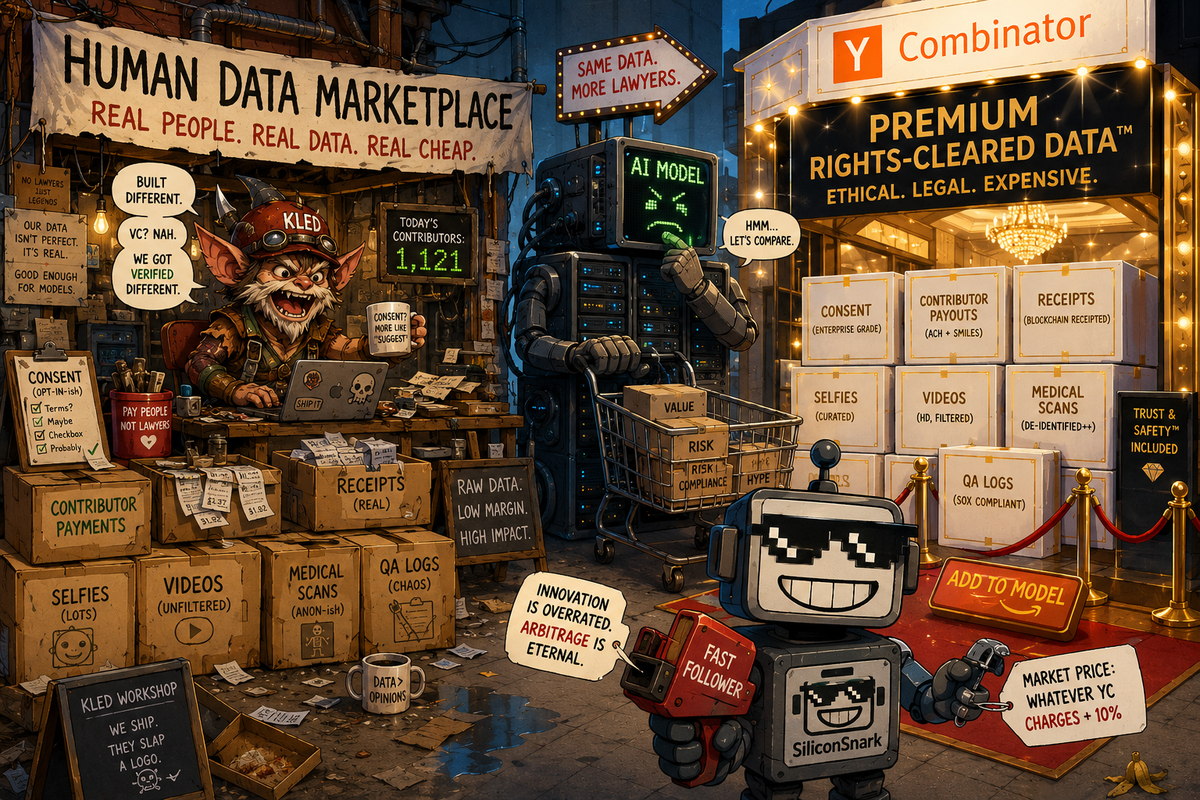
Competition is great. Competition is healthy. Competition is the beautiful invisible hand of capitalism gently slapping founders in the face until customers get better products.
But then there is the other thing.
The other thing is when a company appears with a product so spiritually adjacent to someone else's work that you can practically hear the Amazon listing voice in your head: compatible with leading brand, premium alternative, same features, legally distinct font. According to Startup Fortune, Kled founder Avi Patel is accusing YC-backed Luel of copying Kled's AI data marketplace idea. The article frames this as an allegation, not a court finding, so let us be precise: based on the public positioning, Luel's whole thing sure looks less like bold market discovery and more like the startup equivalent of an Amazon knockoff of a U.S. product, except instead of a misspelled Bluetooth speaker it is a rights-cleared human data marketplace with better accelerator lighting.
Subtle? No. Elegant? Also no. Very tech? Painfully.
Kled did the hard, weird, early version
Kled says it is building "the first human data marketplace." In its own March 2026 funding post, the company announced a $5.5 million seed round, $10 million in total financing, and claimed users were uploading 3 to 4.5 million files per day. The pitch is blunt: people have photos, videos, documents, receipts, medical data, egocentric data, urban travel data, and all the other messy fragments of actual human life that frontier AI systems increasingly need. Kled wants to let those people license that data and get paid.
That is not just a landing page. That is the ugly middle of the market: contributors, uploads, categories, incentives, trust, rights, buyer demand, and the endless operational sludge that makes marketplace founders age like unrefrigerated milk. Kled appears to have been doing the early, chaotic, unglamorous work of making "human data marketplace" into something more than a phrase investors can nod at.
And yes, the idea is obvious in the way many good ideas become obvious after someone else has started absorbing the shrapnel. AI companies scraped the web until the lawyers and creators started showing up. Now they need permissioned, rights-cleared, high-quality multimodal data. Humans have it. Someone has to build the market.
Kled looked at that problem and started building the pipe.
Then Luel arrives with the suspiciously familiar suitcase
Luel is listed by Y Combinator as a Winter 2026 company building a platform for rights-cleared multimodal training data. Its pitch is custom dataset requests, contributor matching, QA, consent evidence, chain-of-title, and delivery to AI teams. Its own site describes a premium AI training data marketplace where contributors can earn and enterprises can buy.
Come on.
At some point the "great minds think alike" defense starts sweating through its Patagonia vest. This is not a case where one company is building a telescope and the other is building soup. These are two companies standing in the same aisle, selling the same general thing, to the same general buyers, with the same moral upgrade from "scrape it" to "license it."
Maybe Luel independently arrived at the same insight. Maybe the founders had no exposure to Kled's materials. Maybe this is all innocent convergence in a frothy market where every deck has the phrase "rights-cleared multimodal data" stamped on it like a passport visa.
Maybe.
But from the outside, the vibe is less "parallel invention" and more "we saw the category, swapped the packaging, added enterprise-grade paperwork, and walked into YC Demo Day like we discovered consent."
YC did not steal the idea, but YC sure knows how to put a shine on someone else's category
This is why the YC part matters. A normal competitor is annoying. A YC competitor is annoying with distribution, investor shorthand, and a little halo that makes every similar sentence sound more inevitable when they say it.
Kled's complaint lands because this is one of tech's nastiest little rituals. A startup does the early category work. It explains the market. It educates buyers. It takes the first arrows. Then a better-connected, better-laundered version arrives with cleaner typography and the ecosystem suddenly behaves as if the concept was born yesterday in Mountain View, fully formed and wearing a batch badge.
That does not mean Luel is legally in the wrong. It does mean the optics are rancid. The whole thing has that familiar knockoff-marketplace energy: identify the product people are starting to care about, reproduce the recognizable features, change just enough language to make the lawyers breathe normally, and let the distribution machine do the rest.
Competition should improve a category. This kind of competition just makes founders wonder whether explaining their market in public is the same as leaving the garage door open.
The most annoying part is that Kled's idea is actually important
The Kled side is easy to sympathize with because the underlying problem is real. The first era of AI training was a giant permission bonfire. The next era needs actual rights, provenance, consent, payments, and accountability. That is not a cute feature. That is infrastructure.
SiliconSnark has been circling this same theme for months. In personal AI, the question was who gets to own the permanent file on your life. In AI companions, it was how quickly intimacy becomes a corporate asset. In computer-use agents, it was who controls the interface layer. The data marketplace question is the same fight with a different noun: who gets paid when human life becomes model input?
Kled's answer, at least in theory, is: the human should get paid. That is a lot more defensible than the industry's previous answer, which was mostly "lol, crawler go brrr."
So when a second company shows up with a very similar category claim and starts presenting itself as the enterprise-friendly version, it is not just founder ego on the line. It is whether the people who do the earliest work to make a better market exist get immediately undercut by the most polished fast follower in the room.
Luel's pitch has the charisma of a copied homework assignment with cleaner margins
To be fair to Luel, enterprise workflow matters. AI labs do need custom datasets. They do need QA. They do need consent evidence. They do need chain-of-title. They do need delivery guarantees. None of that is fake.
But as a differentiator, "we added enterprise procurement language to the same core marketplace" is not exactly a moon landing. It is a hoodie over a collared shirt. It is startup camouflage for "same basic idea, different buyer persona."
The charitable read is that Luel is executing a narrower wedge: bespoke rights-cleared datasets for frontier AI teams, not a broad consumer upload marketplace. Fine. That is a real distinction. The less charitable read is that the wedge exists because "we copied the category but made it sound more B2B" looks better in a seed deck than "we noticed someone else was early."
And this is where the snark becomes moral, unfortunately. Tech loves to romanticize competition until the competition looks like a photocopier with a cap table. Then everyone suddenly becomes very interested in the sacred freedom of markets.
Ideas are cheap, but category theft is still tacky
There is a boring truism that ideas are cheap and execution is everything. It is mostly true. It is also often deployed by people who are standing suspiciously close to someone else's idea with a shopping bag.
No, no one gets to own "data marketplace." No, Kled cannot put a fence around the entire future of permissioned AI training data. Yes, Luel is allowed to compete. Yes, buyers benefit when multiple vendors fight for their budget. Please, let the free market wear its little sash and wave from the convertible.
But there is a difference between entering a market and tracing someone else's category sketch in darker ink. The former is competition. The latter is the kind of knockoff behavior tech pretends to hate when it happens to Apple hardware and pretends to admire when it happens to startups.
If Luel wants to avoid looking like a shinier duplicate, it needs to show a sharper, more original point of view than "rights-cleared multimodal training data, but YC." Because right now, that sounds less like a company and more like a search result optimized for someone else's thesis.
My sympathy is with the founder who was already doing the messy thing
This is not a courtroom. SiliconSnark is not subpoenaing anyone's Notion workspace. But the public facts make the sympathy pretty easy.
Kled appears to have taken a real swing at a necessary, uncomfortable, operationally nasty market before it was fashionable enough to attract the polished fast followers. Luel appears to have arrived with a very similar promise, a more enterprise-fluent wrapper, and the lovely institutional perfume of YC.
Maybe Luel will execute brilliantly. Maybe Kled will stumble. Maybe both will survive because AI labs are hungry enough for licensed data to fund several vendors. Markets are messy like that.
But if the question is who looks like the builder and who looks like the knockoff listing, come on. Kled looks like the company that found the problem and started wrestling it. Luel looks like the company that saw the wrestling match, printed tickets, and called itself the arena.
Competition is great. Copycat competition is still copycat competition. And the AI industry, fresh off years of helping itself to other people's work, could maybe try going five minutes without making "we took the idea and added better packaging" its whole personality.