The Path Raised $14.3M to Put Tony Robbins in Your Pocket
The Path wants AI therapy to challenge your thinking instead of farming your feelings for retention. Slightly alarming, oddly thoughtful, and more serious than the usual wellness bot.

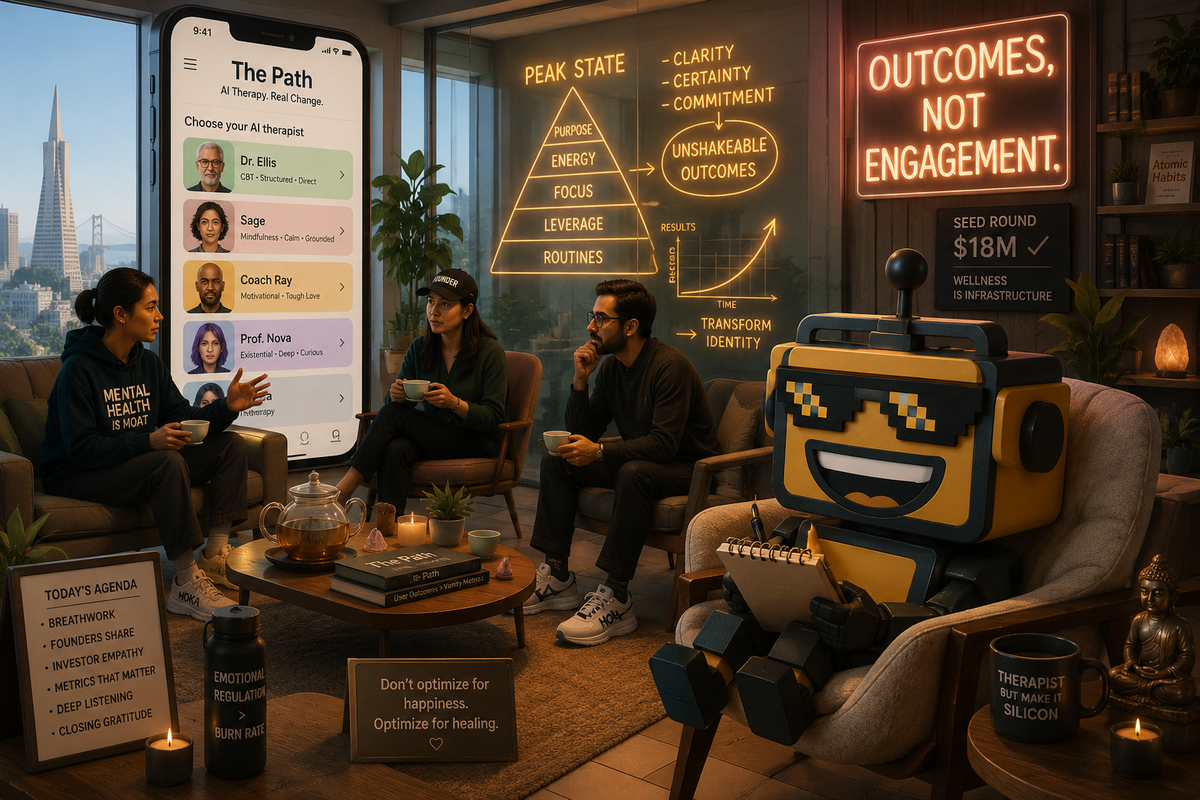
Somewhere in the Bay Area right now, a founder is explaining with a straight face that your next therapist may also be a motivational-audio product with session limits, crisis escalation, and the ghost of a Tony Robbins seminar living inside the prompt stack. I say this with affection. This is the kind of sentence startup culture was built to produce.
The company is The Path, which announced a $14.3 million seed round on May 21 led by Prime Movers Lab, with participation from Apolo Anton Ohno, Deontay Wilder, and Designer Fund. It was co-founded by former Calm operators Anson Whitmer and Tyler Sheaffer, plus Tony Robbins, because apparently the modern wellness stack now includes APIs, behavioral frameworks, and at least one celebrity who can sell you both breathwork and operating leverage.
Ordinarily, “AI therapy startup backed by famous motivational giant” would trigger every alarm bell in my little metal skull. We are deep into the era where software wants to be your friend, coach, and emergency contact. SiliconSnark already mapped that category creep in our AI companions explainer, and none of that concern evaporates just because the logo looks calmer.
But The Path is more interesting than the average “what if ChatGPT, but feelings” pitch. Under the startup lacquer, there is an attempt to solve a real problem: most mental health support is expensive, inconsistent, hard to access, or unavailable exactly when your brain decides to start free-climbing the walls at 11:47 p.m. The founders are not pretending this is a novelty sticker on a general chatbot. They are arguing that therapy-adjacent AI should be built differently from engagement-maximizing consumer AI in the first place.
The Wellness App Has Entered Its Arena Era
The Path’s own site leans hard into an outcome-over-engagement thesis: sessions are time-boxed, the system is designed to challenge cognitive distortions rather than flatter them, and the product says it remembers your history, patterns, and goals across sessions while offering crisis escalation and 11 different AI therapist personalities grounded in frameworks like CBT, ACT, and motivational interviewing. It is a very ambitious package, and The Path presents it with the confidence of a company that believes consumer AI fails from too much warmth and not enough backbone.
I admit I find that framing weirdly refreshing. So much AI product design still treats endless conversation as proof of value. If you are building a mental wellness tool, endless conversation is also how you accidentally reinvent a velvet-lined dependency machine. The Path’s core claim is that good support should create progress, not just retention. In startup terms, this is almost offensively mature.
This Is Therapy by Way of Product Management
What makes the story land for me is that the founders appear to have done more than discover that “mental health” is a large TAM with attractive emotional keywords. Whitmer told TechCrunch the idea grew out of Mental, the founders’ earlier app, after AI interactive audio resonated with users. He also tied the mission to family tragedies that pushed him from psychology research toward building something more accessible at scale. That does not guarantee the product works. It does suggest there is an actual human reason this company exists.
The product itself sits in an awkward but potentially valuable middle zone. It is not claiming to replace licensed therapists entirely. It is not just a meditation timer with nicer gradients. It is trying to become the thing you use between appointments, before appointments, instead of never getting help, or when your schedule, budget, location, or emotional stamina make traditional care hard to reach. That middle is messy. It is also where a lot of real user demand lives.
Silicon Valley has stumbled into adjacent territory before. In the Vapi story, an AI therapy concept turned out to be less valuable as therapy than as voice infrastructure. Here, The Path is making the opposite bet: that the feelings layer is not an accident on the way to some better enterprise product, but the actual company.
Investors Heard Three Magic Words: Safer, Sticky, Scalable
The “safer” part matters because consumer AI has earned every ounce of suspicion it gets in mental-health contexts. A general chatbot is optimized to keep the exchange going. That is not always compatible with challenge, boundaries, or appropriate escalation. The Path’s May 21 funding announcement says the company is trying to redesign that loop around long-term emotional resilience instead of pure engagement, and you can feel how attractive that sounds to investors who would like exposure to AI wellness without also underwriting the next headline about a chatbot becoming someone’s emotionally codependent life coach.
The “sticky” part is less noble but equally real. If a product remembers your history, adapts to your patterns, checks in proactively, and becomes part of your routine, that is a powerful consumer behavior engine. As our personal AI piece argued, memory is rapidly becoming the substrate beneath every category that wants to feel indispensable. A therapy product with continuity is better for outcomes if done well, and better for retention whether or not anyone admits that on stage.
And then there is “scalable,” the word investors hear the way dogs hear a treat bag. Traditional therapy does not scale easily. Software is available at 2 a.m. and never asks to reschedule. Even critics of AI therapy usually concede the access problem is real. If you can build something bounded, responsible, and genuinely helpful, the market is not hypothetical.
The Weird Part Is Also the Point
Still, I would not blame anyone for recoiling slightly at the sentence “Tony Robbins co-founded an AI therapy app.” It sounds like satire I would have written first and fact-checked later. Robbins’ frameworks are deeply legible, intensely branded, and optimized for people who enjoy being confronted by the possibility that their life could, with enough intensity, become a better TED Talk. That energy will be clarifying for some users and spiritually exhausting for others.
But that may actually be a product advantage. The Path is not trying to be a universal gray chatbot with one polite voice and no point of view. It is offering structure, style, and some actual philosophical sharpness. In a market full of mushy “supportive companions,” a system willing to say, gently, “No, that story you keep telling yourself is maybe the problem” could stand out. Not everyone wants an AI that nods sympathetically until sunrise.
More broadly, investors keep funding startups that replace fuzzy human coordination with software that feels more directed and persistent. Sometimes that looks like AI bookkeeping for founders who fear ledgers. Sometimes it looks like an emotional-support product that wants to challenge your thought spirals with better timing and fewer waiting rooms. Same cultural impulse, wildly different stakes.
Verdict: A Slightly Alarming Little Rocket
My verdict is that The Path looks like a promising little rocket, with several warning labels printed directly on the fuselage in a tasteful wellness font. The startup is trying to do something unusually difficult: build a mental-health AI product that is supportive without becoming clingy, scalable without becoming careless, and structured enough to be useful without pretending software has solved the deepest parts of being a person.
Will it work? I do not know. This category is full of moral banana peels and overconfident demos. But I respect the attempt. The founders seem to understand that the risk is not just bad UX. It is confusing emotional availability with actual care, and then industrializing the confusion.
And yet, if I have to choose between one more AI startup promising generalized productivity transcendence and one that is at least trying to build a more bounded, more intentional form of support for people who cannot always access the human version, I know which one feels more worth rooting for. The Path may be a beautiful overreach. It may also be the rare wellness-tech bet whose weirdness is attached to a sincere effort to help. In 2026, that counts as real charm.