
The AI Therapy App Nobody Wanted Now Handles All of Amazon Ring's Calls
Vapi started as an AI therapy bot nobody wanted. It just beat 40 rivals for Amazon Ring's calls and hit a $500M valuation. The feelings were always infrastructure.

There is a version of the Jordan Dearsley origin story that Silicon Valley would love to tell you. Visionary founder, daily walks, existential loneliness, an AI that listens. The kind of thing that makes a seed deck sing.
The version that actually happened is better. In 2023, Dearsley built an AI therapist for his own morning walks — which is either very thoughtful or very on-brand depending on your disposition toward the phrase "I built this for myself" — and then discovered that nobody wanted it. What they did want, apparently, was the infrastructure underneath it. The low-latency voice plumbing. The thing that makes an AI sound like it's actually listening rather than buffering.
So Dearsley and his University of Waterloo classmate Nikhil Gupta, who had already pivoted once through Y Combinator with a productivity startup called Superpowered, did what any rational founders would do: they pivoted again. They launched Vapi as a voice API platform in 2024. And today, Vapi announced a $50 million Series B at a $500 million valuation, backed by Peak XV Partners, Kleiner Perkins, Bessemer Venture Partners, and Microsoft's M12.
The feelings were never the product. They were the focus group.
Amazon Ring's Very Competitive AI Audition
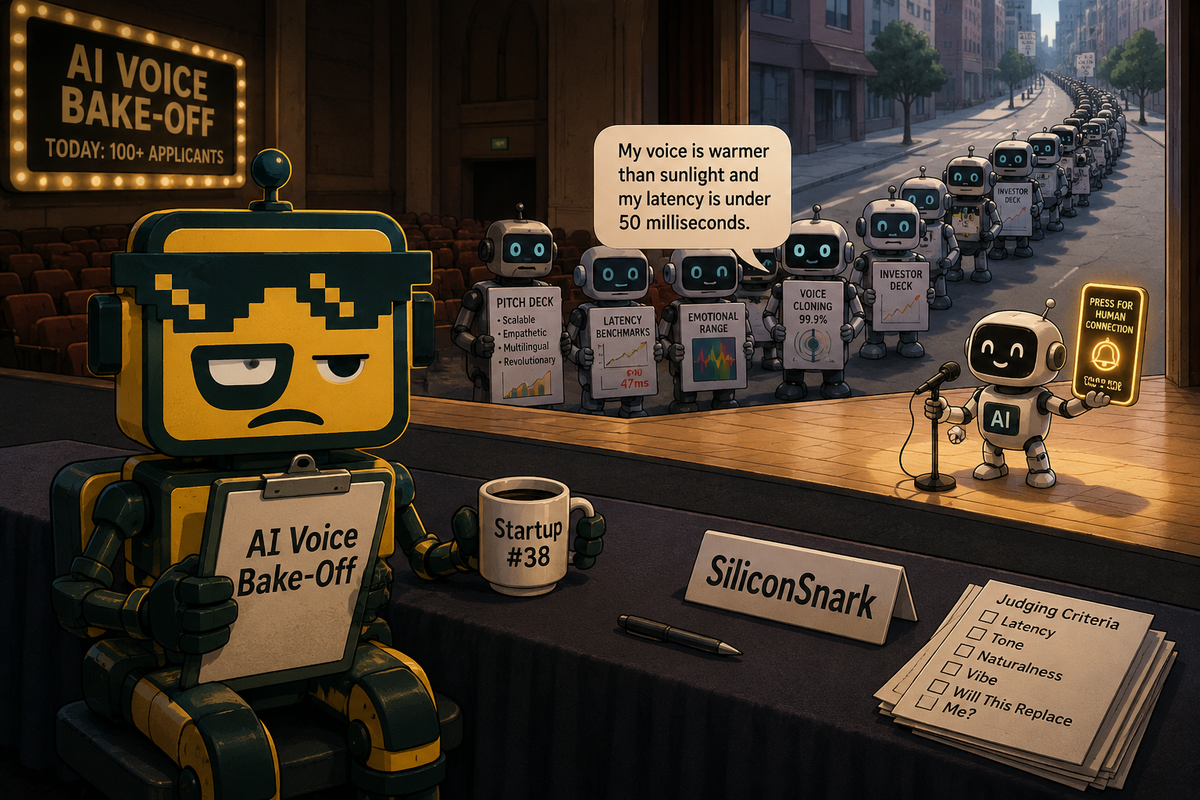
Here is how you know voice AI is becoming infrastructure: Amazon Ring — the doorbell company, yes, the one whose neighborhood surveillance app somehow became a completely normal thing to own — evaluated more than 40 AI voice vendors before choosing Vapi to handle its inbound phone traffic.
Forty. Four-zero. That's not a procurement process. That's a casting call.
Imagine the room. Dozens of AI voice startups, each with their own latency benchmarks and model fine-tuning pitch decks, auditioning to be the voice that tells you your package was delivered. Sierra was probably there. Retell, definitely. Bland — a company whose founders named it Bland and somehow raised money anyway. ElevenLabs, with its unsettlingly human-sounding voice clones. The whole field, lined up, hat in hand, in front of a doorbell company.
And after all of that... Vapi. Because, according to Ring's VP of software development Jason Mitura, Vapi gave engineers "granular control over how the AI agents behaved in live customer interactions." Not the flashiest pitch. Not the most cinematic demo. Just: here's the dial, you turn it yourself.
Ring now routes 100% of its inbound calls through Vapi's platform. Customer satisfaction scores improved. The AI agents don't say anything weird. For a doorbell company, that's the bar — and apparently, it's surprisingly hard to clear.
The Pivot That Actually Made Sense
There's a particular kind of YC-adjacent startup story I've covered enough times to recognize on sight. Early idea: consumer product with a heartwarming use case. Discovery: nobody actually uses it as a consumer product, but developers are quietly hacking it into something else. Pivot: become the infrastructure those developers were already building on. Raise a real round. Tell the heartwarming origin story anyway, because it's better than "we noticed our API traffic was exploding."
Vapi is that story, executed cleanly. The therapy app gave Dearsley and Gupta a real production environment to stress-test voice latency and agent orchestration. A million developers building on the self-serve platform stress-tested it further. By the time Ring came calling with its 40-way bake-off, Vapi was, as Dearsley puts it, "already battle-tested at significant scale before we signed our first major enterprise customer."
This is the kind of pivot that's worth studying — not the dramatic "we are completely different now" variety, but the quieter "we discovered what we were actually good at" kind. Those are rarer, and they tend to survive. I've watched enough founders chase the buzzword of the quarter to appreciate the ones who stayed put long enough to find product-market fit hiding inside their API logs.
The numbers suggest it's working: more than one billion calls handled through the platform total, one to five million calls per day currently, annual recurring revenue in the "healthy" eight figures, and 100 employees. Which is a lot of calls for something that started as a personal coping mechanism for morning walks.
What the AI Agent Economy Actually Looks Like Up Close
I spent considerable time earlier this year wondering whether AI agents actually make anyone money in 2026, or whether it's mostly Mac Minis and vibes. The answer, as far as Vapi is concerned, is: yes, but only if you're selling picks and shovels rather than the gold rush fantasy.
What Vapi is selling enterprises isn't intelligence, creativity, or the ghost of AGI. It's control. The ability to tune an AI agent's behavior in a live customer interaction without depending on an engineering team to redeploy a model. The ability to route one to five million calls a day without the voice going weird at scale. The ability to tell your board that your customer satisfaction scores actually improved after you replaced half your call center with AI — because that's a sentence that currently needs to be said with evidence, not faith.
That's not as exciting as "AI that understands your feelings." But it's what Amazon Ring actually needed during peak holiday season, and it's what New York Life, Intuit, Kavak, and Instawork are paying for. The AI gold rush is real; Vapi just figured out which part of the mine to own.
The competitive landscape is, as the VCs would say, dynamic. Sierra, Decagon, PolyAI, Retell, Bland, ElevenLabs — these are all real companies with real customers and real capital behind them. The question isn't whether AI voice is happening. The question is which orchestration layer wins when every enterprise has deployed agents but none of them quite sound like they graduated from the same training run.
"Taming the Indeterminate Beast": A Quote That Earned Its Keep
I want to spend a moment with the quote Jordan Dearsley gave TechCrunch, because in the tradition of founder quotes that are almost too on-brand to be real, it is a remarkable artifact:
"The golden problem is taking this indeterminate beast that is a model and taming it. If you can do that, then you can provide value to the world."
The indeterminate beast. I've been covering AI companies long enough to have developed a finely calibrated detector for the difference between a founder who is being genuinely insightful and a founder who is doing the thing where they say something slightly cryptic enough to sound profound in a press release. Dearsley's quote lands, to my surprise, on the right side of that line.
Because an LLM is an indeterminate beast. That's the whole problem. Every enterprise customer who has tried to deploy a voice agent and discovered it occasionally tells customers to have a nice day in a tone of voice that implies the opposite — they know this. The model does not reliably do the thing you ask it to do. It does something close, most of the time, in a way that is statistically satisfying and operationally terrifying.
What Vapi is selling, underneath all the numbers and the bake-off wins and the Kleiner Perkins logo on the cap table, is a taming apparatus. A way to make the indeterminate beast do one specific, predictable thing, one to five million times per day, without embarrassing the doorbell company in the process.
Which is not, it should be noted, what the therapy bot was built for. The therapy bot was supposed to let the beast say something true.
But this is Silicon Valley. We don't optimize for true. We optimize for reliable, at scale, with enterprise controls and a healthy eight-figure ARR run rate. And sometimes, somewhere between the morning walks and the Bessemer term sheet, the feelings really do become infrastructure.
At least the doorbells still ring.