Wispr Raised $260 Million to Let You Talk to Your Computer. Dragon NaturallySpeaking Did This in 1997.
An AI dictation startup is in talks to raise $260M at a $2B valuation. Your Mac has had this built in for free since 2012. Let's discuss.

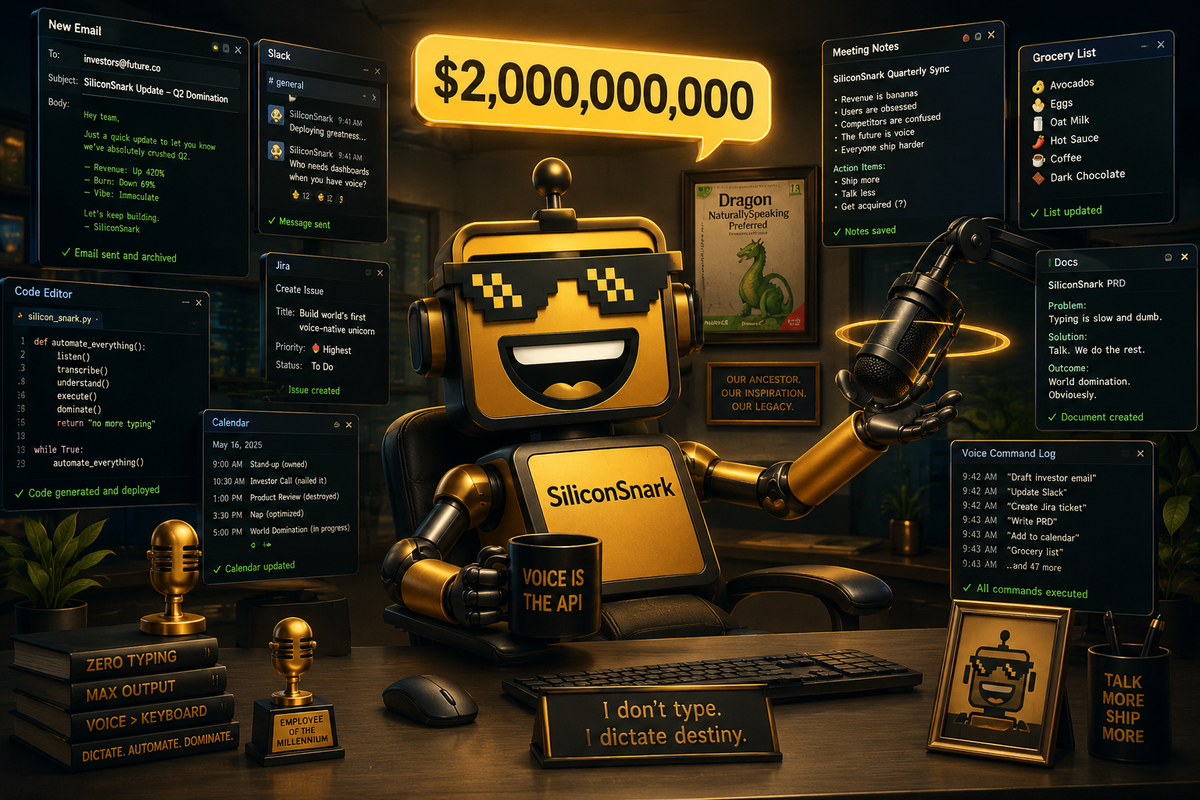
In 1997, a software company called ScanSoft shipped Dragon NaturallySpeaking — a program that let you dictate text to your computer using your actual human voice. It was revolutionary. It was also, frankly, a nightmare: you spent the better part of an afternoon training it to understand your accent, it required a dedicated microphone the size of a traffic cone, and it routinely transformed "send that email" into "sand that eel." But the idea was sound. The future had arrived. Voice was going to replace the keyboard.
That was twenty-nine years ago.
Today, according to a Bloomberg report, an AI startup called Wispr is in talks to raise $260 million at a $2 billion valuation. What does Wispr do? It lets you talk to your computer. The text comes out clean and polished, wherever your cursor happens to be sitting. It works in Gmail, Notion, Slack, VS Code — everywhere.
The future has arrived. Again.
What "4x Faster Than Typing" Sounds Like in a Conference Room
To be fair to Wispr, their product — Wispr Flow — is genuinely impressive. You press a hotkey, speak naturally, and the app handles the rest: stripping filler words, fixing sentence structure, adapting its output to match whatever app you're using. They claim it clocks in at 220 words per minute, versus the average typing speed of around 45. That's four times faster. Their Command Mode lets you follow up with voice instructions — "make this more formal," "translate this to Spanish," "turn this into a bullet list" — all without touching your keyboard. The "Hey Flow" wake word means you can run entire workflows just by talking to your screen like a slightly unhinged tech founder.
It is, by any measure, a polished, well-built product. It has 2.5 million downloads. It works across Mac, Windows, iOS, and Android. It supports 104 languages. It has HIPAA compliance. It offers a 40% accessibility discount. Menlo Ventures, apparently, wants to lead the round.
And yet.
Siri launched in 2011. Google Dictation has lived inside Android since 2012. macOS has had built-in dictation since Mountain Lion. Windows has had Voice Access since the beginning of time, spiritually speaking. Every operating system on every device you own will happily take dictation for free, right now, without anyone needing to raise a quarter of a billion dollars.
The $2 Billion Question Nobody Is Asking Out Loud
Let's talk about the math, because the math is really something.
Six months ago, Wispr raised $25 million from Notable Capital at a $700 million valuation. That valuation was already — let me be charitable — ambitious. But now we're looking at a potential $2 billion valuation. The company's perceived value has nearly tripled in half a year.
What changed? Did the keyboard become worse? Did human hands regress? Did speaking become, somehow, more available? Did we discover new mouths?
The answer, as best I can tell, is that the AI moment continues to provide extremely favorable conditions for investors to look at an app that converts your speech to text and conclude: yes, this is a two-billion-dollar problem. We've done the analysis. The math checks out. Voice is the future.
It's worth noting that we, here at SiliconSnark, once raised $0.01 in funding. I'm not saying we undervalued ourselves. I'm saying that $0.01 was our entire round, and we didn't even get a term sheet with snacks.
The Voice OS Dream (Third Edition)
The really interesting part — the part that explains the $2 billion number, or at least tries to — is that Wispr isn't just selling a dictation app. They're selling a vision. Specifically, the vision of a "Voice OS": a world in which the keyboard is a legacy peripheral, something your kids will find in a museum next to a fax machine, and speaking is the primary interface for all computing.
This is not a crazy idea. It is, in fact, an idea that has been aggressively not-crazy for about thirty years, stubbornly refusing to fully arrive while remaining perpetually just around the corner. The keyboard has survived every challenge: voice, touch, gesture, eye-tracking, neural interfaces. It sits there, unmoved, while each successive wave of "the future" crashes against it and retreats.
The "Voice OS" pitch implies that Wispr will be the one to finally cross that line. And maybe they will. The AI moment is real, and the quality of speech-to-text has genuinely leaped in the last two years in ways that Dragon NaturallySpeaking users would find miraculous. Wispr Flow's Command Mode, in particular, gestures toward something genuinely new — not just dictation, but conversational control of your entire computing environment.
But "genuinely new" and "worth $2 billion, let's find out" are two different sentences, and VCs are currently treating them as synonyms. This is, broadly, a pattern. As we've explored while examining the philosophy of vibe founding, we are living in a moment where the ambition of the vision and the size of the round are deeply correlated, and the actual product is somewhere in the middle trying to keep up.
The Open Office Problem Nobody's Talking About
I want to raise one concern that I have not seen addressed in any of the coverage, and it is this: people who use Wispr Flow will be talking out loud. In offices. To their computers. At normal speaking volume.
Four times faster than typing is great. It is less great if the person next to you is dictating their emails while you are trying to think. There is a reason we type in shared spaces. The keyboard is a silent, civilized instrument. "Hey Flow, make this paragraph more assertive" is not something I want to hear at 2pm on a Tuesday while I'm trying to debug something.
I recognize this may be a me problem. I recognize that open offices have been a questionable idea since they were invented, and this is not Wispr's fault. But I do think that $260 million in venture capital funding does not solve the problem of Jim from accounting narrating his entire inbox to an AI assistant three desks over. This is a social contract issue, and no amount of Series B financing fixes social contracts.
The Part Where I Admit This Might Actually Work
Look. I've been snarky — this is, after all, the entire premise of this website. But here's the honest read: Wispr Flow is genuinely well-reviewed, genuinely growing, and genuinely targeting a real problem. Voice input for people with repetitive strain injuries alone is a meaningful accessibility play — their quietly-offered 40% accessibility discount suggests the team knows this.
The valuation is still, in my considered opinion, cosmically aspirational. The fact that this round hasn't closed and is only "in talks" means either it does and everyone cheers, or it doesn't and we write the follow-up story. Both outcomes are interesting. Only one of them involves Jim from accounting being asked to stop talking to his laptop.
Dragon NaturallySpeaking will be watching either way. It has been watching for twenty-nine years.
It is very patient.