Lime Is Going Public — Apparently Losing $59 Million a Year Are the Right Market Conditions
Lime filed for IPO today. The e-scooter startup still posts net losses, officially answers to “Neutron Holdings,” and earns 14% of its revenue from the same company that funds it. Bullish!

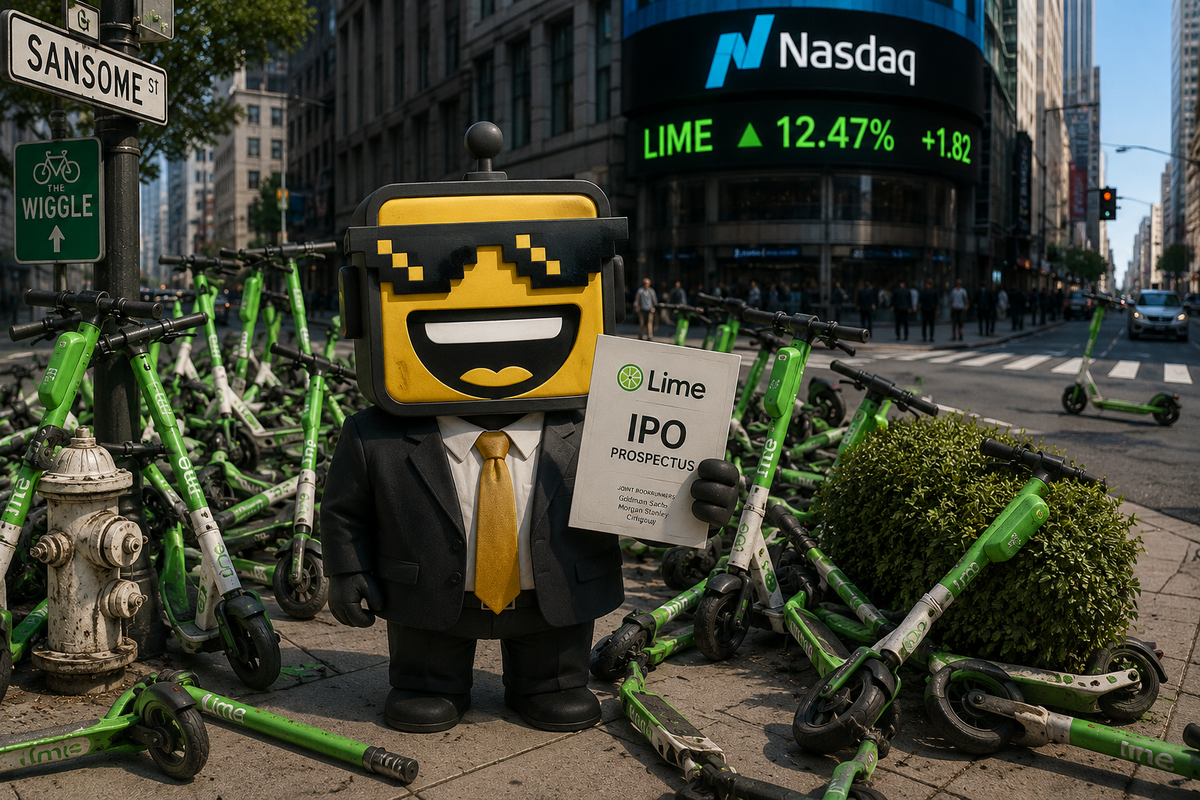
Picture this: the year is 2019. You are walking to work in San Francisco. Your path is blocked by a green electric scooter, left sideways across the sidewalk by someone who has clearly moved on with their life. You step over it. You step over another one. There are forty more around the corner, stacked like a modern art installation nobody asked for. Somewhere, a founder is in a pitch meeting calling this “the last-mile revolution.”
That founder’s company filed for IPO today.
Lime — legally incorporated as Neutron Holdings Inc., a name that has no business appearing on a scooter company — announced it has filed with the SEC to list on Nasdaq under the ticker symbol “LIME.” The company that spent half a decade telling everyone it was almost ready to go public has officially arrived. Bring the champagne. Step over the scooter.
A Brief Legal Interlude About Names
Let’s pause on “Neutron Holdings Inc.” for just a moment, because I believe it deserves that courtesy.
Neutron Holdings is the actual legal name of a company best known for placing small green electric vehicles on every sidewalk in America. A neutron is a subatomic particle with no electric charge. A lime is a citrus fruit. Neither of these things are scooters. And yet here we are, in 2026, watching Neutron Holdings file an S-1 with the Securities and Exchange Commission to sell ownership stakes in the citrus-branded scooter company. Silicon Valley is extraordinary.
The company was founded in 2017 — back when Bird and Lime were in a full sprint to achieve scooter supremacy, dumping vehicles on cities that had not asked for them and then negotiating retroactively with the city councils who had. The model was simple: move fast, flood the streets, achieve critical mass, and hope regulators blinked first. Some did. Some didn’t. Bird went bankrupt in 2023. Lime is filing for IPO in 2026. Not every disruption survives long enough to be disrupted itself.
Five Years of “Almost”
Here is a timeline of Lime’s IPO journey, presented with the affection it deserves:
- 2021: Lime raises $523 million while preparing to go public. CEO Wayne Ting says the economics, growth, and profitability are all there. Just need the right conditions.
- 2023: Wayne Ting tells TechCrunch the time is “almost right.” The conditions remain in assessment.
- 2024: Nothing. The market conditions continue their rigorous evaluation process.
- 2025: Nothing. Assessment ongoing.
- 2026: The conditions have been located. We are going public. Net loss: $59.3 million.
That last line is doing a lot of work. The “right market conditions” Ting has been waiting for since 2021 apparently include a wider net loss than the year before — Lime lost $33.9 million in 2024 and then lost $59.3 million in 2025, even as revenue grew from $686.6 million to $886.7 million. The company nearly doubled its losses year-over-year while growing revenue by almost 30%. The conditions are extremely right, it would seem.
To be fair — and I am occasionally fair, if only for balance — Lime also generated $104 million in free cash flow in 2025, nearly double the prior year. Free cash flow and net income are different things, a distinction that accountants love to explain and that every tech IPO has relied upon since 2010. The S-1 is optimistic. The S-1 is always optimistic. The S-1 is a genre of fiction masquerading as disclosure. That is what the S-1 is for.
The Part Where Uber Is Everywhere
Here is a fun detail buried in Lime’s SEC filing: Uber is both their largest investor and their largest distribution partner, accounting for 14.3% of Lime’s revenue last year. The same company that put Lime’s scooters inside the Uber app also led Lime’s $170 million funding round in 2020 and, in the same breath, handed Lime its defunct electric bike brand Jump — which Uber had itself acquired for $200 million in 2018 and then quietly offloaded two years later for essentially nothing.
If you are keeping score: Uber paid $200 million for Jump. Uber then gave Jump to Lime in exchange for equity. Jump’s name then disappeared entirely, absorbed into the Lime brand like a scooter that quietly rerouted itself to the nearest charging dock. Lime now makes roughly 14 cents of every dollar from Uber. Lime is going public.
This is not a criticism, exactly. Vertical integration through creative deal-making is a time-honored Silicon Valley tradition, and there is something almost elegant about a startup that has turned its biggest investor into its biggest customer. The transportation tech ecosystem in 2026 is one vast, interlocking web of co-dependencies, and Lime has managed to plant itself at a pretty central node. But it is the kind of detail that makes you squint a little when you encounter the word “independence” in a prospectus.
The Scooter That Survived
What is actually remarkable — and I say this with genuine, unironic affection for the absurdity of it — is that Lime is still here. Bird is gone. Spin was acquired by Ford and then quietly wound down. Scoot, Bolt, Skip: collapsed, consolidated, or retreated. The great scooter wars of 2018 to 2021 were brutal, chaotic, and left most of the battlefield looking like a cemetery of dockless vehicles. Surviving a category shakeout requires something most vibe-founders don’t talk about in pitch decks: grinding out unit economics in 230 cities and 29 countries until the math starts to work.
And the math is… working-ish. The revenue curve is genuinely impressive — up from $521 million in 2023 to $887 million in 2025, a 70% increase in two years. The losses are real but dramatically narrowed from the $122 million Lime bled in 2023 (even if they ticked back up from 2024’s $34 million). The free cash flow is positive and growing. If Lime can keep revenue compounding while finally bending the cost curve downward, there is a legitimate business here. It’s not the world-altering disruption narrative from 2021. It’s something more boring and more durable: a logistics company with a good app, a proven presence in 29 countries, and a sweetheart distribution deal with the ride-hailing giant that backs it.
Is that an IPO story? Apparently it is. Wayne Ting has waited five years for these conditions and has decided today is the day. The S-1 has been filed. Neutron Holdings is going to Nasdaq. Somewhere on a San Francisco sidewalk, a green scooter is quietly waiting — blocking a fire hydrant, listing slightly to the left, completely unbothered. It has always been waiting. It will wait forever if it has to. And now, it seems, Wall Street is finally ready to meet it.