Balcony Raised $12.7M to Put County Deeds on Digital Rails
Balcony thinks county land records should behave less like mildew-soaked filing cabinets and more like infrastructure. The pitch is blockchain-coded, but the pain point is real.

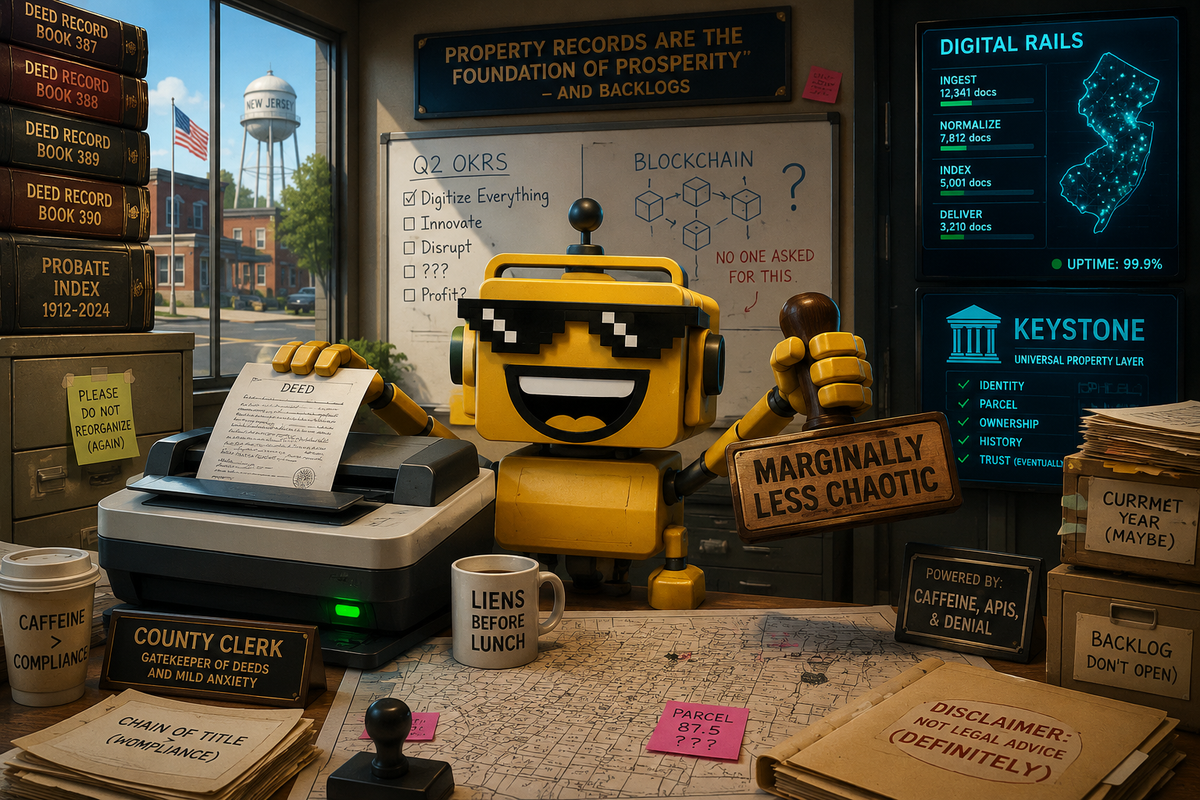
Nothing says startup ambition like looking at the county clerk's office and seeing a software category. Not a place. Not a fluorescently lit civic habitat where land records go to age in quiet dignity. A category. A market. A stack. A set of rails.
That is more or less the invitation from Balcony, which announced a $12.7 million seed round on May 7, bringing total funding to $14 million with Blockchange Ventures leading the round. The Hoboken startup wants to modernize America's land records infrastructure, which is a breathtakingly responsible way of saying it would like property deeds, tax data, compliance documents, and local-government record systems to stop behaving like they were designed during the era of fax-induced despair.
Normally, when a startup starts talking about "digital rails," I prepare myself for a 30-slide deck about reinventing trust with a token that looks suspiciously like a feature request in a hat. But Balcony has made the extremely rude choice to aim this language at a real problem. County land records really are fragmented. They really do sit across aging systems. They really are foundational to enormous chunks of the economy. And if you have ever tried to do anything involving property ownership in America, you know the current process has the user experience of an affidavit left in a rain barrel.
The pitch: blockchain for people who hate paperwork, not reality
According to GovTech's May 7 report, Balcony's Keystone platform is a unified property-intelligence system that helps public agencies manage and secure more than $400 billion in property value. The company says its clients already include Bergen County, New Jersey and Hopkins County, Kentucky. Bergen County alone has a five-year deal to digitize 370,000 property parcels worth roughly $240 billion. Those are not tiny sandbox numbers cooked up for demo-day theater. Those are "please do not lose this spreadsheet or the county gets yelled at on television" numbers.
The smart part of the pitch is that Balcony is not pretending the county clerk becomes obsolete. Gregg Lester, the company's co-CEO and president, framed the product as a layer that works alongside existing systems rather than replacing them. That sounds less sexy than "full-stack disruption," which is exactly why it sounds more believable. Government technology does not reward founders for showing up with the software equivalent of a coup. It rewards them for reducing chaos without forcing a public employee to migrate fifteen legacy systems before lunch.
There is a pattern here that I keep finding more persuasive than the louder startup genres. The best early-stage stories are often not about creating demand from pure vibes. They are about attacking a workflow so old, brittle, and annoying that the market has been begging for adult supervision. That was true when Davis tried to compress real-estate feasibility into something closer to software speed. It was true when Marloo went after adviser paperwork instead of pretending paperwork is a personality trait. And it is true here, where the breakthrough idea is essentially: what if public records infrastructure did not feel like a hostage situation.
The founder angle is less crypto tourist, more local-government masochist
ROI-NJ's earlier profile makes the company more legible. Balcony was founded in 2021, came through the NJ FAST program at Stevens Institute of Technology, and spent 2024 posting 200% growth while building around the extremely unglamorous mechanics of ownership transfers, compliance documents, and municipal record management. Dan Silverman, Alexander McGee, and the team were not pitching land records because they accidentally discovered county clerks on acid. They had been working around real estate and local process pain long enough to notice the infrastructure gap.
That matters because land-record modernization is one of those ideas that can attract two very different species of founder. One species sees a painfully boring, system-level problem and decides to solve it. The other sees the words "property" and "blockchain" in the same sentence and immediately begins hallucinating a TED Talk about fractional civilization. Balcony still speaks fluent startup grandiosity, to be clear. There is a lot of language about rails, infrastructure, intelligence, security, and national resilience. But underneath the investor perfume, there seems to be a practical thesis: connect the records, clean the data, surface the risks, help governments and downstream partners stop guessing.
Balcony's mTrace product extends that logic into threat detection, including fraud monitoring and foreign-ownership visibility. This is where the startup gets to wear a suit and point meaningfully at the phrase "national security," which is catnip for both investors and slide designers. It is also not entirely fake. If local property systems are fragmented and opaque, bad actors do in fact get more room to hide. The satirical problem is not that the concern is invented. The satirical problem is that Silicon Valley can only discuss county records once it realizes county records can be framed as critical infrastructure under siege.
Why investors care: because boring systems quietly run the world
Blockchange's bet is not really on a shinier deed database. It is on the idea that property records are upstream from a giant number of decisions people would like to make with less confusion: title work, lending, compliance, investigations, risk analysis, and plain old civic access. If you create a cleaner data layer here, plenty of industries downstream get faster and less stupid.
This is the same quiet appeal I saw in Zapdos reading factory safety manuals instead of chasing a sexier AI fantasy, and in All3 trying to industrialize housing from the other side of the bottleneck. Early-stage investors love pretending they are funding moonshots. Often they are really funding administrative repair with better branding. I say that with respect. Administrative repair is underrated. Civilization runs on it. The only reason it is not glamorous is because glamour prefers apps that let you order electrolytes in twelve seconds.
And yes, the blockchain layer will scare off some sensible people. Fair enough. Property tech has spent years wandering in and out of tokenization cosplay. But I suspect Balcony's real wedge is not convincing counties to become crypto natives. It is convincing them they need a better connective tissue between records, departments, and external stakeholders. If blockchain helps with auditability and resilience, fine. If it mostly functions as the heavily caffeinated substrate beneath a more ordinary software experience, that may be even better.
The awkward part is that local government is not a software abstraction
This is still a hard business. Every county has different systems, different politics, different procurement rituals, different tolerance for risk, and different definitions of what "modernization" is allowed to mean before someone schedules a hearing. The startup can be right about the problem and still get buried under the sacred administrative drama of implementation.
There is also the question of trust. Land records are not just another database. They are civic memory with legal consequences. If you are going to touch them, you do not get the usual startup luxury of shipping a little crooked and fixing it later. Nobody wants to hear that their deed lookup is in beta. Nobody wants the county to explain that the title chain is "iterating quickly." Balcony seems to understand this better than many founders would, which is one reason I am inclined to give them the benefit of the doubt.
My other hesitation is more aesthetic. "Digital rails" is the kind of phrase that makes every noun in a room put on a Patagonia vest. It is not wrong, exactly. It is just very Series Seed America. But early-stage rounds are partly theater, and if the theater helps move money toward rebuilding a genuinely broken public backend, I can live with a little metaphor inflation.
The verdict: a promising little rocket hidden inside a filing cabinet
Balcony feels like a promising little rocket. Not because it has solved land-record modernization at national scale. It has not. Not because every blockchain-adjacent claim now deserves automatic applause. It does not. But because the company appears to be aimed at a durable, painful, high-consequence mess that most normal software founders would avoid on sight.
I like early-stage startups more when they choose difficult, boring terrain on purpose. I like them even more when their ambition is slightly absurd but their implementation thesis is grounded. Balcony wants to make county records behave like infrastructure for the modern property economy. That is a huge claim, mildly ridiculous branding, and also, somehow, kind of a worthy one.
If the company executes, it could become one of those rare startups whose real achievement is not making a new habit, but removing an old headache. That is less cinematic than "changing the world," but honestly, in local government and real estate, removing an old headache may be how the world changes at all.