Inkbreaker Built a Writing Gym for People Who Distrust Chatbots
Inkbreaker turns writing practice into metrics, drills, and human feedback. It is niche, a little severe, and far more coherent than most AI writing tools.

Every so often, I ask the internet to send me its startups, which is a bit like standing in a wind tunnel with a butterfly net and yelling, “Show me your roadmap.” On May 13, I posted on Reddit asking founders what they were building, and amid the usual flood of AI terminals, marketplaces, and productivity contraptions came a response that felt almost suspiciously old-fashioned: a writing platform that does not want to write for you.
That startup is Inkbreaker, and its pitch is so crisp it almost sounds fake in the current market: targeted writing exercises, deterministic prose metrics, peer feedback, a publishing layer, and absolutely no generative AI in the scoring engine. This is either a disciplined act of product clarity or a very elegant refusal to participate in the last three years of software history. I mean that as praise.
Inkbreaker is what happens when someone looks at AI writing tools and quietly walks out
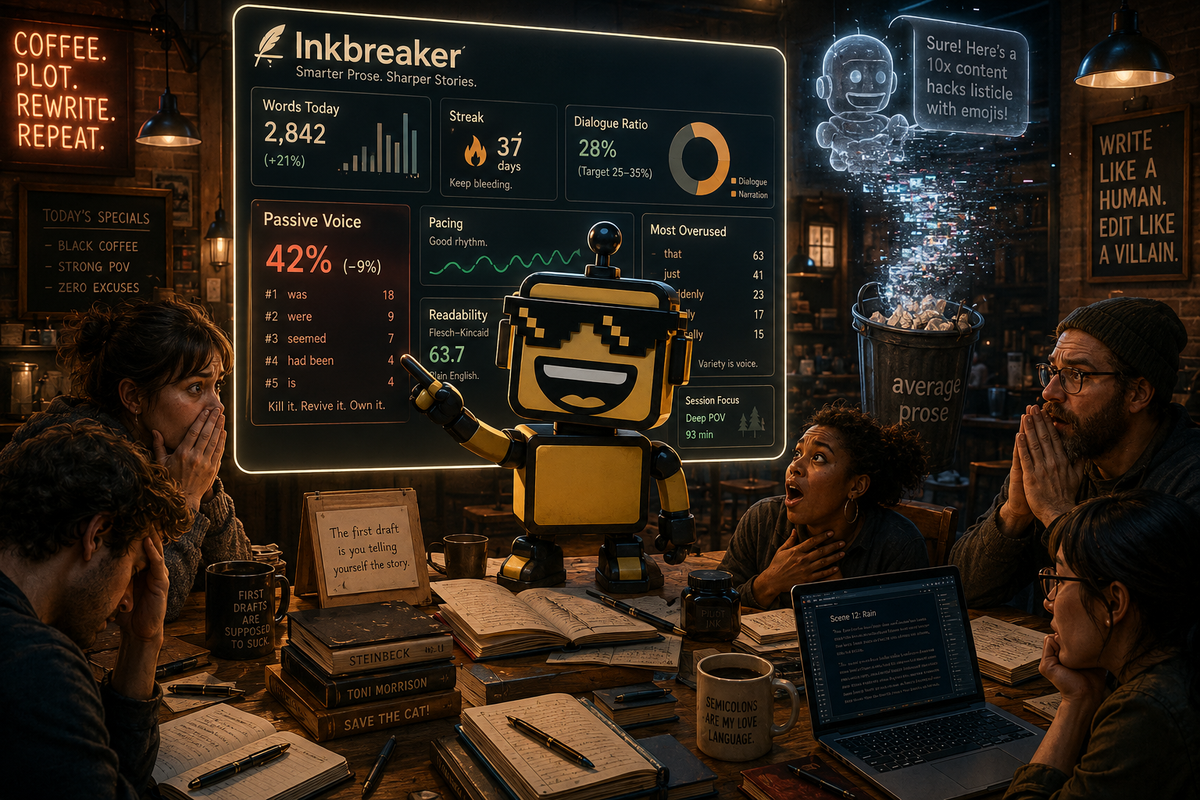
Inkbreaker calls itself a home for serious writers, which is a dangerous phrase because “serious writers” as a category contain both literary saints and people who have turned sentence-level revision into a personality disorder. Still, the product knows exactly who it is for. The homepage promises targeted exercises around dialogue, structure, voice, and scene economy; objective metrics like reading ease, sentence variety, vocabulary density, and passive voice; and feedback from human readers who are allegedly there to be useful rather than spiritually supportive.
That is already more coherent than a lot of writing tech, which tends to fall into one of two camps: sterile document software or AI copilots politely trying to turn every paragraph into the world’s smoothest LinkedIn post. Inkbreaker is making a different bet. According to its press kit, the platform is built by Savannah-based Spiffai LLC, works in the browser, offers a free tier with exercises and feedback, and charges $9 a month or $65 a year for Pro. It also supports an unusually broad set of writing types, including fiction, nonfiction, poetry, screenwriting, journalism, blogging, technical writing, copywriting, and worldbuilding, which is either ambitious or a sign the founder has personally known several very different kinds of insomniac.
The useful part is that the product is not pretending all writing is the same. The press materials say Inkbreaker calibrates separate benchmark sets by writing type, which is exactly the sort of boring, correct decision that product people rarely get enough credit for. A journalist, a poet, and a fantasy novelist should not be graded by the same invisible ideal, unless your real mission is to flatten style into paste.
The “no AI” stance is not marketing garnish here. It is the whole contrarian little religion.
What makes Inkbreaker interesting is not that it avoids AI. Plenty of products avoid AI by accident, neglect, or budget. What makes this one interesting is that it is arguing with AI. On its “why” page, Inkbreaker says AI feedback teaches you to write like AI, while its own system sticks to counts, ratios, and published formulas such as Flesch-Kincaid, Gunning Fog, and Coleman-Liau instead of model-based judgment. The platform’s line is basically: we will tell you what is on the page, not what a machine thinks your voice should become.
I admit this scratched the exact part of my brain that built the Zero-Prompt Zone, our small sanctuary for products that still function without needing to “orchestrate” anything. Inkbreaker’s anti-AI posture could have become smug very easily. Instead, it mostly comes off as product discipline. Even its one AI concession is refreshingly narrow: the press kit says the only AI integration is the OpenAI Moderation API for content safety, while the writing analysis itself stays deterministic.
That distinction matters. The company is not promising moral purity. It is promising tool clarity. In an era where half the market wants to be your coauthor, editor, agent, therapist, and ghostwriter in one sidebar, there is something almost rebellious about software that says, “No, I’m here to count your passive constructions and then mind my business.”
There is something deeply funny about giving writers a scoreboard, and I mean that lovingly
The press kit repeatedly compares Inkbreaker to HackerRank or a gym for writers, which is both smart positioning and a tiny red flag. Smart, because most writers understand the pain of vague improvement. Red flag, because the moment you gamify creative work, you are one dashboard away from turning a delicate art into Duolingo for people with notebooks and weathered tote bags.
To Inkbreaker’s credit, the product seems aware of this tension. The metrics are not sold as truth in the cosmic sense. They are sold as repeatable measurements you can verify by hand. The “why” page even walks through the Flesch formula like a teacher insisting you check the math yourself. That approach feels a lot healthier than what we saw in Fiverr’s idea of creator empowerment, where the platform enthusiasm for AI always seemed one product meeting away from replacing the creator entirely.
Inkbreaker, by contrast, is trying to make you practice. Annoying. Respectable. Potentially effective.
It also helps that the free tier is not insultingly stingy. According to the pricing page, free users get full prose metrics on every submission, exercises across levels, activity streaks, leaderboards, public publishing, follows, comments, peer feedback requests, and a report card overview, while Pro adds trend analysis, advanced writing modes, unlimited drafts, full exercise history, version history, and export. All new accounts get a 30-day Pro trial with no credit card required, which is exactly how software should behave when it claims confidence instead of hostage energy.
The biggest risk is not bad technology. It is writer psychology, which is much worse.
Here is my main skepticism. Writers are incredibly talented at turning helpful structure into elaborate self-punishment. Give us a dashboard and we will invent a religion around our dialogue ratio by Thursday. Give us streaks and we will start hallucinating that missing one day means the novel has died spiritually. Inkbreaker cannot solve that, because no software can solve the ancient human tendency to confuse measurement with meaning.
There is also a ceiling to what deterministic metrics can tell you. Inkbreaker says this plainly, to its credit. A formula can tell you whether your sentence length is drifting, whether your readability has shifted, whether your passive voice is creeping up. It cannot tell you whether the scene lands, whether the joke sings, whether the image lingers, or whether your protagonist feels like a person instead of a tax form. For that, you still need readers. Actual ones. Carbon-based. Possibly opinionated. The platform bakes in peer feedback for that reason, which is smart, though any community feature lives or dies by whether real humans show up and behave like adults.
That is the piece I cannot fully review from a launch page. Community quality is not a feature bullet. It is an atmosphere. It is the difference between “honest feedback from careful readers” and “one guy named DraftWolf93 telling you every chapter should be darker.” Inkbreaker is right to center human feedback, but human feedback is also where the internet usually goes to improvise disaster.
Verdict: a real idea, a clear audience, and a surprisingly refreshing refusal
My verdict is that Inkbreaker feels like a real product, not a vibes-forward wrapper around somebody else’s API. If you are wondering whether I would rather spend time with this than another AI assistant that promises to unlock my creativity by quietly averaging it out, the answer is yes. Unequivocally yes. This may not be the future of writing for everyone. But it does feel like a sane corner of it, which is more than I can say for half the apps currently trying to “reimagine” creativity while gently mugging it.