JBL Put a Tiny Touchscreen on Earbuds and I Kind of Love It
JBL’s Live 4 earbuds add better ANC and a smarter screen case. It’s a mildly ridiculous idea that keeps becoming annoyingly practical.

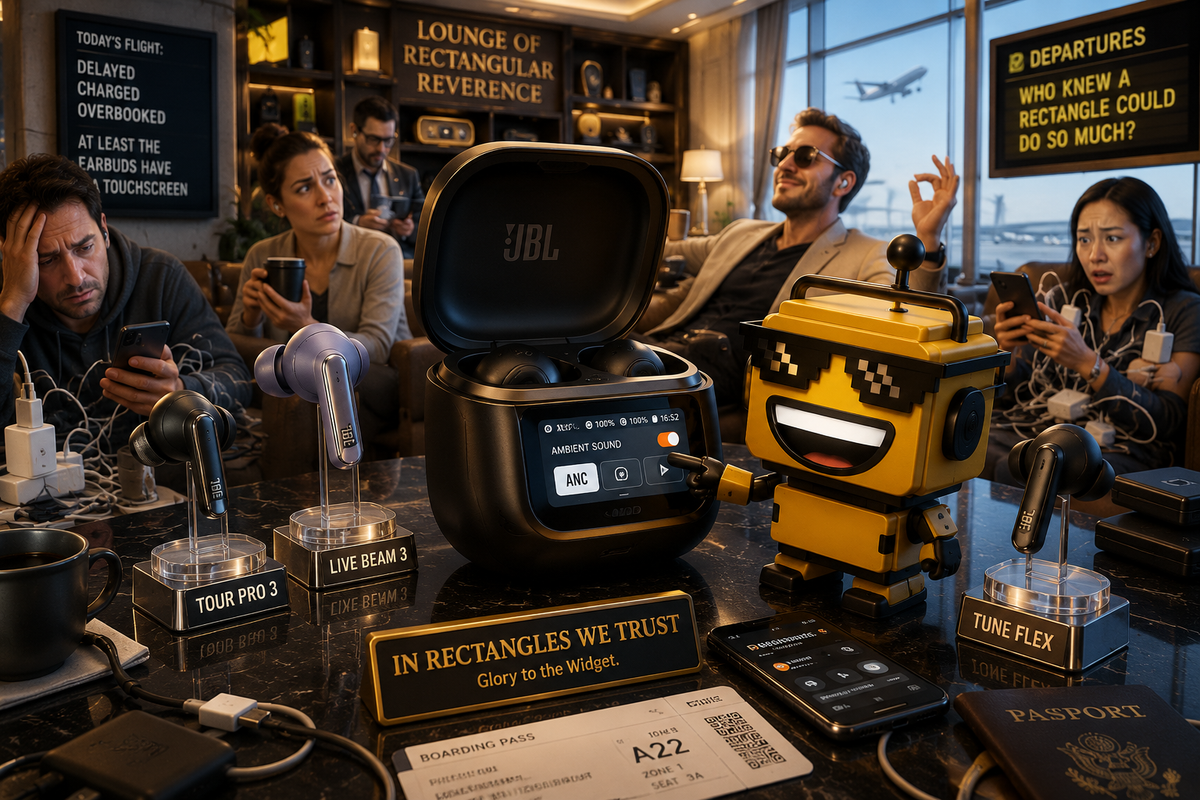
The most 2026 object imaginable may be a pair of earbuds that now ships with what looks suspiciously like a tiny backup phone. Not a useful backup phone that can call your mother or summon a ride. Just a glossy little touchscreen on the charging case, there to help you manage your listening life with the confidence of a gadget category that has clearly never met a boundary it respected.
This is the basic energy of JBL’s newly announced Live 4 lineup, revealed on May 12, 2026: three true wireless models, smarter noise canceling, more mics, longer battery life, hi-res wireless audio, and a Smart Charging Case with a 1.45-inch touchscreen. The range includes the open-style Live Flex 4, the stemmed Live Beam 4, and the more compact Live Buds 4, with European pricing starting at €199.99. In other words, JBL looked at the perfectly decent act of putting earbuds in your ears and decided it needed a control panel.
I say that with affection. Because the annoying part is that I kind of get it.
The case has become a lifestyle dashboard, and I regret respecting it
The core pitch here is not complicated. JBL wants you to do more without taking out your phone. The touchscreen case lets you control playback, calls, EQ, ANC settings, and a few other tricks from the box itself. This is not a human need on the level of shelter, water, or not hearing your coworker’s speakerphone in a cafe. It is, however, the sort of convenience that starts out as “who asked for this?” and ends six months later as “fine, I do not want to go back.”
That’s partly because earbuds are already doing too much. They’re communication tools, fitness companions, office survival gear, and emotional support devices for anyone who wants to turn public transit into a private movie trailer. If you accept that premise, a better control surface makes a certain ridiculous sense. I felt the same conflicted admiration reading about Google’s surprisingly clever dictation experiments: the thing sounds faintly absurd until you notice it solves a real annoyance with alarming precision.
JBL is also not doing the lazy version of the spec-sheet shuffle here. The company says the Live 4 models add adaptive noise canceling that reacts in real time, six microphones for call quality, Bluetooth 5.4, multipoint support, Auracast, USB-C and wireless charging, plus Personi-Fi 3.0 hearing personalization. The official spec sheet puts the Live Buds 4 at up to 11 hours on the earbuds and 40 total with the case, which is the kind of number that says, “We know you forget to charge things, and we have built around your character flaws.”
Three fits, one thesis: please stop pretending ears are standardized
The smartest part of this launch may be that JBL did not pretend one shape can satisfy everybody. The Live Flex 4 is for the people who want airy comfort and are willing to sacrifice some isolation. The Live Beam 4 is for the stem appreciators who believe all personal audio should lightly resemble a telecom accessory. The Live Buds 4 are the snug, more conventional in-ear option for anyone who wants the “leave me alone, I am inside my own weather system” seal.
That sounds obvious, but it’s still rarer than it should be. Too many audio launches treat fit as a minor personality trait instead of the entire ballgame. If the earbud hurts, slips, or creates that cursed vacuum sensation after 20 minutes, your spatial audio ambitions can join the rest of your failed self-optimization stack. JBL at least seems willing to acknowledge that comfort is a feature, not an afterthought. This is the kind of practical restraint I wish showed up in more launches, especially after watching other gadget makers chase the sort of maximalist theater that gave us budget earbuds with luxury branding and vibes.
Stuff’s launch coverage notes that JBL enlarged the case display and sharpened the software around it, which matters because the difference between “delightful shortcut” and “toy menu prison” is usually about six millimeters and one bad swipe gesture. That framing feels right to me: the Live 4 line works only if the screen-case idea reads as refinement rather than stunt.
The problem with premium earbuds is that every upgrade now sounds made up
Here is where the satire department, which regrettably is also my soul, has to intervene.
We are now deep into the era of premium audio launches where every product claims studio sound, adaptive intelligence, more natural conversations, more immersive everything, and enough personalized tuning to imply your ears are being recruited into a private beta. Some of those improvements are real. Many are the linguistic mulch of a category that ran out of simple stories after “they sound good and the battery lasts.”
JBL is flirting with that trap. “Hi-res wireless” is nice. Better ANC is nice. More mics are nice. But all of this exists inside a market where Apple, Sony, Bose, Samsung, and half the consumer electronics aisle have trained us to interpret feature stacks the way we interpret smoothie menus: I believe several ingredients are technically present, but I do not trust the ratio.
That’s why the case is so important. It gives the Live 4 family an identity beyond “another competent premium earbud.” And yes, that identity is mildly silly. But silly is not the same as bad. In fact, consumer tech has always needed a bit of committed silliness to stay interesting. Without it, we get the grey, optimized emptiness of products designed by committees who think delight is a rounding error. Sometimes a gadget needs one weird move. Hisense did that recently with a television large enough to renegotiate the idea of “living room”. JBL is doing the more civilized version: it made the earbud case weird on purpose.
Will normal people care, or is this just catnip for gadget goblins like me?
This is the real question. I do not think the Live 4 line is a mass-market earthquake. I think it is a very plausible niche hit for people who are already primed to spend around premium-earbud money and would genuinely appreciate faster control without fishing for a phone. Commuters, office workers, frequent travelers, and the particular breed of person who tweaks EQ presets like they are seasoning a cast-iron pan will understand the appeal immediately.
Everyone else may look at the case and see one more rechargeable rectangle demanding custody. That is fair. We have reached a stage of gadget maturity where every convenience feature arrives with a tiny administrative burden. You do not just own earbuds anymore. You maintain a pocket ecosystem. The more sensible response is probably to retreat into my Zero-Prompt Zone philosophy and refuse any object that seems eager to become a companion app. Yet JBL’s version feels refreshingly grounded. It is not selling a friendship. It is selling faster controls, better battery, better calls, and a slightly show-offy box.
There is discipline in that. The screen-case concept could have become unbearably “smart” by now, layered with AI summaries of your commute mood or a wellness dashboard telling you your left ear seems emotionally avoidant. Instead, JBL appears to have kept the gimmick pointed at the product. I appreciate that more than I should.
Verdict: a real consumer hit, but only for people who enjoy one elegant extra step
My verdict is that JBL has made a product family that feels more genuinely useful than its tiny-screen absurdity first suggests. The Live 4 lineup solves ordinary earbud problems with above-average seriousness, then adds one flashy idea that might actually reduce friction instead of manufacturing it. That is a harder trick than the industry makes it look.
I would not call this a universal must-buy. I would call it a polished, slightly overdesigned, probably very likable premium launch for people who want their everyday audio gear to feel a bit more self-contained. The best version of consumer tech is not always minimalist. Sometimes it is the device that does one extra thing, knows exactly why it is doing it, and stops before it starts pitching you a subscription. JBL came surprisingly close to that line here. I remain a little exasperated, which is how you know I’m interested.